Song structure: give every section a purpose
What should a verse add? Does the song need a bridge? Choose a clear structure, develop the story and make the final chorus count.
Published by WaveQuake, the studio featured in this guide. Product screenshots show the live interface. Illustrations explain the ideas; examples are creative starting points, not guaranteed results.

Song structure is the order and relationship of a song’s sections. In a familiar verse–chorus song, the verses develop the situation, the chorus returns to the central idea, and an optional bridge introduces a different angle before the final return.
A useful beginner map is verse → chorus → verse → chorus → bridge → chorus. It is a starting point, not a compulsory formula. Some songs need no bridge, some begin with the chorus, and some use a repeated refrain instead of a separate chorus section.
This guide explains the differences, compares four practical maps and develops an original example. You will also see how to organize a lyric and test its movement in WaveQuake without assuming that section labels provide exact control over generated audio.
The main parts of a song
Think of section names as descriptions of musical jobs. They help you communicate a plan, but they are not a checklist of everything a song must contain. A short lyric can work with a verse and a recurring refrain; a longer narrative may need several verses before its meaning becomes clear.
| Section | Typical purpose | Useful writing question |
|---|---|---|
| Intro | Establish the sound or invite attention. | What does the listener need before the first line? |
| Verse | Develop a scene, story or argument. | What new information appears here? |
| Pre-chorus | Connect the verse to the chorus and create anticipation. | What makes the chorus feel ready to arrive? |
| Chorus | Return to the song’s main statement or emotional centre. | What should be recognizable on its return? |
| Post-chorus | Extend or reinforce the chorus through a further hook or passage. | Is there a useful reason to linger? |
| Bridge | Introduce contrast or a new perspective. | What changes our understanding before the return? |
| Outro | Give the ending an intentional shape. | What should remain after the last line? |
These are common functions, not definitions every genre follows identically. Electronic music may organize its energy around builds, drops and breakdowns. A narrative folk song may prioritize successive verses. Start with the kind of movement your idea needs rather than forcing every song into a pop outline.
Berklee’s lyric-writing curriculum distinguishes narrative development, a chorus’s main theme and contrasting bridge sections. The practical question for your draft is simple: if you removed a section, what would the listener lose?
Verse vs chorus: details and the main idea
In many verse–chorus songs, the verse lyrics change while the chorus remains recognizable through repeated words and music. The verse gives you a reason to care about the chorus. The chorus gives the changing verses a shared centre.
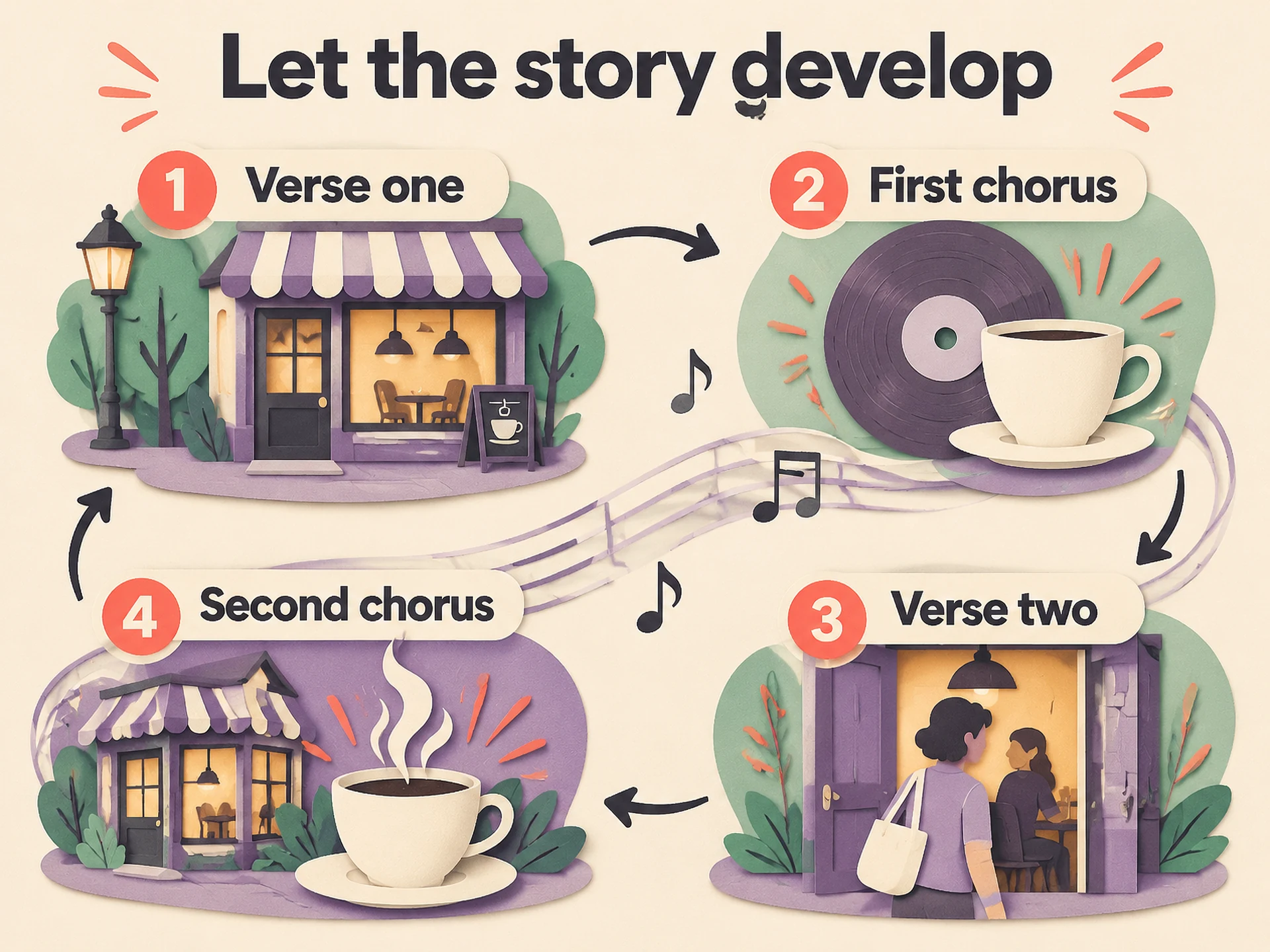
Imagine a song about reopening a family café. Verse one could show the narrator finding the old sign in a storeroom. Verse two could show the first customer walking through the door. The chorus might express the wish to make a place where people belong. The scenes change; the central promise returns.
If both verses describe the same empty room with different adjectives, the song may stop moving. If each chorus introduces a completely unrelated idea, it may stop feeling like a return. Neither repetition nor variation is automatically good: each needs a purpose in the particular song.
 View full-size infographic
- Verse oneShow the café before the doors reopen.
- First chorusMake a promise about the place it could become.
- Verse twoLet another person enter and complicate the plan.
- Second chorusRepeat the promise with new evidence behind it.
Try a two-sentence outline before writing rhymes. Describe verse one in one sentence and verse two in another. If the sentences are interchangeable, decide what happens between them. The change might be an event, an admission or a shift in perspective rather than a dramatic plot twist.
For detailed hook exercises, use our guide to writing a chorus. Here the focus is the relationship between sections: what the hook means on its first appearance, and what it means after the next verse.

Pre-chorus vs bridge: a lead-in and a new angle
A pre-chorus commonly sits between a verse and its chorus. Its role is transitional: it can narrow the focus, increase anticipation or make space for the main statement. A bridge is usually a more distinct contrasting section, often later in a verse–chorus song.
For the café example, a pre-chorus might move from the physical work of reopening to the fear of turning the key. The chorus answers that fear with a promise. A bridge could later reveal that the narrator does not need to recreate the café exactly as it was. That new thought changes the final chorus.
The label alone does not create contrast. A section called Bridge that repeats the verse’s information in the same way may still feel like another verse. Look for a change in perspective, rhythm, melody, harmony or texture. You do not need to change all of them.
| Question | Pre-chorus | Bridge |
|---|---|---|
| Where does it commonly go? | Between verse and chorus. | Later in the song before a return. |
| What is its job? | Prepare or connect. | Contrast or reframe. |
| Can it repeat? | Often, with the verse–chorus cycle. | Often used once, but not a universal rule. |
| Does every song need one? | No. | No. |
Carnegie Hall’s workshop explicitly asks whether a song needs a bridge. That is a useful permission to leave it out. If the last verse already changes the listener’s understanding, another contrasting section may delay the ending without adding anything.
Four song structure examples you can adapt
1. A direct verse–chorus song
Verse 1 → Chorus → Verse 2 → Chorus → Outro
Use this when the idea is clear and two verses provide enough development. It is a good first draft because there are fewer sections to justify. The second chorus can feel different through its context or arrangement even if its words stay the same.
2. A verse–chorus song with a bridge
Verse 1 → Chorus → Verse 2 → Chorus → Bridge → Final chorus
Choose this when the story has a later realization that deserves its own space. Write the bridge’s purpose in one sentence before adding it. “Something different happens here” is less useful than “The narrator admits they have been trying to preserve the past.”
3. A verse–pre-chorus–chorus cycle
Verse 1 → Pre-chorus → Chorus → Verse 2 → Pre-chorus → Chorus
Try this when the verse needs a transition into the main statement. A repeated pre-chorus can create anticipation, but it also adds time before the hook. If the song feels slow to arrive, test whether the pre-chorus can be shorter or whether the verse already provides the transition.
4. A verse-based song with a refrain
Verse 1 + refrain → Verse 2 + refrain → Verse 3 + refrain
A refrain is recurring material, often a repeated lyric line within a larger section. This map lets a story progress through successive verses without requiring a separate chorus section. Make sure each verse earns its space, and consider how the same refrain changes meaning as the story develops.
 View full-size infographic
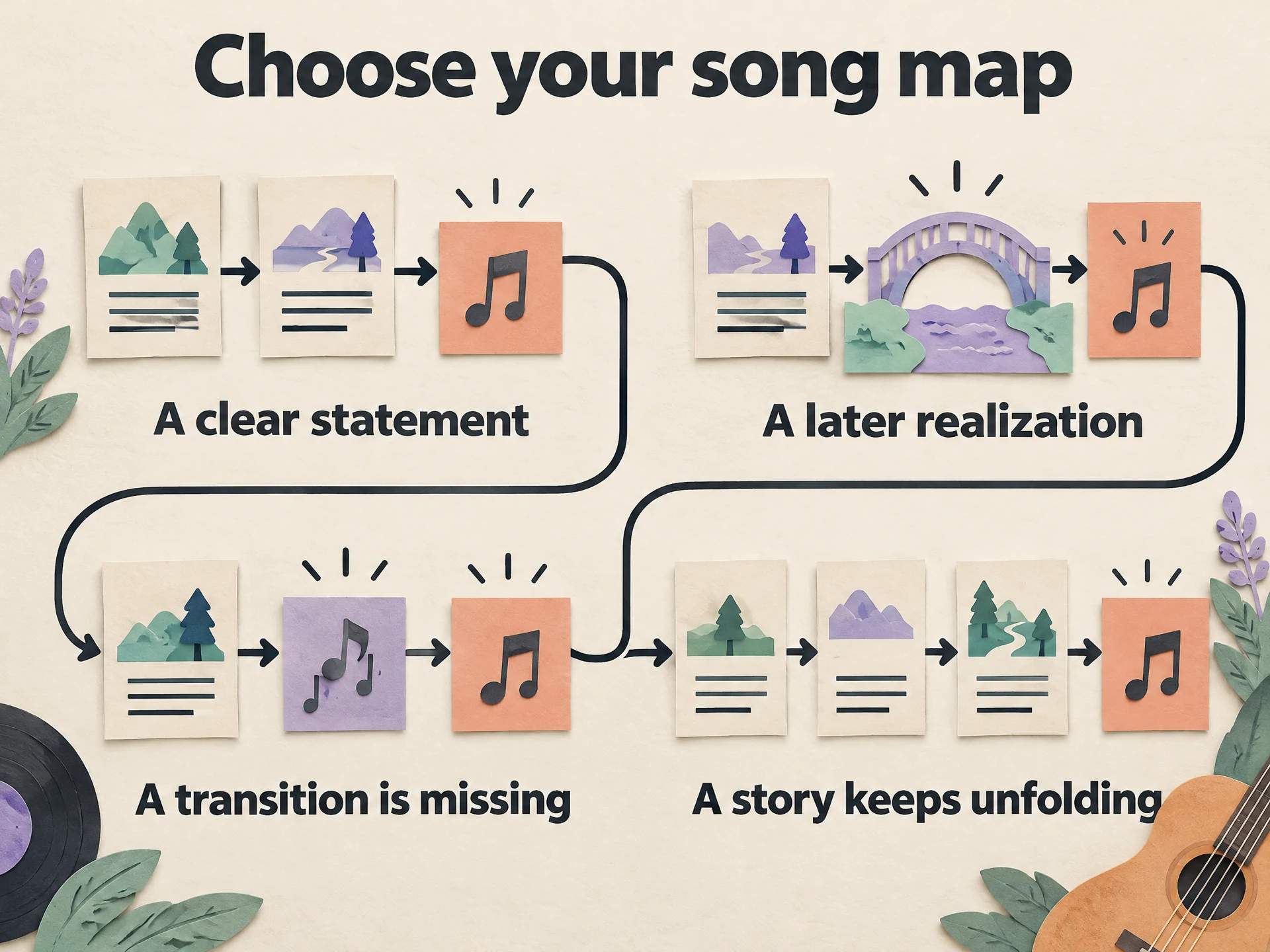
- A clear statementTry two verses and a recurring chorus.
- A later realizationMake room for a bridge before the final return.
- A transition is missingExperiment with a short pre-chorus.
- A story keeps unfoldingTry successive verses connected by a refrain.
These maps are not ranked from beginner to advanced. The longest one is not inherently more sophisticated. Keep the simplest version that carries the experience you want the listener to have.
An original verse, chorus and bridge example
Here is a short editorial sketch for the café story. It demonstrates section roles, not a generated WaveQuake result. The language is deliberately compact so you can see how the scene, main statement and later realization fit together.
Working title: Room at the Table

[Verse 1]
I found the sign behind the stairs
Beside a stack of broken chairs
Your painted letters, faded blue
Still said there’s room enough for you

[Chorus]
There’s room at the table
Come in from the rain
We can start with a coffee
We don’t have to stay the same

[Verse 2]
The first one through was Mrs Grey
She asked if I would stay all day
I said the menu might be small
She said she’d come to talk, that’s all

[Chorus]
There’s room at the table
Come in from the rain
We can start with a coffee
We don’t have to stay the same

[Bridge]
I thought I had to keep it
The way you left the room
But every chair I move around
Makes space for someone new

[Final chorus]
There’s room at the table
Come in from the rain
We can start with a coffee
We don’t have to stay the same
Verse one introduces an inherited place. Verse two shows what a visitor needs from it. The bridge questions the narrator’s assumption that preservation means leaving everything untouched. The final chorus repeats the same words, but the line about change now has a more specific meaning.
There is still writing work to do. The verse phrasing and chorus phrasing need to fit their melodies. “Mrs Grey” could become a less convenient rhyme and a more distinctive character detail. A structural sketch makes those revisions easier because you can change a line without losing the section’s purpose.
You can also remove the bridge and listen to how the second chorus feels as an ending. Comparing a shorter plan with a longer one is an editorial exercise. It does not require you to assume that every added section improves the song.
Plan contrast without overloading the lyric
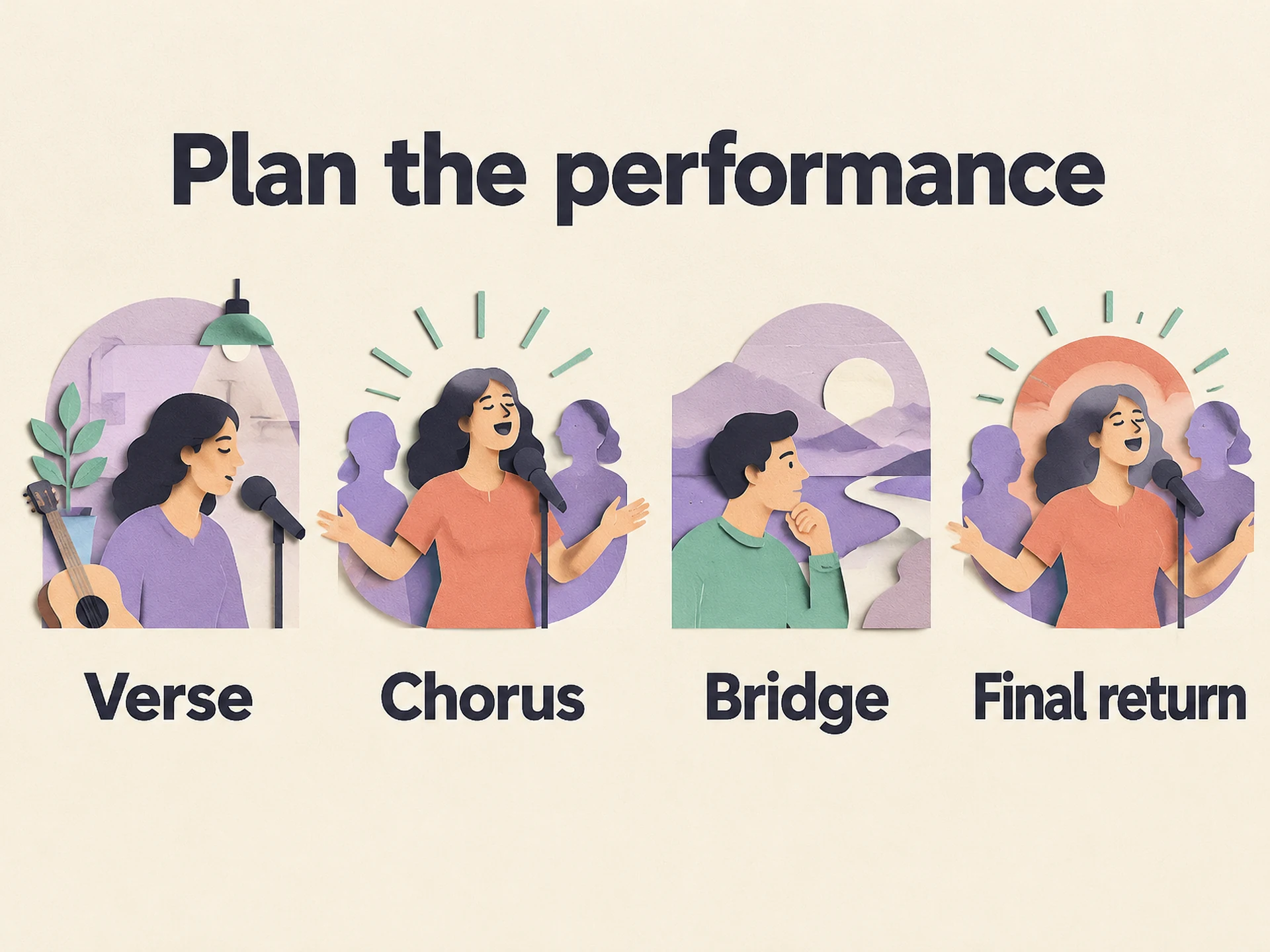
Once the sections have different purposes, give them a musical relationship. For the café sketch, you might choose a close, conversational verse and a warmer chorus. Keep the bridge smaller if the admission should feel private. Those choices are more useful than attaching the word “epic” to every section.
 View full-size infographic
- VerseClose vocal, light accompaniment and room for the scene.
- ChorusA warmer, more open delivery around the central invitation.
- BridgeA restrained moment for the narrator’s realization.
- Final returnBring back the familiar chorus with the story now understood.
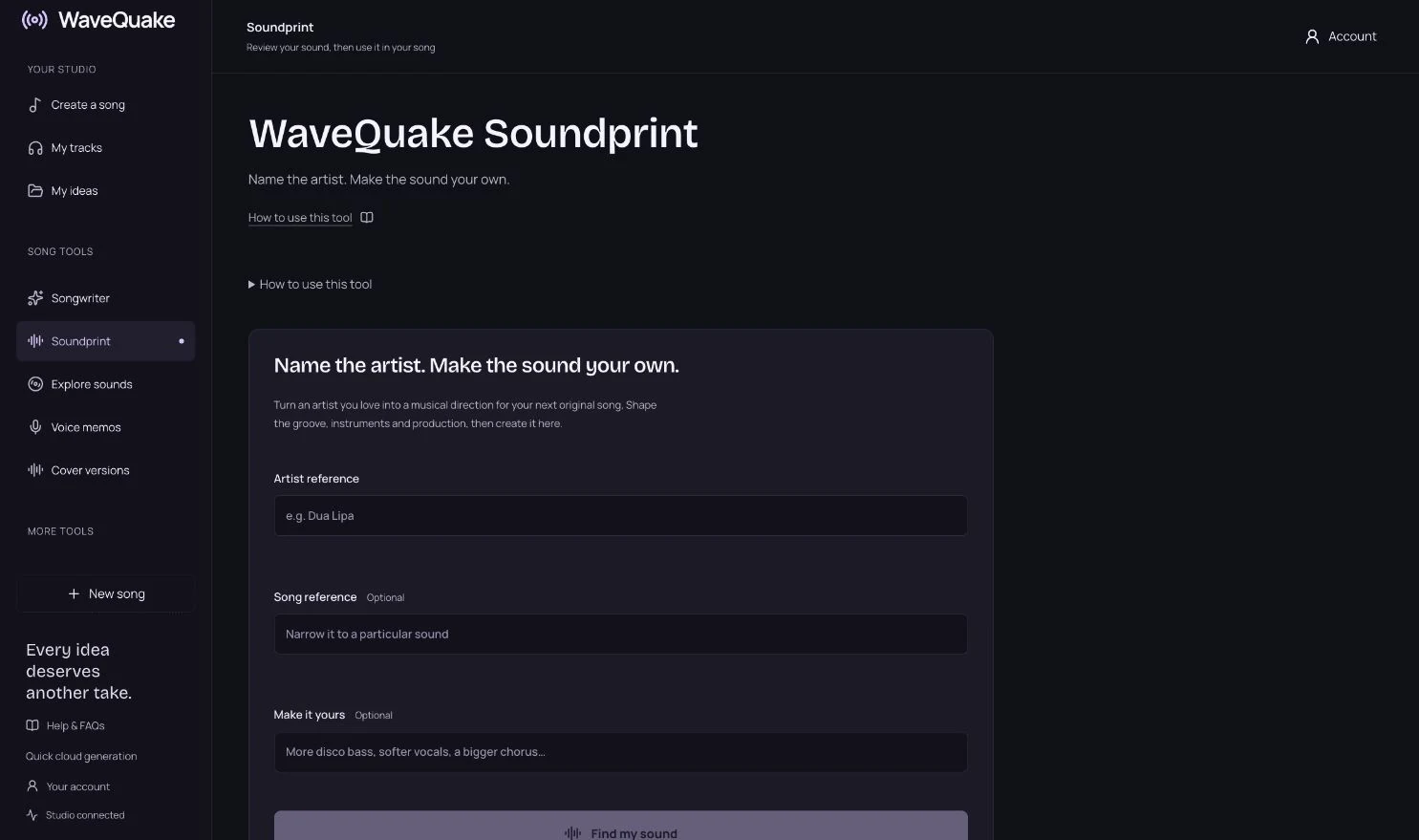
If you need a reference, Soundprint can help describe the sound you have in mind. Keep its output as editable musical direction. It does not supply a guaranteed arrangement, exact tempo or a copy of a particular singer.
In the lyric itself, plain labels such as [Verse], [Chorus] and [Bridge] are a useful starting point. Short performance cues can add direction, but they are interpreted suggestions. If a result sings an instruction or loses the intended structure, simplify the cues and check the words before another attempt.
Build and review the song in WaveQuake
- Prepare the words. Paste your own lyric or create a Songwriter draft. Check that each section has a clear purpose.
- Review the title and lyric. In the embedded writing room, choose Use these lyrics when you want to apply the draft.
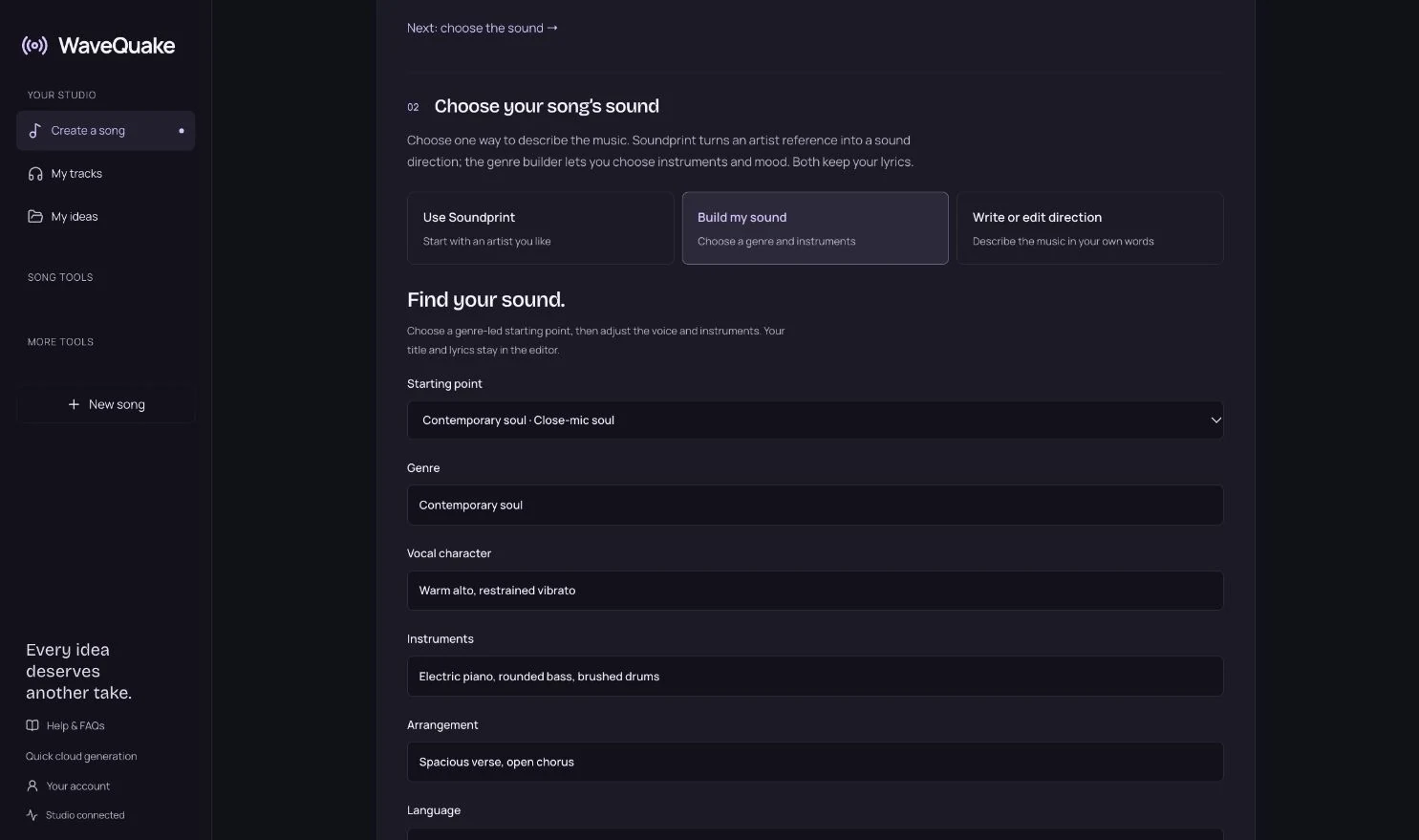
- Set the sound. Write a direction, use Build my sound, or develop a reference through Soundprint.
- Create the music. Submit the reviewed song and follow the reported processing stages.
- Listen to the transitions. Compare both versions through the chorus, bridge and ending.
The section plan is not a timeline editor. Generated music may repeat, stretch or interpret sections differently from your outline. If you need an exact duration or arrangement for a project, check the actual audio and use an appropriate editing workflow for the final requirements.
Listen with one question per pass. First check whether the story is understandable. Then notice where the chorus arrives and whether it feels like a return. Finally, check whether the bridge and ending add anything. This is easier than trying to judge wording, vocal sound, structure and loudness at once.
| What feels wrong | What to inspect first |
|---|---|
| The song takes too long to begin | An intro or first verse that repeats information. |
| Verse two feels unnecessary | Whether it adds an event, image or changed viewpoint. |
| The bridge feels disconnected | Whether its new idea belongs to the same central story. |
| The final chorus feels flat | Whether anything before it changed the meaning of its return. |
| The ending feels accidental | Whether the lyric and musical direction suggest a deliberate close. |
Choose the performance before comparing mastering profiles. Finishing can change the presentation of a take, but it does not give verse two a new plot or turn a redundant section into a necessary one.

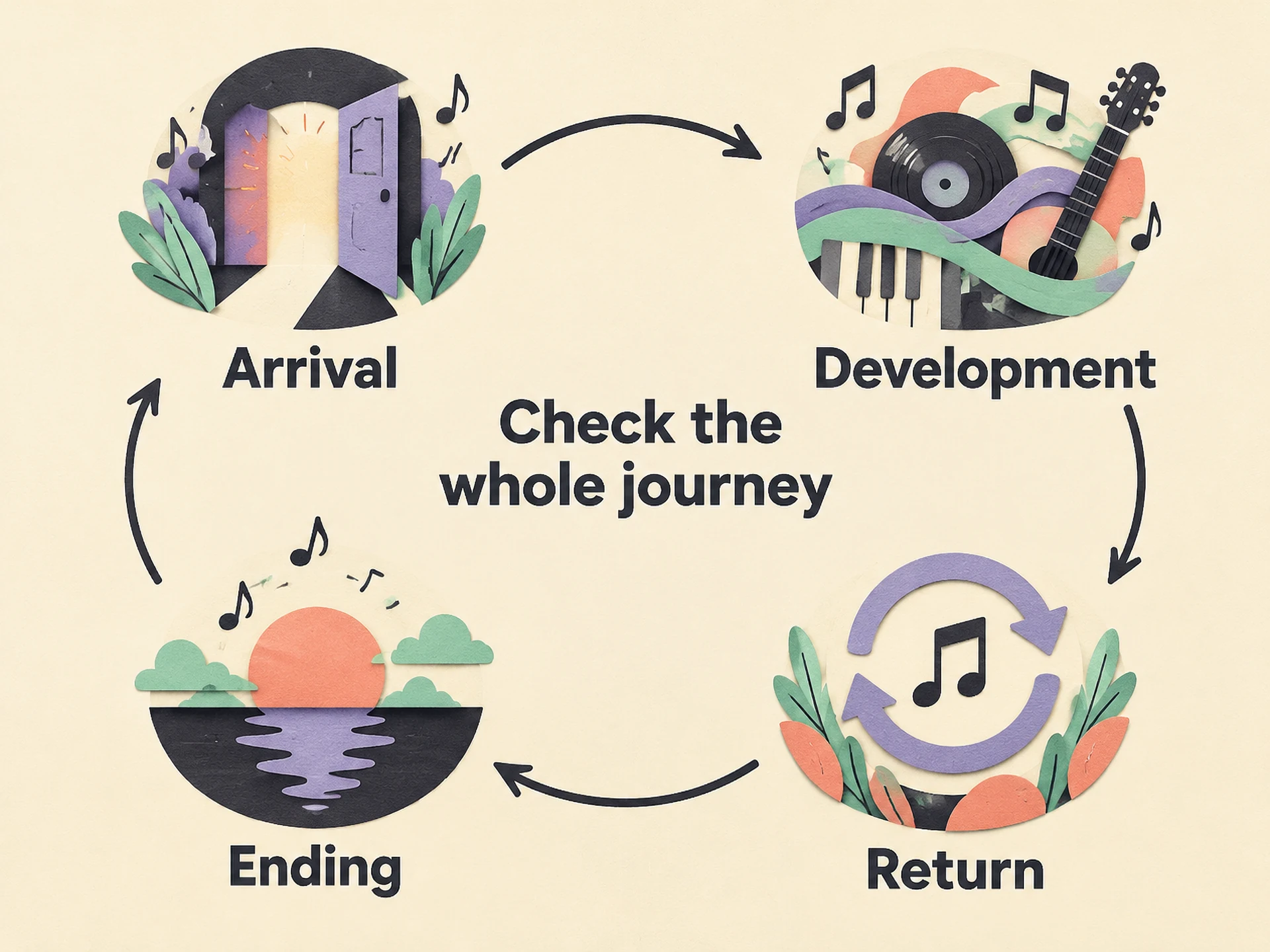 View full-size infographic
- ArrivalDoes the opening give a reason to keep listening?
- DevelopmentDoes each new section add something?
- ReturnIs the repeated idea recognizable and worth hearing again?
- EndingDoes the song stop at an intentional point?
WaveQuake’s creation bank is finite, so plan a focused revision before generating again. You can edit the lyric manually without using another writing request. Keep local copies of audio you want to retain; hosted storage is for working files, with 30-day retention.
Common questions
What is a common song structure for beginners?
Verse, chorus, verse, chorus is a manageable starting point. Add a bridge or outro only if it has a clear job. A short, complete song can be more useful than a long draft with sections that repeat the same information.
What is the difference between a verse and a chorus?
In a typical verse–chorus song, verses develop the story through changing lyrics while the chorus returns to a recognizable main idea. The sections often contrast musically too. Not every genre or song uses this pattern.
What is a bridge in a song?
A bridge is a contrasting section that can introduce a new perspective or musical idea before a return. It often appears later in a verse–chorus song. A bridge is optional; include one when it contributes something the other sections do not.
Is a pre-chorus the same as a bridge?
In common contemporary usage, a pre-chorus connects a verse to a chorus, while a bridge provides a more distinct contrasting section. Terminology can vary, so explain the musical job you mean when collaborating.
Does every song need a chorus?
No. Some songs use successive verses with a repeated refrain, and other forms organize their material differently. Choose a structure that supports the lyric and musical idea rather than treating section names as required fields.
Do bracketed section labels guarantee the generated arrangement?
No. Labels and concise performance cues communicate your intention, but the music generator can interpret them loosely. Check the resulting audio for section order, repetition, timing and ending before using it for a project.
Sources & checking
Product details checked on 26 October 2026. Prices, features and terms can change; review the linked offer before purchasing. This is a product guide, not a comparative audio benchmark.