24 songwriting prompts to start your next song
Small scenes, unexpected viewpoints and clear writing exercises. Pick an idea, make it personal and turn it into an editable lyric.
Published by WaveQuake, the studio featured in this guide. Product screenshots show the live interface. Illustrations explain the ideas; examples are creative starting points, not guaranteed results.

Good songwriting prompts give you a person, a situation and something unresolved. “Write about love” names a subject. “Write about the small practical things two people do for each other” gives you a scene you can start writing.
Here are 24 original song ideas you can use with a notebook, an instrument or WaveQuake Songwriter. Each includes a specific writing task and an editing question. Choose one that makes you curious, change a detail, and finish a rough section before looking for another idea.
These prompts are about what a song says. If you already have lyrics and need to describe the instruments or production, use our separate AI music prompt examples.
Choose a prompt by the kind of start you need
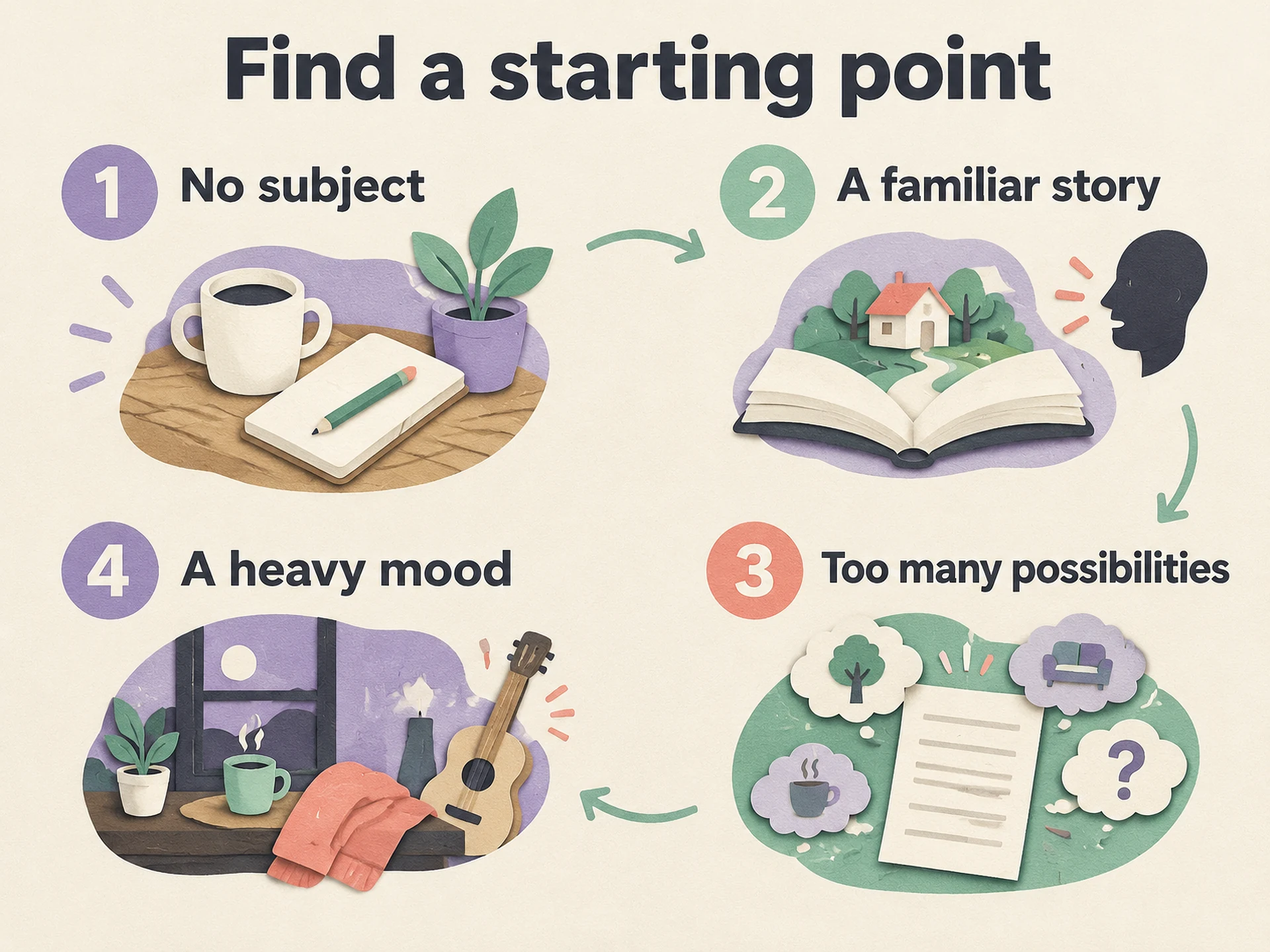
If you have no subject, begin with an object or a place. If you have a subject but every line sounds familiar, change the viewpoint. If you keep stopping after two lines, try a constraint that reduces the number of decisions you have to make.
 View full-size infographic
- No subjectStart with a small moment or ordinary object.
- A familiar storyGive it to someone who sees it differently.
- Too many possibilitiesLimit the lyric to one room, question or repeated line.
- A heavy moodTry a modest victory, affectionate joke or shared ritual.
The Recording Academy’s discussion of songwriting prompts describes them as a way to move beyond familiar habits. You do not need to feel inspired by every suggestion. A prompt is useful when it gives you a decision you can make now.
For a first attempt, choose a scene you understand. You can invent a character without inventing every practical detail of their world. A believable kettle, train platform or broken chair can give a lyric more substance than an unfamiliar setting described in vague language.
Small moments with something at stake
1. The extra mug
Write about someone who still sets out two mugs even though they now live alone. Decide whether the habit hurts, comforts them or makes them laugh. Let the chorus reveal the meaning without explaining the whole relationship.
Make it yours: Choose one ordinary action that changes in the final verse.
2. The last late bus
Two strangers miss the last bus and have to wait together. One is avoiding home; the other cannot wait to get back. Tell the story from one viewpoint and let the chorus change what getting home means.
Make it yours: Give each person a different reason to stay in the conversation.
3. A borrowed jacket
Someone finds an old receipt in a borrowed jacket. It recalls a day the owner has forgotten. Write about the difference between the small thing one person remembers and the big occasion everyone else talks about.
Make it yours: Let the object reveal the memory without using a flashback in every line.
4. The empty shop window
A person walks past a shop that has closed after years on their street. They remember one quiet kindness from its owner. Make the song about what a neighbourhood loses when an ordinary place disappears.
Make it yours: Keep the narrator’s memory specific enough to picture.
Love, distance and unsaid things
5. A practical love song
Write a love song about the unglamorous ways two people care for each other. Use a repaired chair, a packed lunch or a remembered appointment. Let the chorus celebrate attention rather than a grand romantic promise.
Make it yours: Replace one broad compliment with a small observable action.
6. The message not sent
A narrator writes a message after a long silence and decides not to send it. The verses show what they almost say. The chorus reveals what they need to admit to themselves instead of asking the other person to fix.
Make it yours: Decide whether not sending it is avoidance or a healthy decision.
7. Different clocks
Two people keep a friendship across different time zones. One sends a voice note at sunrise; the other hears it on a night train. Let the chorus connect the separate scenes through a shared joke or ritual.
Make it yours: Use one repeating detail that belongs naturally in both places.
8. The apology with no excuse
Write from the viewpoint of someone learning to apologize without adding a defence. The first verse shows the old habit. The second shows a different action. Give the chorus a direct sentence that does not demand forgiveness.
Make it yours: Avoid letting a clever rhyme soften the responsibility of the speaker.
Change, courage and starting again
9. The unfamiliar key
A person opens the door to their first place after a major life change. The room is almost empty. Write about freedom that feels awkward before it feels exciting, using the first sound they make in the space.
Make it yours: Choose a hopeful ending that still leaves one problem unresolved.
10. The small brave thing
Write about a decision that looks tiny from outside but takes courage for the narrator: joining a choir, making a call or showing someone a drawing. Let the chorus honour the action without claiming every fear has disappeared.
Make it yours: Make the stakes personal rather than turning the song into general advice.
11. The route you stopped taking
A narrator deliberately takes a different route through a familiar town. Each avoided turn carries a memory. The chorus asks whether changing the route changes the story, and the final verse gives one honest answer.
Make it yours: Use a location the narrator could actually point to.
12. A second first day
Write about a person starting over at something they used to do well. They feel clumsy and compare themselves with their younger self. Let the chorus make room for being a beginner without dismissing what they once knew.
Make it yours: Keep the tone warm enough that the narrator can laugh at one mistake.
Characters and unexpected viewpoints
13. The person who stays
Tell a leaving-town story from the viewpoint of the friend who stays behind. They are proud and jealous at the same time. Let both feelings remain true, and give the chorus something more complicated than a goodbye.
Make it yours: Give this character an ambition unrelated to the person who leaves.
14. The night-shift witness
A night-shift worker sees the same city at a different hour from everyone else. Build a song around three details from one shift. Let the chorus reveal what they know about the place that daytime visitors miss.
Make it yours: Choose a specific job so the details have a believable point of view.
15. The unreliable storyteller
A narrator insists they are over a disappointment while their actions suggest otherwise. Let the listener notice the contradiction through small details. The chorus should sound confident at first and less convincing after the second verse.
Make it yours: Do not explain the contradiction; show the behaviour that exposes it.
16. The family photograph
Write from the viewpoint of someone standing just outside the frame of a family photograph. Decide why they are there and what they want the picture to remember. Let the chorus explore belonging without making every person a villain.
Make it yours: Leave room for a generous interpretation of another character.
Joy, humour and ordinary victories
17. The terrible dance
Two people have a favourite dance that looks ridiculous to everyone else. Write about the freedom of being unembarrassed together. Let the chorus use an easy repeated phrase and keep the verses grounded in a particular room.
Make it yours: Make the joke affectionate rather than at someone else’s expense.
18. A day that almost worked
Tell the story of a day when every small plan goes wrong but one unexpected good thing makes it worthwhile. Escalate the mishaps in the verses. Let the chorus return to a modest victory the narrator did not plan.
Make it yours: Keep the final win small enough to belong to the same story.
19. The unofficial champion
A group of friends treats an ordinary contest as if it were a world championship. Choose the contest and give everyone a reason to care. Let the chorus celebrate the group more than whoever happens to win.
Make it yours: Use one exaggerated image, then anchor it with a concrete detail.
20. Nothing to celebrate
Someone decides to mark an ordinary Tuesday with a small celebration. There is no anniversary or promotion. Write a song about choosing to notice a good moment without pretending everything else in life is perfect.
Make it yours: Make the chorus an invitation another person could answer.
Constraints that force a different draft
21. One room, two times
Keep the whole lyric inside one room, but visit it at two different moments in the narrator’s life. Repeat one object in both verses. Let the chorus show how the meaning of that object has changed.
Make it yours: Use time and action to create movement instead of adding new locations.
22. A question with two answers
Choose a simple question such as whether someone should stay. Write the first verse as one answer and the second as another. Let the chorus hold the question open until the final return makes a small decision.
Make it yours: Make both answers understandable so the tension feels real.
23. No emotion words
Write about missing someone without naming sadness, loneliness, love or heartbreak. Show what the narrator does differently in an ordinary day. Let the chorus centre on an action or image that carries the feeling.
Make it yours: Treat the restriction as an exercise; relax it if the final lyric needs clarity.
24. The same line, changed meaning
Invent a short sentence that could be reassuring or unsettling. Use it as the chorus hook. Build two verses that make the same sentence mean something different, then decide which interpretation the ending should leave behind.
Make it yours: Keep the wording stable long enough for the changed context to register.
Turn one prompt into a rough lyric in 15 minutes
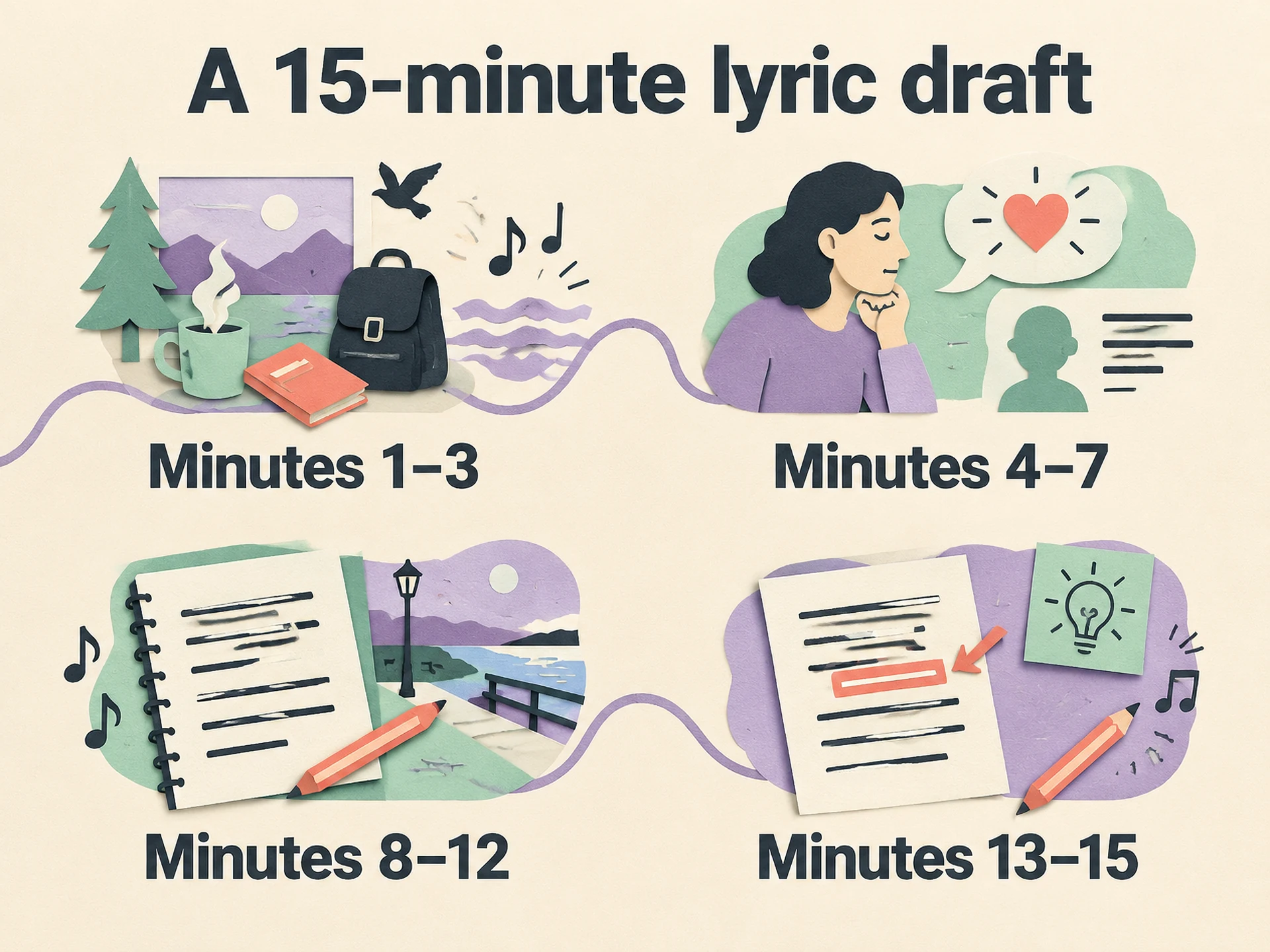
Use a timer as a boundary, not as a test of talent. Spend three minutes writing details without rhyming. Spend four minutes choosing a speaker and a central sentence. Use the remaining time to draft a short verse and chorus. The aim is a page you can revise, not a finished recording on a deadline.
Take “The extra mug.” A detail list might include the blue handle, a cupboard that sticks and a teaspoon left on the drying rack. Choose one detail that has an action attached to it: the narrator reaches for the second mug, pauses, then puts it back.
Now decide what the action means. Perhaps this is grief, perhaps a recent separation, or perhaps a child who has moved out. Those are different songs. Choose one rather than asking the first verse to remain vague enough to fit all three.
 View full-size infographic
- Minutes 1–3List objects, actions and sounds from the scene.
- Minutes 4–7Choose the speaker and the main emotional sentence.
- Minutes 8–12Draft a verse that shows the situation.
- Minutes 13–15Write a short hook and mark one thing to revise.
Original sketch — not a finished song

The blue cup catches on the shelf
I set it down beside myself

Possible hook:
I’m learning what to leave in place
The sketch does not explain who left. That might be an effective opening, but a complete song will need enough context for the intended meaning to land. Decide what to reveal in verse two. Our song structure guide can help assign each section a job.
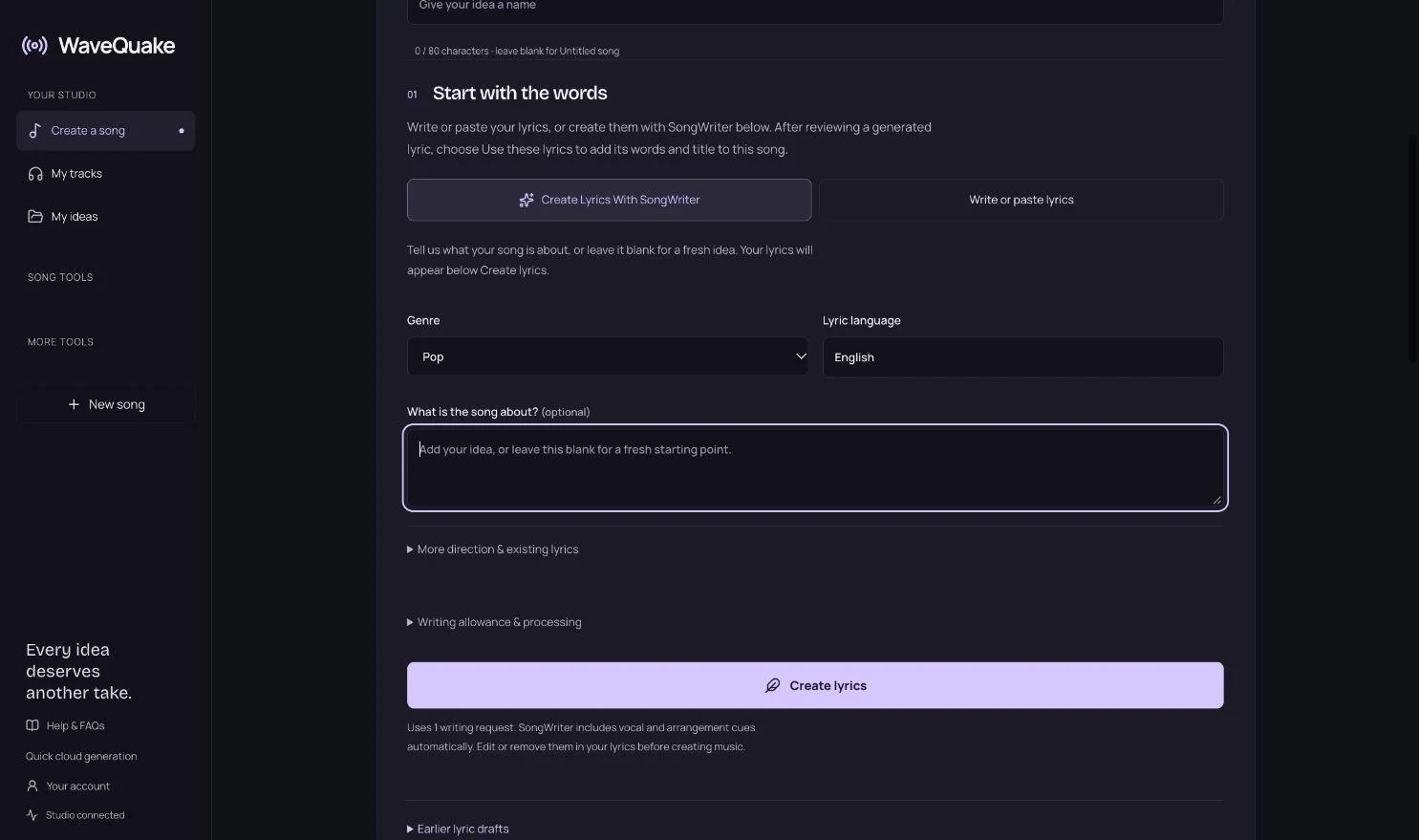
Use a writing prompt in WaveQuake Songwriter
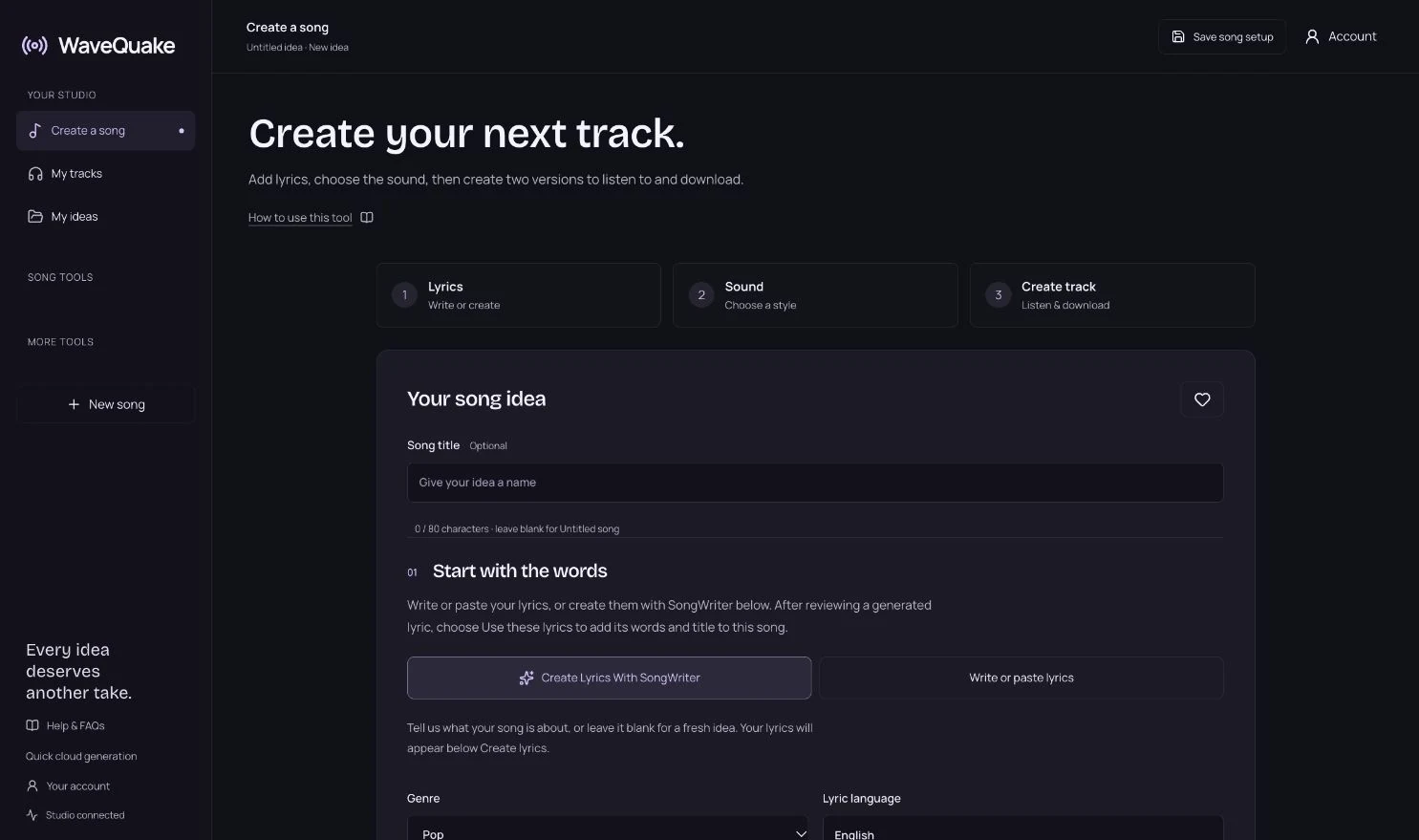
Open Create a song, choose Create Lyrics With SongWriter, and paste a prompt into What is the song about? Choose the genre and lyric language separately. A country setting does not require a country arrangement, and a sad story does not require a slow song.
Before creating lyrics, replace the generic character with a person you can imagine. Add one specific detail in the optional direction controls. If you already have a hook, put it in Hook to build around. Use the exact-line field when a particular line must remain unchanged, then review the result.
Click Create lyrics once and follow the writing stages shown beside the result area. A writing request creates the lyric draft; creating music is a separate action. You can revise the Songwriter title and lyrics before choosing Use these lyrics in the embedded writing room.
 View full-size infographic
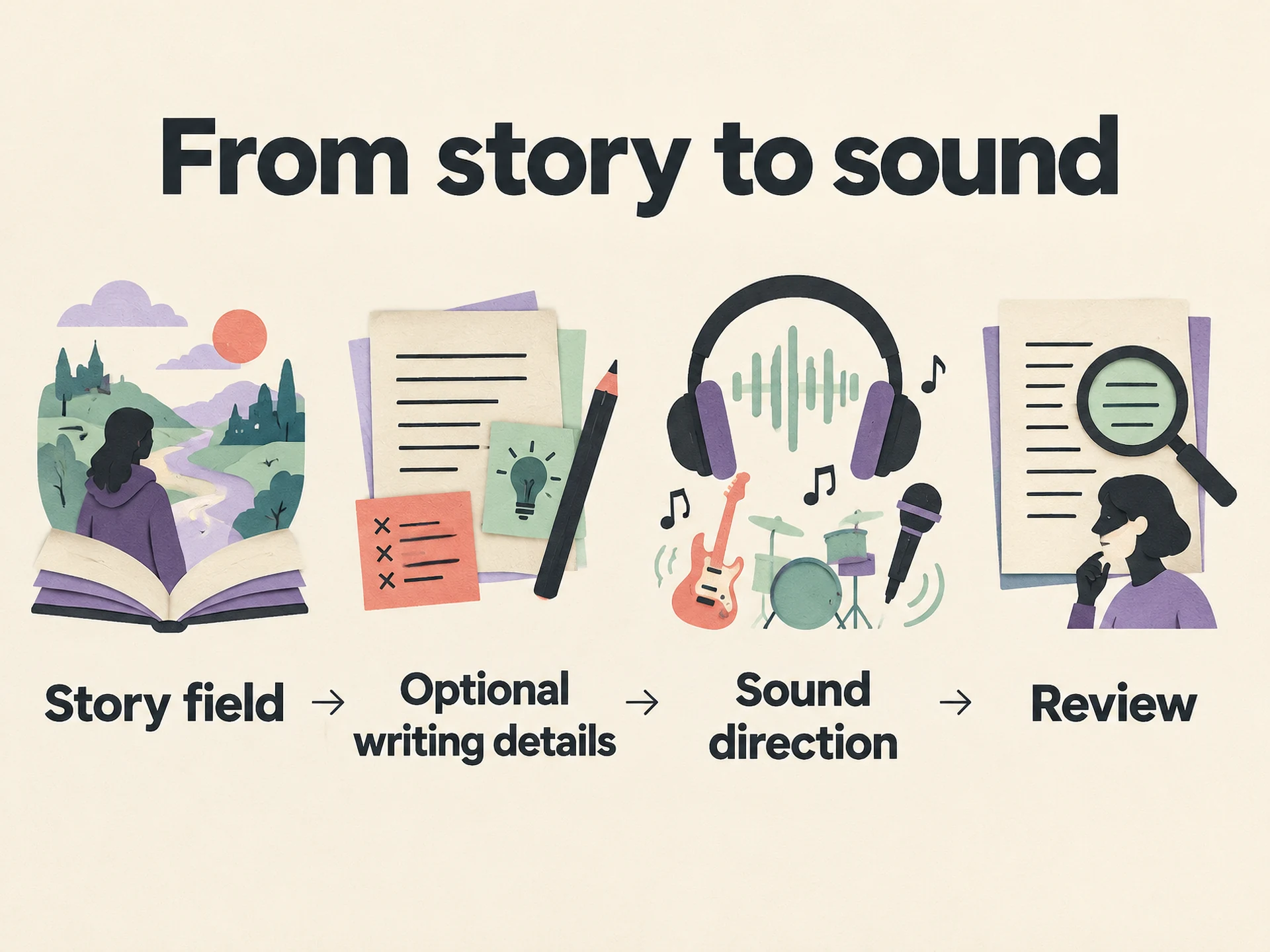
- Story fieldWho is speaking, what happens and what changes.
- Optional writing detailsThe hook, exact lines and ideas to avoid.
- Sound directionGenre, groove, instruments and vocal delivery.
- ReviewRead the words before creating the music.
If you prefer to write everything yourself, use the prompts offline and bring your lyric into the composer. The article does not require an account to use its ideas. WaveQuake becomes useful when you want to develop or hear the song inside the same browser workflow.
Give the story a sound of its own
After the lyric has a centre, choose a musical direction that supports it. Start with the vocal delivery: should the narrator sound conversational, hesitant, playful or defiant? Then choose a groove and a small instrument palette. This order can help keep the arrangement connected to the story.
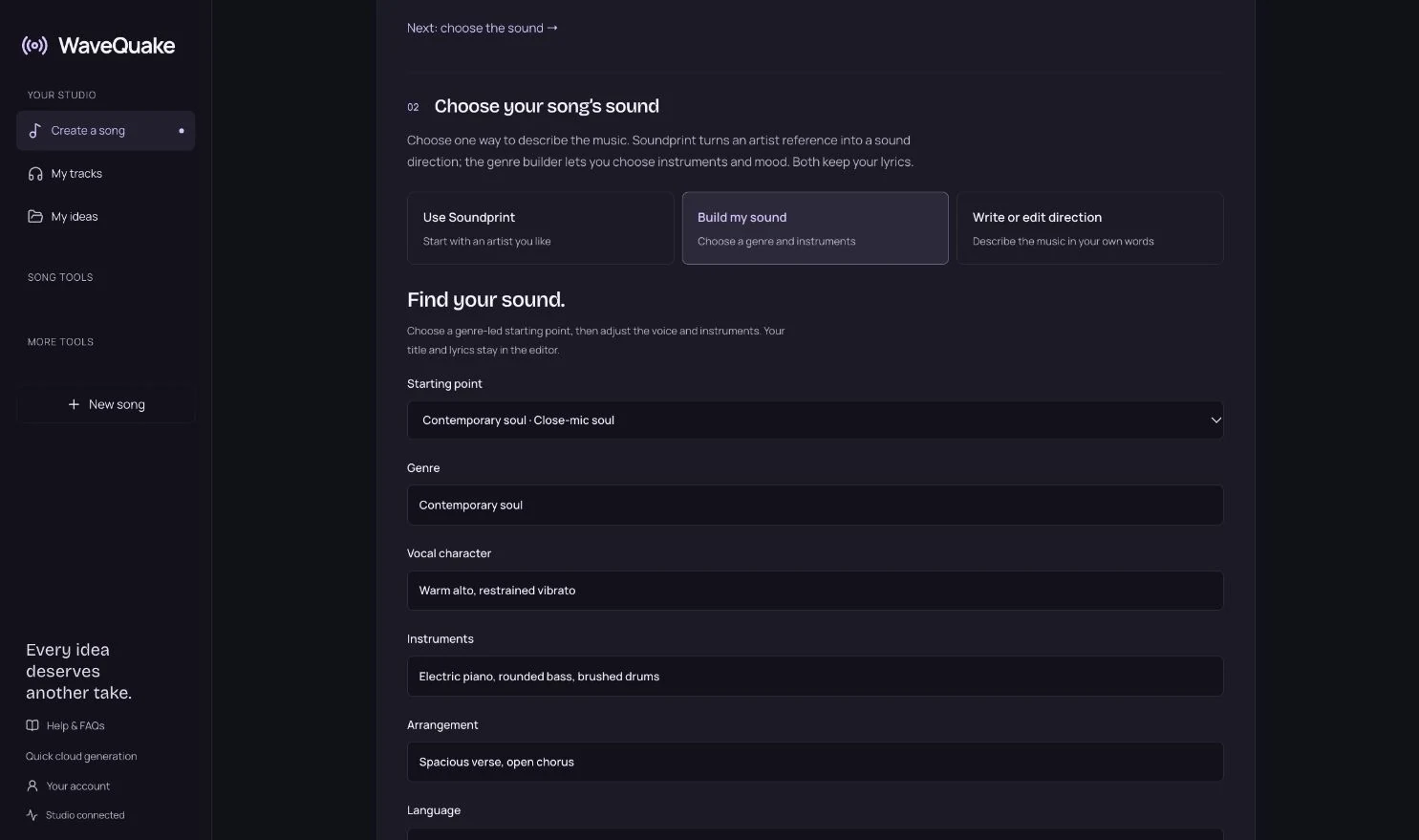
For “The terrible dance,” you might try buoyant pop with light percussion and an unpolished, friendly vocal character. “The message not sent” could work as quiet folk or restless electronic pop. These are creative options, not tested claims that a prompt will produce a particular performance.
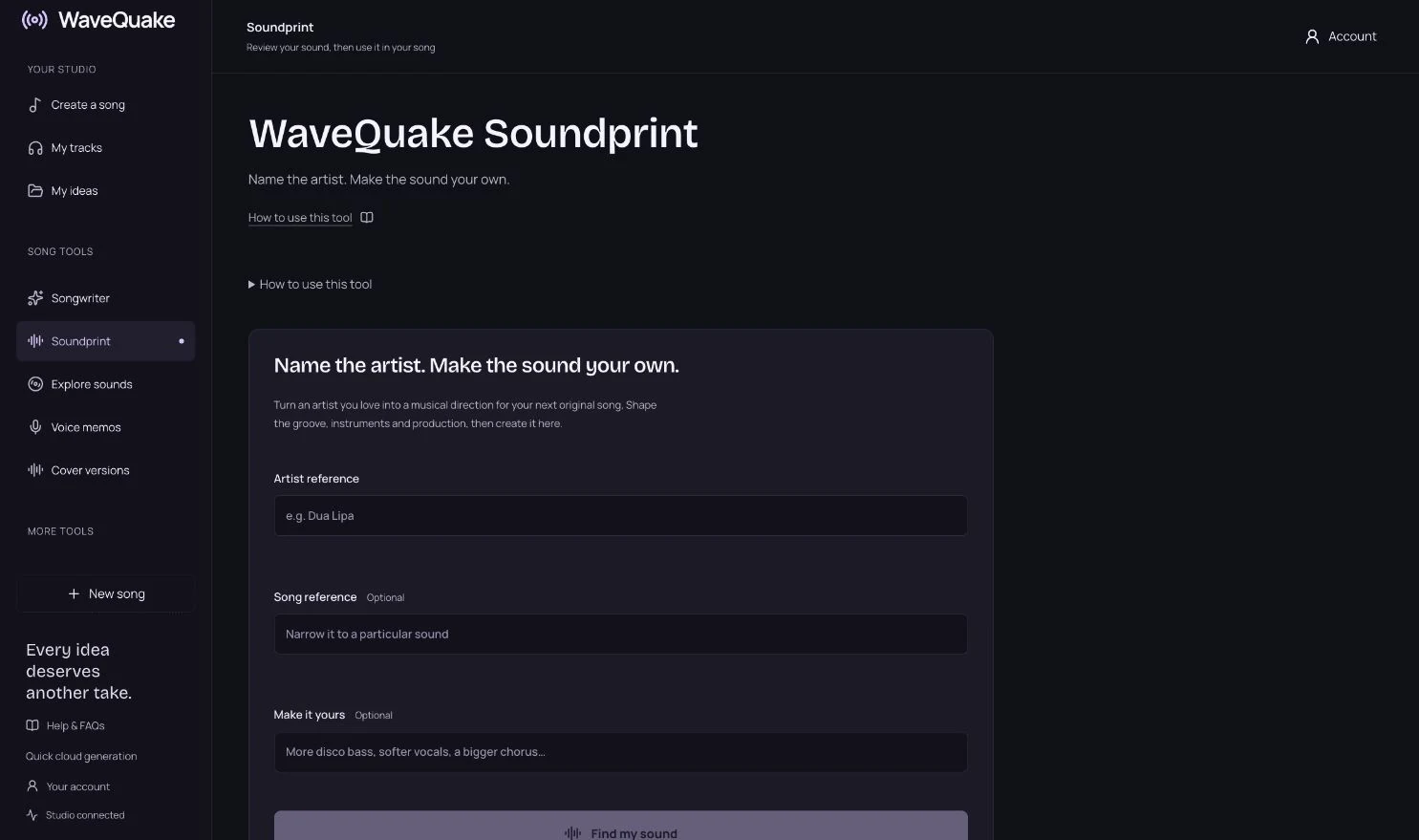
Soundprint offers another starting point when you know a reference artist but not the musical vocabulary. Add your own twist and review the description it creates. Use the traits that support your story; it does not clone the reference singer or reproduce a recording.
Keep the lyric readable. Songwriter automatically adds performance cues, and you can remove or simplify them. A brief cue for a restrained verse or a fuller chorus is easier to assess than a different instruction on every line. Exact timing and arrangement still need to be checked in the resulting audio.
Keep the specific details when you edit
A polished first draft can still lose the detail that made you choose the prompt. Read it once just for concrete actions and objects. If every line could fit a hundred other songs, restore one moment that belongs to this narrator.
Next, read the chorus on its own. Does it express the main idea, or merely repeat the subject? “I miss you every day” names a feeling. A small action that reveals the feeling may give you a more distinctive hook. The chorus writing guide shows a complete revision exercise.
After creating the music, compare the two versions at the same part of the song. Listen for words that become rushed, unclear or emotionally out of place. Save the stronger take before experimenting further. Make a local copy of files you want to keep: WaveQuake’s hosted files have a 30-day retention period.
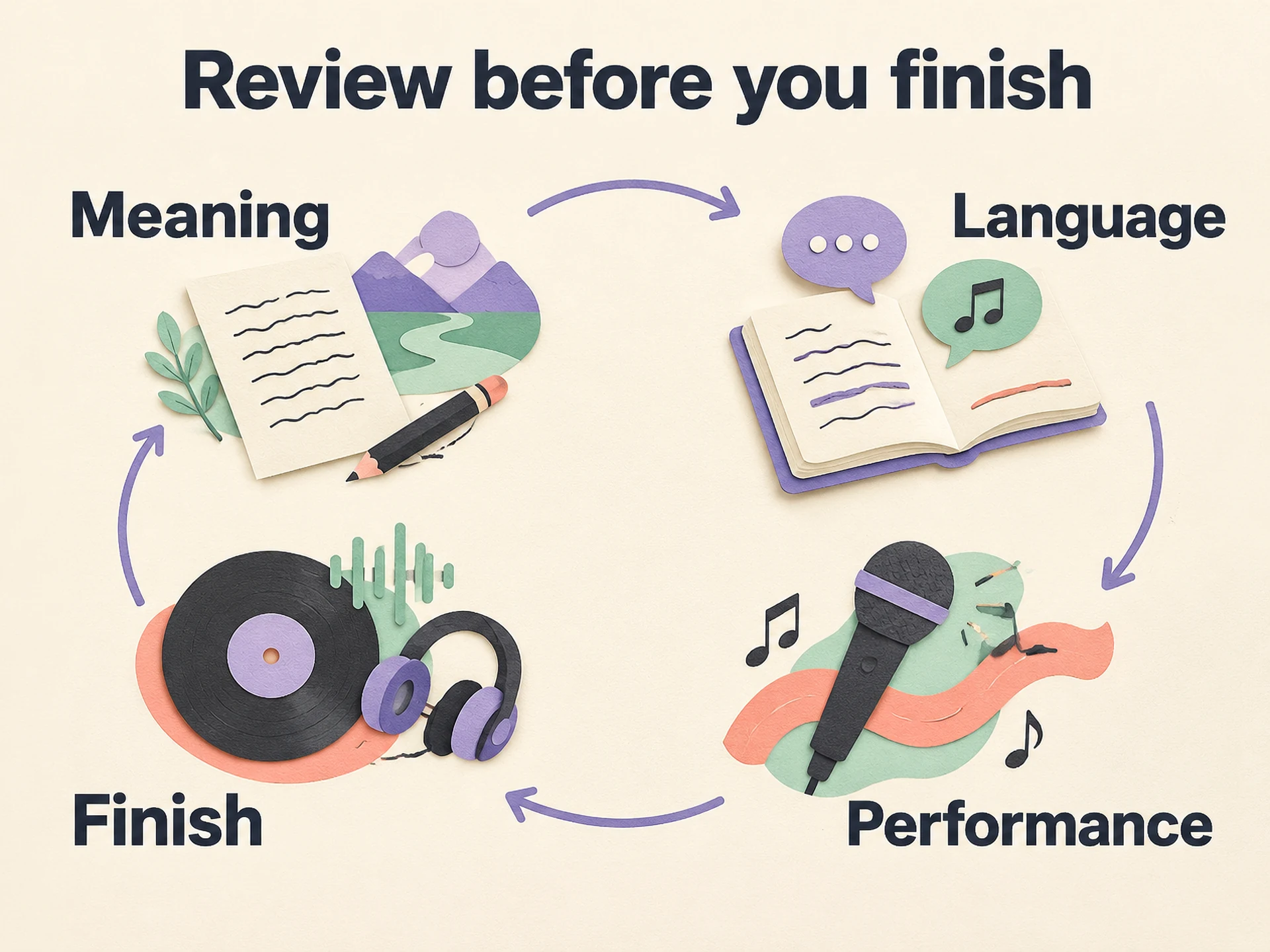 View full-size infographic
- MeaningDoes the song still tell the story you chose?
- LanguageWhich line is too general or difficult to sing?
- PerformanceDo the voice and groove support the narrator?
- FinishCompare mastering only after choosing a performance.
The one-time creation bank includes separate music and writing allowances. Use a few focused writing edits before another music generation. The point of a prompt is to give you a direction you can develop, not to keep you choosing starting points forever.
Common questions
What are good topics to write a song about?
Choose a situation with a person, a concrete detail and something unresolved. A small act of care, a difficult decision or an ordinary place that has changed can give you more to write than a broad instruction such as love or sadness.
How do I make a songwriting prompt feel personal?
Change the setting, speaker or key detail to something you understand. Decide what the narrator wants and what prevents it. You can write fiction; personal does not have to mean a literal account of your life.
Are songwriting prompts the same as AI music prompts?
Not in this guide. Songwriting prompts describe the story and lyric idea. Music prompts describe the genre, instruments, groove, vocal delivery and arrangement. In WaveQuake, put the story in Songwriter and the musical description in sound direction.
Can I use these prompts without AI?
Yes. They are original writing exercises you can use with paper, a voice recorder or an instrument. The WaveQuake walkthrough is optional and shows how to develop a draft and create music in the browser.
What should I do if I cannot finish a song?
Reduce the task to one rough verse and one central hook. Mark the unresolved part instead of restarting immediately. Then decide what new information a second verse would add and whether the song actually needs a bridge.
Does clicking Create lyrics also generate a track?
No. Create lyrics uses one writing request for an editable draft. You review and apply it before submitting the separate music-generation action, which uses creation minutes. Soundprint also uses the shared writing allowance.
Sources & checking
Product details checked on 26 October 2026. Prices, features and terms can change; review the linked offer before purchasing. This is a product guide, not a comparative audio benchmark.