How to write a country song with a story worth singing
A kitchen, two brothers and a chair. Develop a small scene into a hook, a lyric and a musical brief that belongs to the story.
Published by WaveQuake, the studio featured in this guide. Product screenshots show the live interface. Illustrations explain the ideas; examples are creative starting points, not guaranteed results.
To learn how to write a country song, begin with a person doing something that matters. A familiar object, a plainspoken request and a change of heart can give you more to work with than a page of borrowed genre clichés.
We will develop an original song idea called “Leave a Chair”: two brothers packing their dad’s kitchen discover a reason to stop and talk. Follow the story, shape its hook and build a musical brief you can use in WaveQuake. The lyric sketches are original examples written for this guide.
1. Find the event inside your country-song idea
Start with something that happened, not a list of country symbols. A brother arrives to help clear the family house and discovers that the spare key still fits. That situation already contains a place, an action and a relationship. You can decide whether the song is about grief, reconciliation or finally moving on as you explore it.
Write three columns in your notes: what happened, what the speaker noticed and what they will not say yet. For our example, the brothers are packing their dad’s kitchen. One notices two mugs already on the table. Neither wants to admit how long it has been since they sat together.
The mugs matter because of the relationship, not because mugs automatically make a lyric authentic. You could replace the kitchen with a garage, a bus shelter or a city apartment and keep the same emotional problem. Use details you can describe accurately instead of borrowing a setting you only know from other songs.
Soundtrap’s country songwriting guide emphasizes storytelling and plainspoken language. Our exercise is to make those qualities practical: show the brothers doing something together before asking the chorus to explain why it matters.
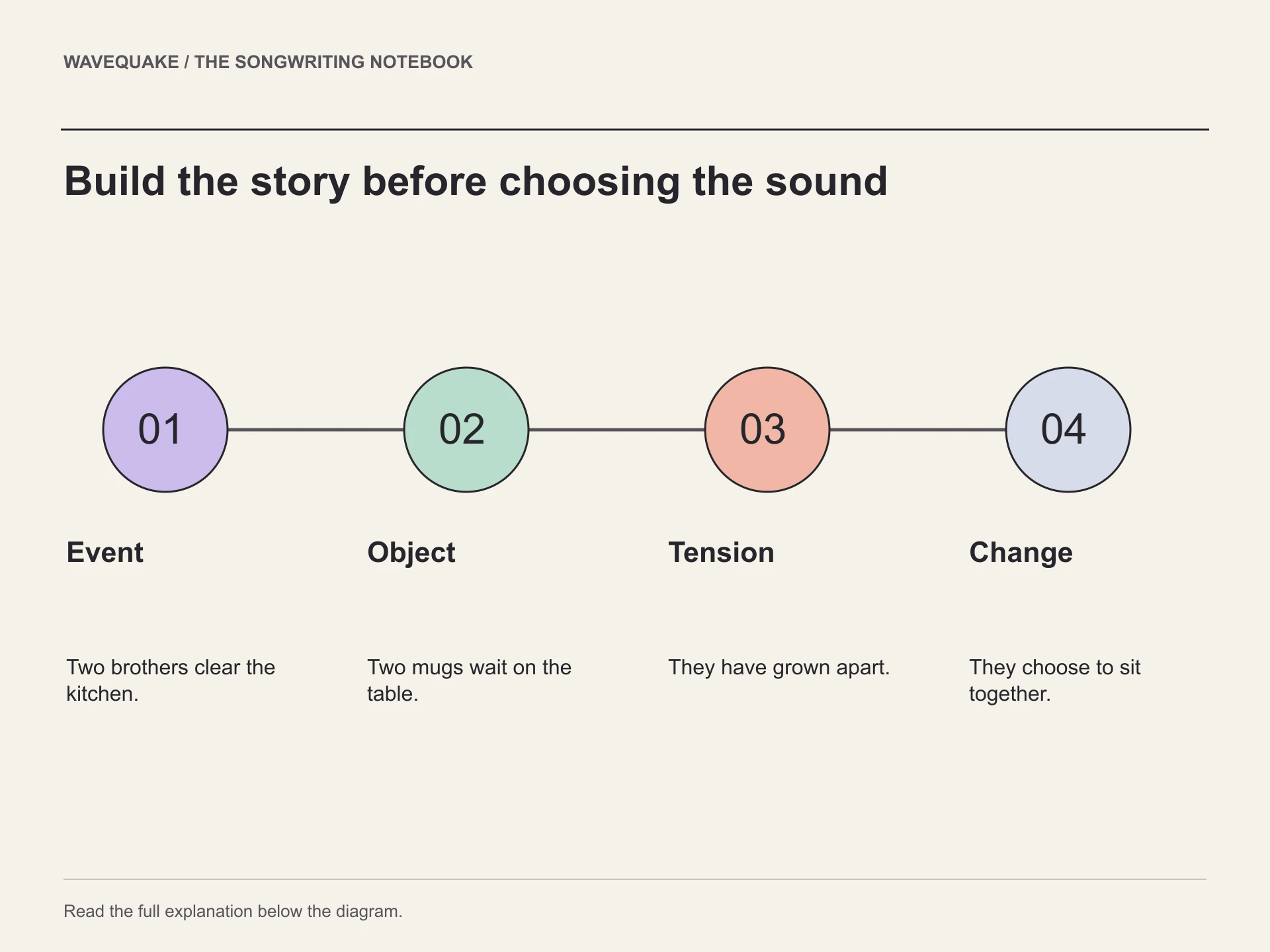 View full-size infographic
- EventTwo brothers clear the kitchen.
- ObjectTwo mugs wait on the table.
- TensionThey have grown apart.
- ChangeThey choose to sit together.
2. Choose a title with room for a second meaning
A useful country hook can mean one thing in the scene and something larger by the end. Our working title is “Leave a Chair.” At first it is a practical request during the house clearance. Later it becomes a way of asking the other brother not to disappear again.
Write a direct version of the emotional message: “I would like us to spend time together.” Then look for an action in your scene that expresses it. Leaving a chair creates that connection without putting the whole explanation in the title. The title earns its place because it belongs to the actual story.
Do not force every line to lead to a clever twist. If the double meaning requires a paragraph of explanation, it may distract from the song. Try saying the hook without the setup. Would a listener understand something emotionally useful even before hearing the second verse?
Make three title candidates and read each against your opening scene. Pick the one that encourages the strongest next line, rather than the one that sounds most like an existing hit. If you need a complete beginner workflow before the genre exercise, start with how to write song lyrics.
3. Write a scene the listener can follow
Give the first verse enough physical information to make the situation clear. You do not need the brothers’ entire history. A key, a cupboard and a small action can put us in the room. Here is an original sketch, written for this guide.
[Verse 1]
Your key still caught halfway around
You laughed and lifted up the latch
I’d packed the plates in yesterday’s news
You found two mugs without a scratch
“Yesterday’s news” could sound like a familiar phrase, but here it also names the packing material. Decide whether the line earns that extra association or simply calls attention to itself. A concrete detail should help the listener enter the scene, not interrupt it for a writer’s joke.
Keep the viewpoint steady. If the song is addressed to “you,” a sudden unexplained “he” can make the relationship difficult to follow. Check every pronoun while reading the verse aloud. This is especially useful in a story with several relatives or changes of time.
The rhyme is loose: “latch” and “scratch” connect two lines, while the others prioritize the scene. You can make the pattern tighter later if the performance asks for it. Do not replace the most revealing action simply because another object rhymes more neatly.
For a first draft, write what happens next in ordinary prose. The speaker wants to keep packing, but the brother starts making tea. That interruption is a natural doorway into the chorus.
4. Let the chorus reveal what the scene means
The verse gives us the room; the chorus tells us why we should care. Use simpler language here so the central request can register. The hook does not need a new metaphor on every line. It needs space and a reason to return.
[Chorus]
Leave a chair when the room is bare
Put the kettle on, I’ll meet you there
We can carry the boxes another day
Leave a chair; there’s something left to say
The chorus changes the pace of the packing and the emotional pace of the song. The brothers can delay a practical task because their conversation matters more. The final line is an invitation, not a complete explanation of what they will say.
Try the chorus in your normal speaking voice. “When the room is bare” may feel too polished for this narrator; “by the kitchen stair” would add a new physical fact that must be true to your imagined setting. Test alternatives against the story instead of accepting the first rhyme.
Our chorus guide covers hook repetition and phrasing in more detail. For this country example, the useful contrast is a verse full of small actions followed by one clear request. You can create that contrast through words before choosing how big the musical chorus should become.
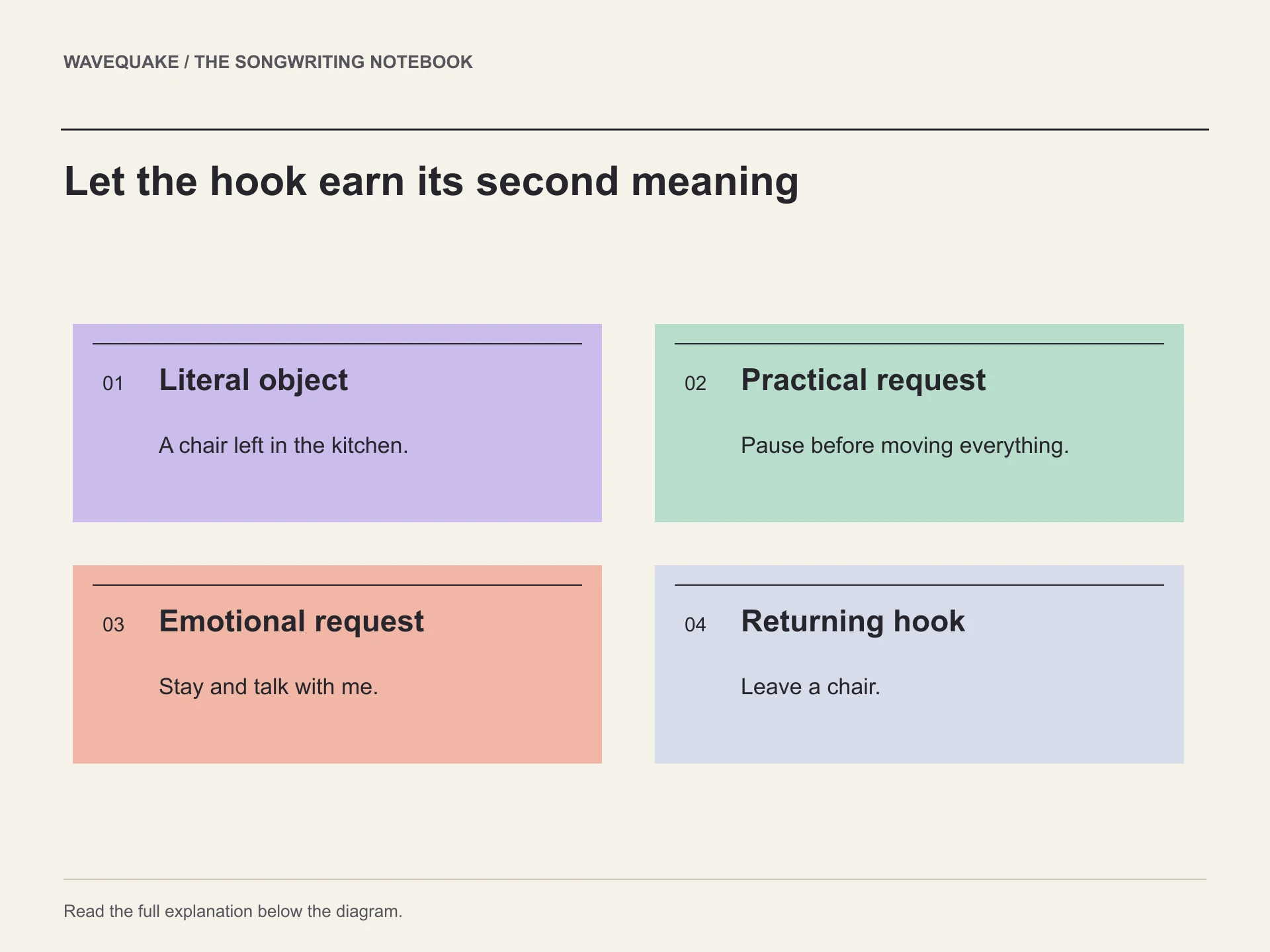 View full-size infographic
- Literal objectA chair left in the kitchen.
- Practical requestPause before moving everything.
- Emotional requestStay and talk with me.
- Returning hookLeave a chair.
5. Make the second verse change the conversation
Verse two should give the repeated chorus a new reason to matter. Repeating more packing details may create atmosphere, but it will not necessarily develop the relationship. Let one brother do something that the first verse made unlikely.
[Verse 2]
You set your phone beside the sink
And turned its bright face to the wood
I asked how long you had to stay
You said, “A little longer would be good”
Turning the phone over is a small choice to pay attention. The last line is longer than the others, which might suit a conversational performance or might feel crowded. Mark it as a listening question rather than assuming the page can answer it. An alternative such as “You said, ‘For once, I think I could’” changes both the rhythm and the implication.
If you add a bridge, give it a new angle. Perhaps the brothers realize that keeping the house is not the only way to keep the relationship. A short spoken admission may be more useful than introducing a second large metaphor. You can also leave the bridge out and let the final chorus follow this verse directly.
Use the song-structure guide to decide whether the extra section earns its space. Do not lengthen a song simply because a familiar template includes more sections. This particular story may work best while the invitation still feels unfinished.

6. Choose which kind of country sound belongs to it
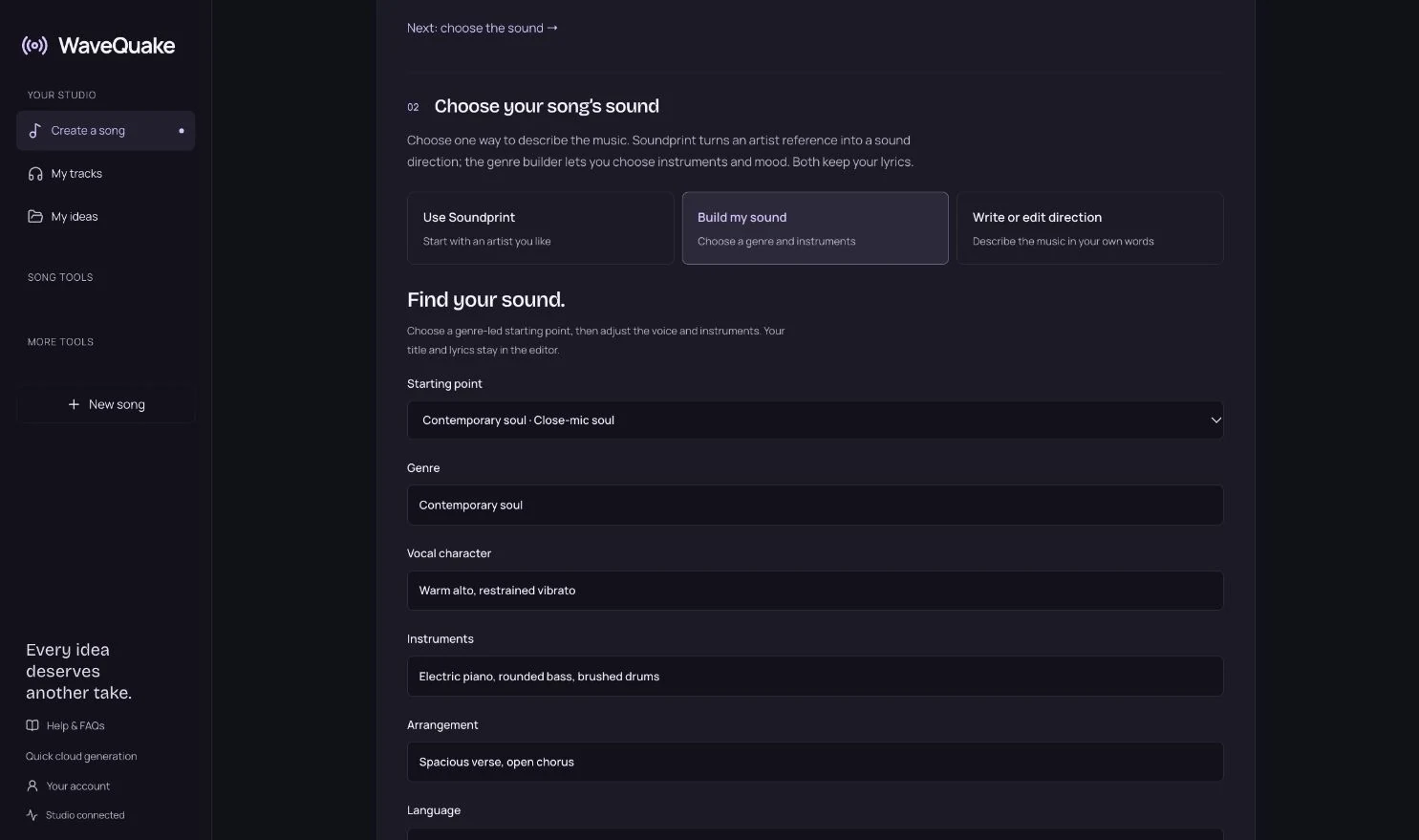
Country is a broad direction, not a single arrangement. An intimate acoustic performance will frame “Leave a Chair” differently from a bright full-band version. Choose the relationship you want the listener to feel: close enough to hear hesitation, or open enough for the chorus to become a shared invitation.
Start with one direction and a few compatible details. For the close version, try acoustic guitar, restrained piano, a warm conversational lead and light percussion. For a fuller version, try steady drums, clean electric guitar and a wider chorus. These are example briefs, not guarantees about which instruments every result will contain.
Keep the lyric fixed while comparing the two directions. If you change the words, the voice and the arrangement together, you will not know which choice helped. The AI music prompts guide explains this one-change comparison method.
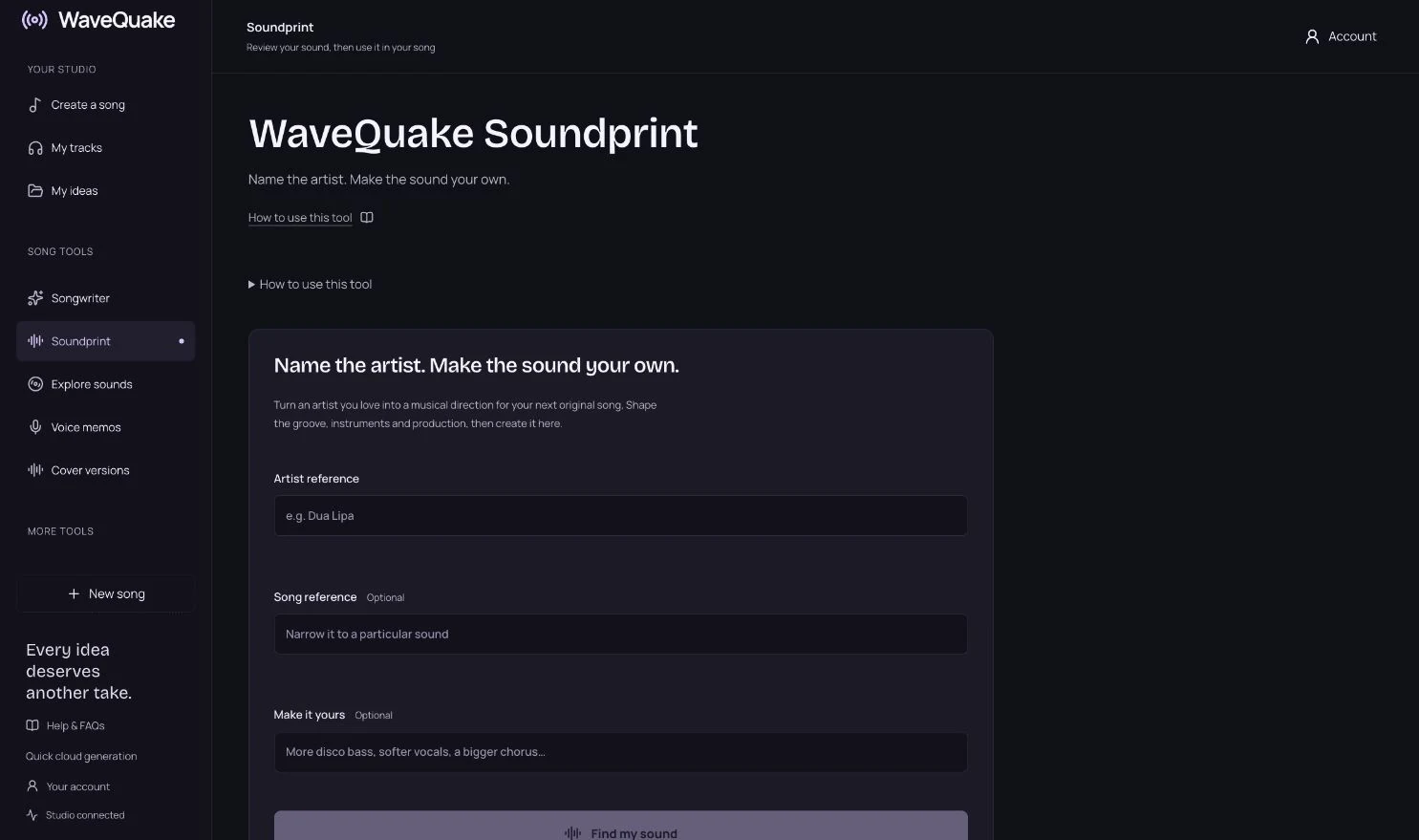
You can also start with Soundprint: enter a reference artist or song, add your own twist, and edit the suggested musical traits. Focus on delivery, instruments, pace and space. Soundprint does not clone the reference singer or promise the same recording with different words.
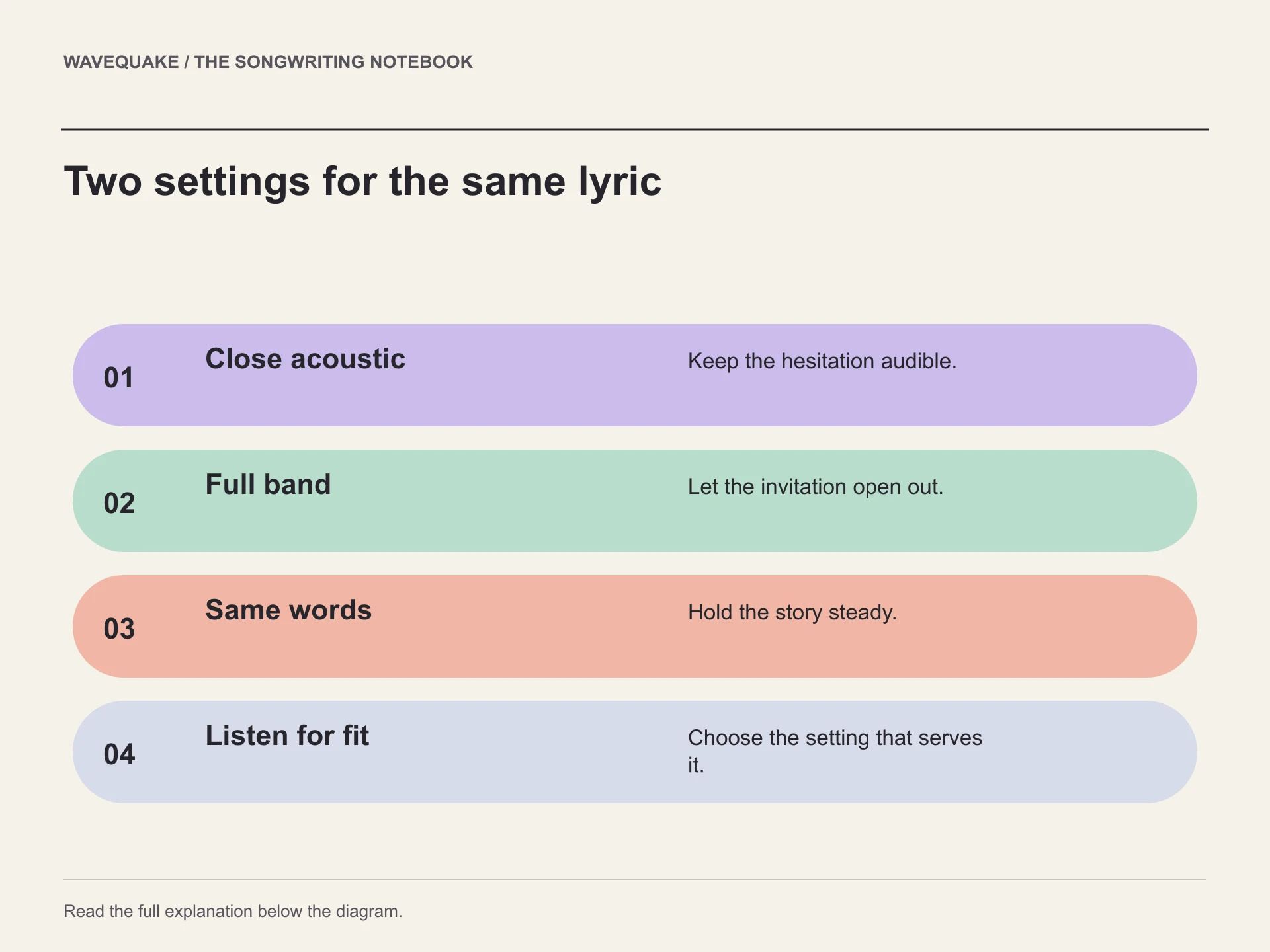 View full-size infographic
- Close acousticKeep the hesitation audible.
- Full bandLet the invitation open out.
- Same wordsHold the story steady.
- Listen for fitChoose the setting that serves it.
7. Build and review a country demo in WaveQuake
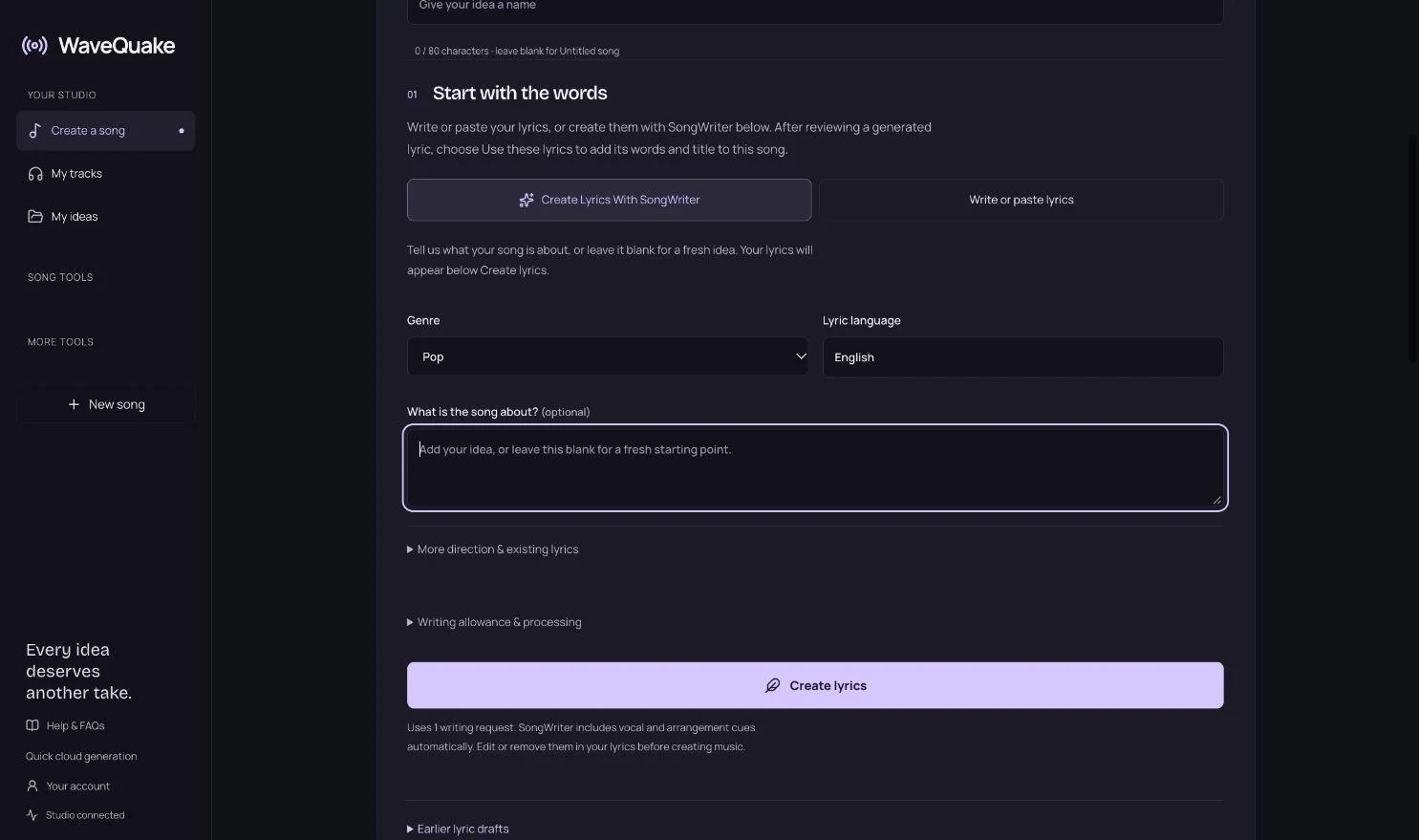
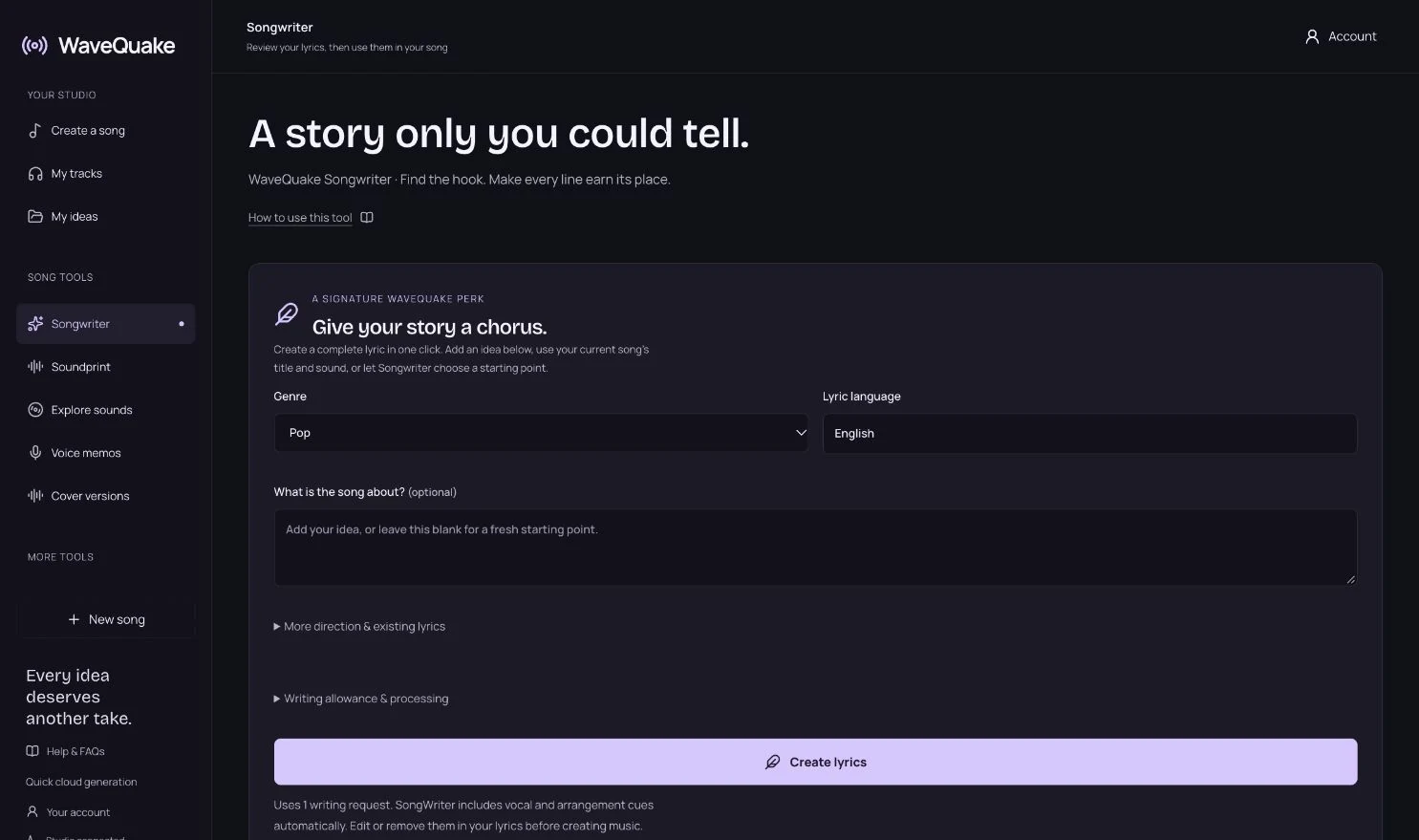
If you want help completing the lyric, open Songwriter, choose the relevant genre direction and give it a specific task. Here is a brief you can adapt. Replace the invented family situation with your own fictional or personal story.
Write a conversational country lyric about two adult brothers packing their late dad’s kitchen. They have grown apart. Two mugs and a chair become reasons to stop packing and talk. Build the chorus around “Leave a chair.” Verse two should show one brother putting his phone away and deciding to stay. Avoid a sudden perfect reconciliation or a list of country clichés.
Review the draft for details that were not in your intended story. If the model invents an argument, a place or a promise you do not want, remove it. Keep your own copy of any exact lines. Apply the edited lyric to Create a song, then set the sound direction separately.
A successful music generation returns two versions. Listen to the entire performance: is the relationship understandable, does the chorus arrive clearly, and is the longer second-verse line comfortable? Write down the actual problem before asking for a new version.
Unlimited Standard Generations are part of the current one-time offer. Songwriter and Soundprint retain their separate writing allowance. That distinction matters when deciding whether you need a lyric rewrite or simply another performance of words you already like. Read the current offer for the full tool allowances.
8. Revise for the listener, then finish the track
Try a listening pass without looking at the lyric. If you miss an important fact, decide whether it needs clearer delivery or simpler wording. A listener cannot pause to inspect the rhyme scheme while hearing the story for the first time.
Next, compare the first and final chorus. The words can stay the same, but verse two should have changed what they mean. Here “Leave a chair” begins as an invitation and ends with a small sign that it might be accepted. If that movement is not audible, revise the connecting scene before decorating the arrangement.
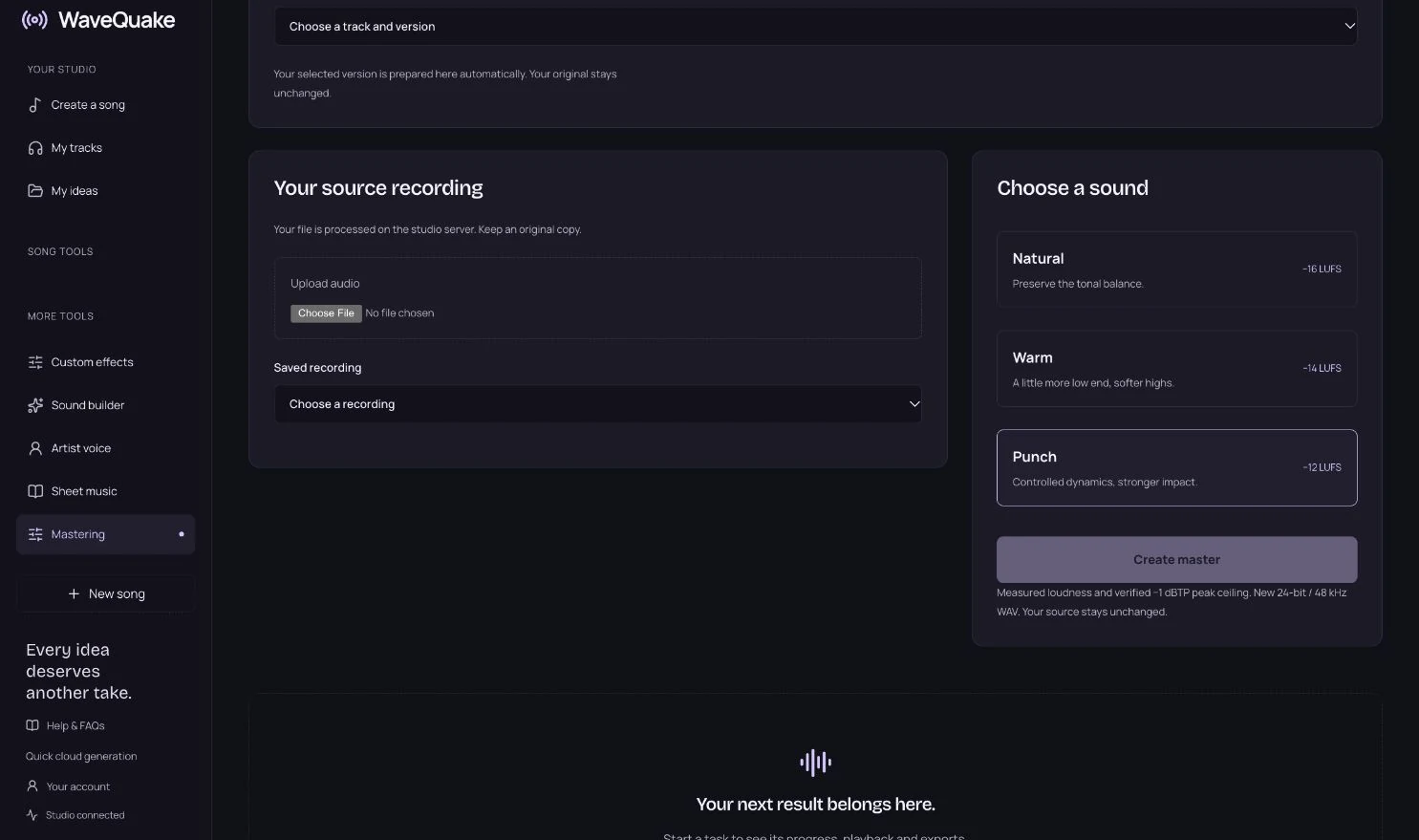
Once you have a take you want to keep, compare Natural, Warm and Punch in mastering. Keep playback levels sensible and listen for the vocal. A finish that makes the instruments feel larger may not be the best choice if it distracts from an intimate conversation.
Save the lyric, musical brief and downloaded recording together. Keep your own backups of tracks you want to retain. For the next song, reuse the process—event, detail, hook, change—while finding a different situation. A repeatable writing method should help you tell more stories, not make every song sound like this one.
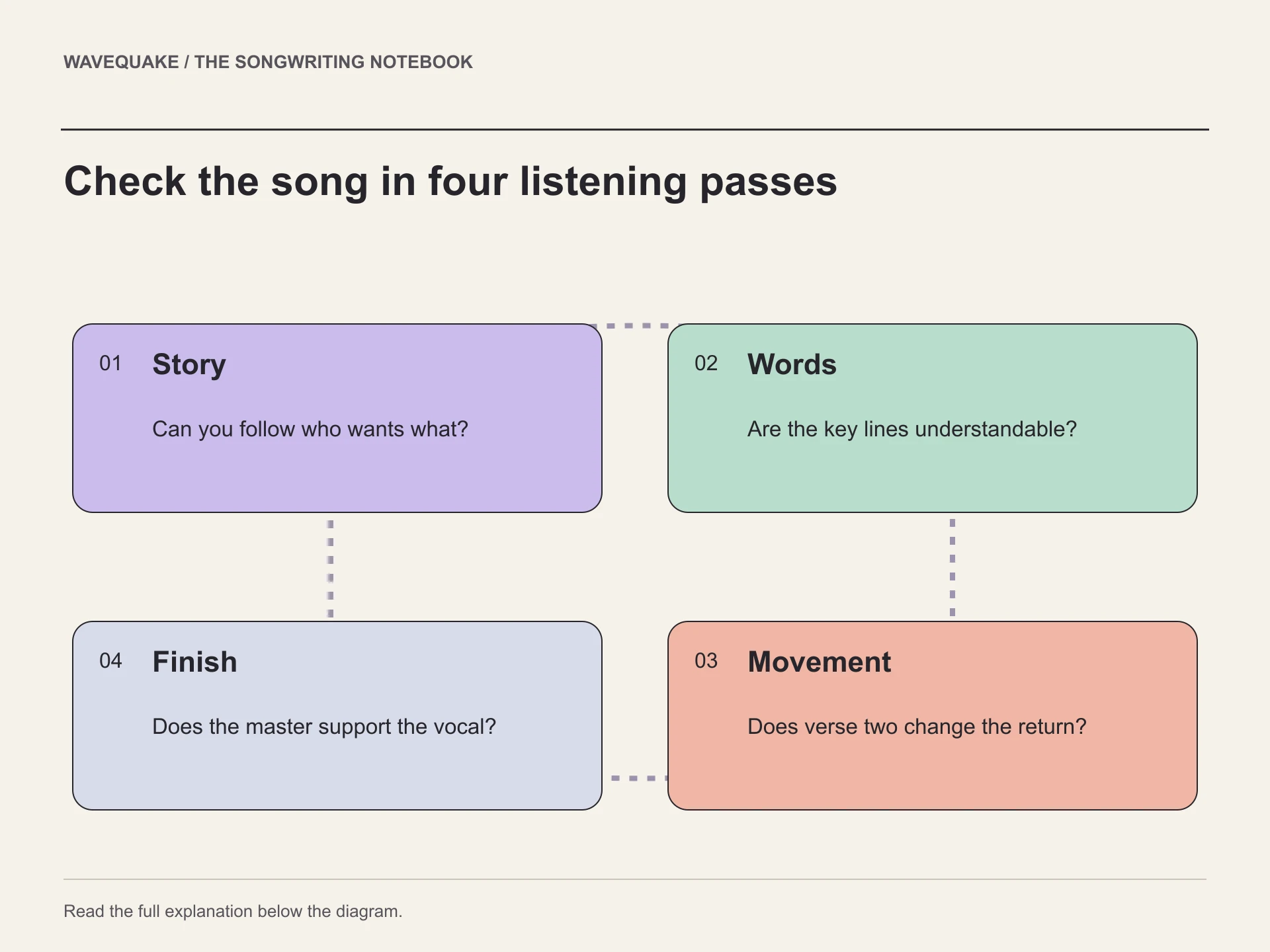 View full-size infographic
- StoryCan you follow who wants what?
- WordsAre the key lines understandable?
- MovementDoes verse two change the return?
- FinishDoes the master support the vocal?
Common questions
What makes a song sound country?
Storytelling, vocal delivery, rhythm, harmony and instrumentation can all contribute. There is no single checklist that covers every country style. Choose a coherent direction and use details that belong to your story instead of relying only on recognizable props.
Do I need a guitar to write a country song?
No. You can develop the story and lyric with a notebook and your voice. A guitar, collaborator or music generator can help turn that draft into a performance. Read the words aloud so you can hear their natural phrasing.
Does a country song need a twist?
No. A clear emotional change can be enough. A double meaning or late realization is useful when it grows naturally from the story, but a forced twist can distract from a straightforward scene.
Can I use my own lyrics in WaveQuake?
Yes. Put your words in the Lyrics field and describe the desired performance separately. You can edit the lyric manually or use Songwriter for a draft before starting music generation.
Can Soundprint make me sound exactly like a country singer?
No. Soundprint turns a reference into editable musical direction. It can suggest broad traits, but it does not clone the reference singer or guarantee a particular performance.
Should every line in a country song rhyme?
No. Rhyme can help connect phrases, but you can use a looser pattern when the story or delivery benefits. Prefer a meaningful natural line to a neat rhyme that changes what the speaker means.
Sources & checking
Product details checked on 29 October 2026. Prices, features and terms can change; review the linked offer before purchasing. This is a product guide, not a comparative audio benchmark.