How to turn a poem into a song without losing its meaning
Choose what to preserve, reshape the phrases and find a returning line. An original poem becomes a lyric you can hear and revise.
Published by WaveQuake, the studio featured in this guide. Product screenshots show the live interface. Illustrations explain the ideas; examples are creative starting points, not guaranteed results.
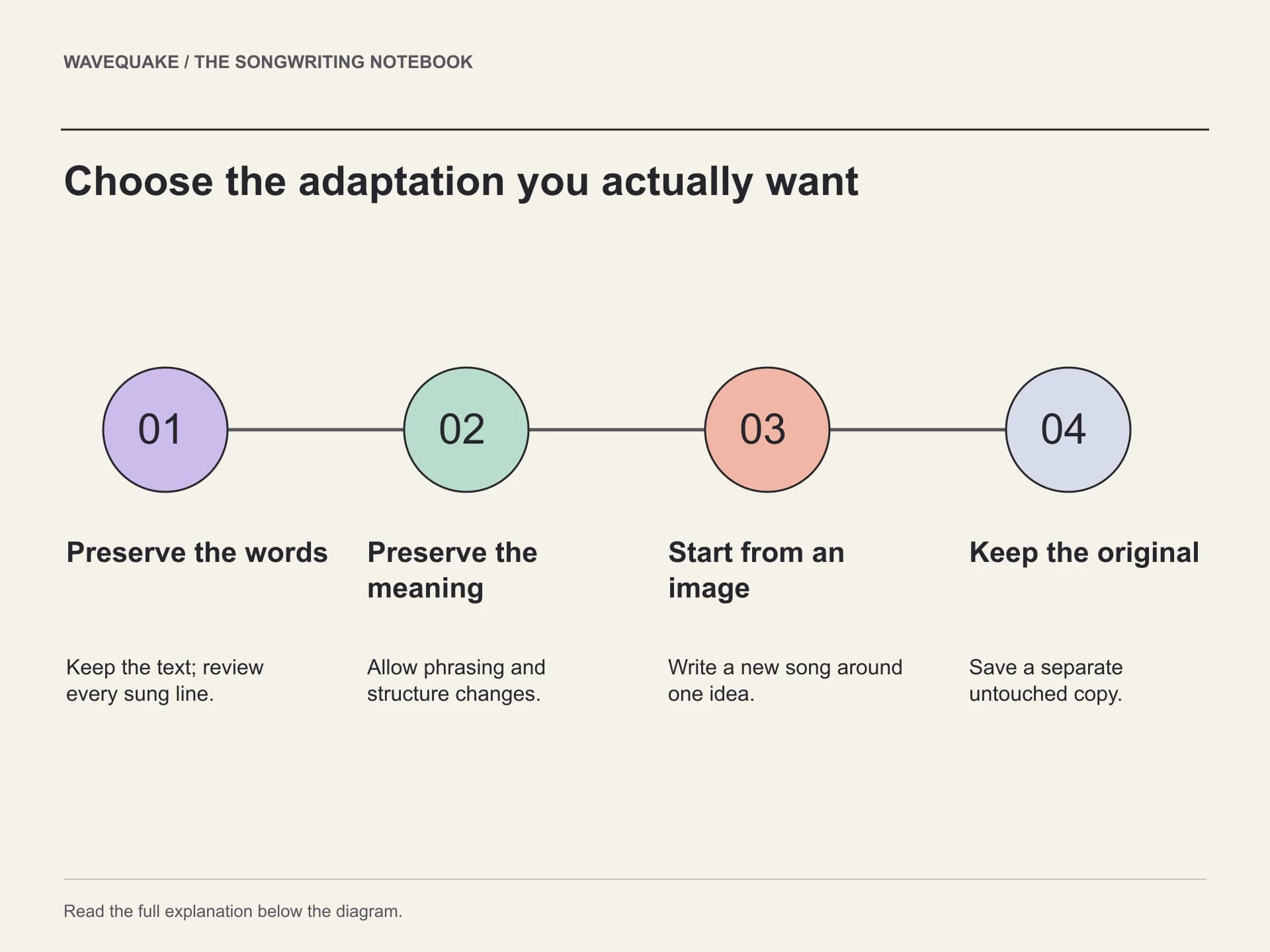
To turn a poem into a song, first decide what you want to preserve: every word, the central images or the feeling that develops across the piece. Then shape phrases that can be performed, choose where a thought should return and listen for what the music changes.
This guide adapts an original six-line poem into a short lyric. You will see the choices and compromises, including a line that still needs revision. The aim is a version you can evaluate, not a promise that any poem becomes a finished song in one click.
1. Decide what must survive the adaptation
Before you add music, make a protected copy of the poem. Work on a second version so every change is a choice you can reverse. Underline the images, phrases and relationships that make the piece yours. Those are the things to protect; the current line breaks may be less important.
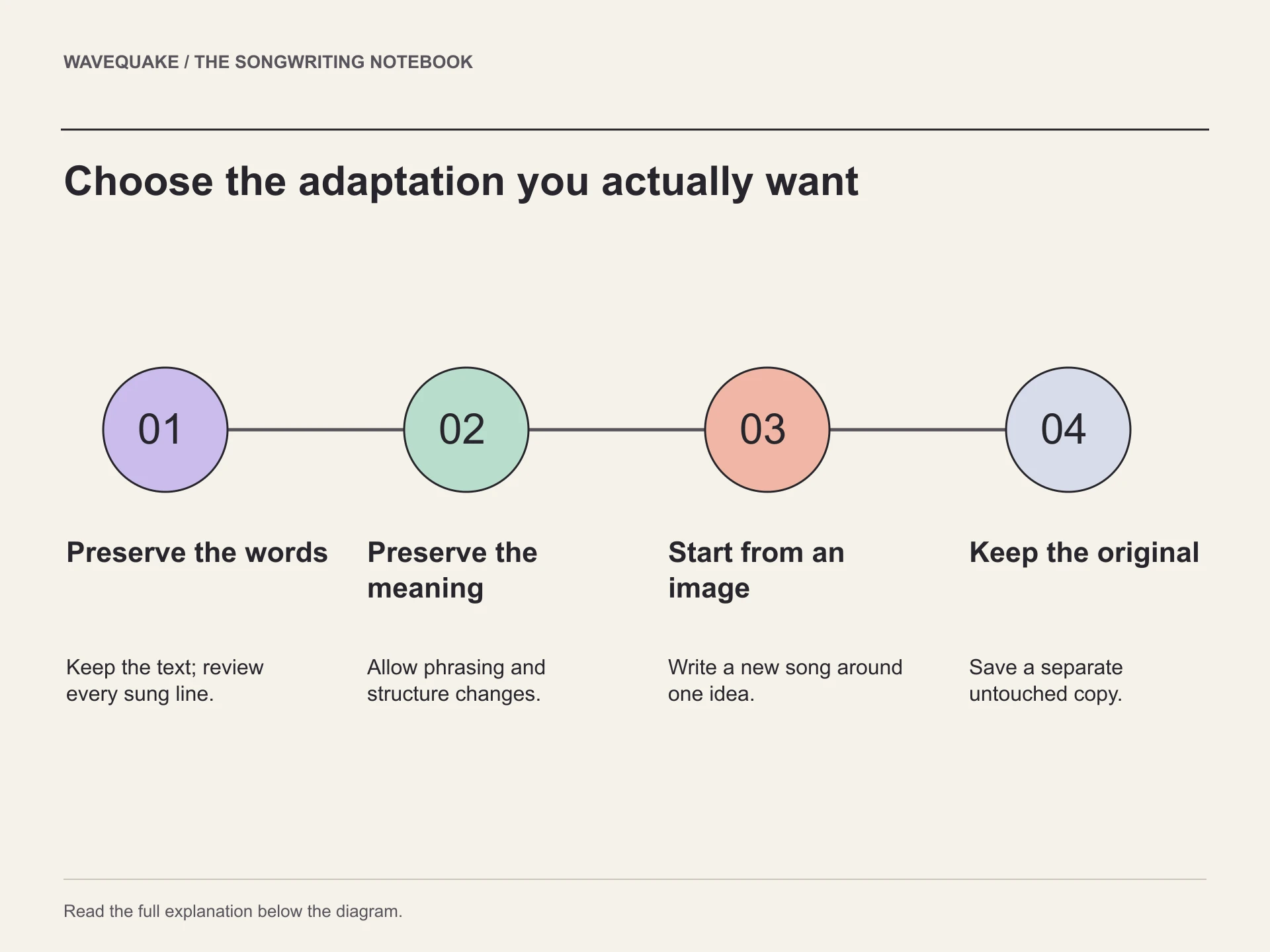
Choose an adaptation goal. You might preserve every word and let the performance be free, or keep the meaning while shortening and rearranging the text. A third option is to write a new song inspired by one image. All three can be useful, but they produce different results. Do not judge a loose adaptation as if you had asked for a literal setting.
If exact wording matters, prefer a performance process where you can check and control every line. An AI-generated song can omit, repeat or change words. A request to preserve text is not proof that the finished recording does so. Plan a word-by-word listening check before sharing it.
For this tutorial, we will keep the central image and emotional movement while allowing changes to phrasing. The source poem below is original to this guide. Use your own writing or material you have permission to adapt when following the exercise.
 View full-size infographic
- Preserve the wordsKeep the text; review every sung line.
- Preserve the meaningAllow phrasing and structure changes.
- Start from an imageWrite a new song around one idea.
- Keep the originalSave a separate untouched copy.
2. Read the poem for stresses, pauses and movement
Here is our short poem. Read it aloud once as ordinary speech and once with a slow pulse. Notice where the syntax wants to continue past a line break, and where a pause helps the meaning.
After the Rain

I leave the window open after rain.
The street returns in pieces:
one bicycle, a closing gate,
your name beneath the kettle’s rising note.
I thought an empty room would teach me silence.
Instead, it keeps a place for every sound.
The poem moves from the outside world into a private memory. Its last two lines change our understanding of the empty room. That is the emotional turn to protect. A song that only lists the bicycle, gate and kettle would preserve the objects but lose the point.
Mark the words you emphasize naturally: “window,” “rain,” “name,” “empty,” “silence” and “sound” might stand out. Your reading may differ, and that difference can suggest another performance. Do not turn the marks into a rigid mathematical grid before hearing a phrase.
Berklee’s lyrics-to-music course treats stressed syllables and phrase lengths as part of the relationship between words and music. For this exercise, record a spoken reading and listen for places where you naturally slow down or take a breath. The recording is a reference for your decisions, not an automatic instruction that a generator will follow.
3. Find a phrase worth returning to
A poem can reveal its meaning once at the end. A song may benefit from returning to a thought, but that does not mean every adaptation needs a conventional chorus. You could use a short refrain, a repeated closing line or a sequence of verses that keeps moving.
For our example, “it keeps a place for every sound” has a useful shape, but the pronoun depends on the previous line. “This room keeps a place for you” is more immediately understandable and turns the sound imagery into a direct emotional statement. It also changes the poem: the absence becomes explicitly addressed to another person.
Decide whether that change is acceptable before building the rest of the song around it. You could preserve more ambiguity with “This room keeps a place for every sound,” at the cost of a longer phrase. Neither choice is automatically more faithful; each protects something different.
We will use “This room keeps a place for you” as a working refrain. Read it after every stanza and ask whether it adds something or merely explains what was already clear. If it flattens the poem, try a verse-only setting instead. The chorus guide offers exercises for developing a returning line without filling every gap with repetition.
 View full-size infographic
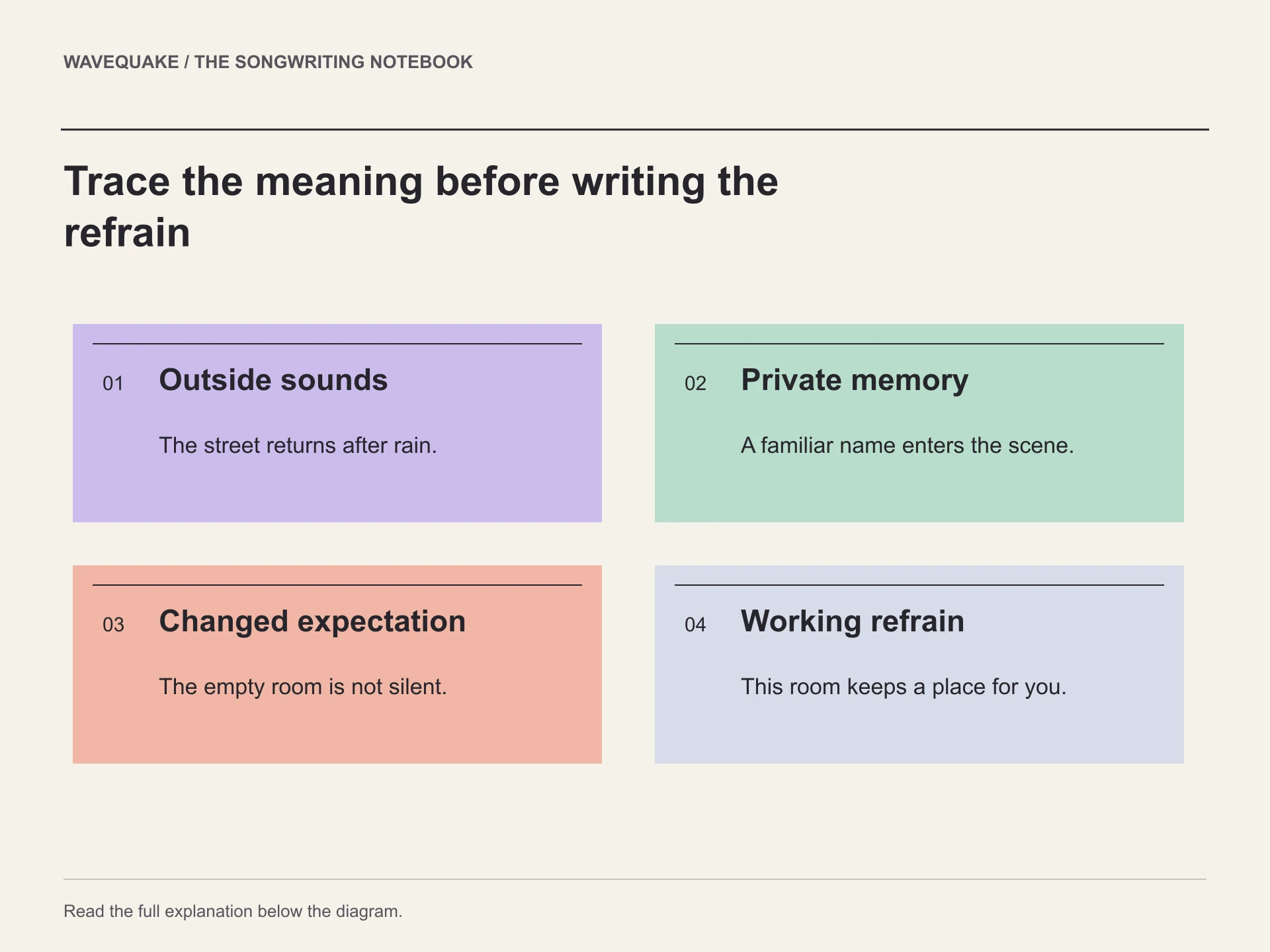
- Outside soundsThe street returns after rain.
- Private memoryA familiar name enters the scene.
- Changed expectationThe empty room is not silent.
- Working refrainThis room keeps a place for you.
4. Reshape long lines without flattening the image
Start with the line that is hardest to say in your chosen pulse. “Your name beneath the kettle’s rising note” contains a strong sound relationship, but it may need more space than a compact melodic phrase allows. You can slow the delivery, split it across phrases or revise the words.
Try alternatives and identify what each loses. “The kettle sings your name” is shorter, but it makes the personification more obvious. “I hear your name as water sings” shifts attention to the speaker. “Your name comes back with morning tea” adds a time of day and a routine not present in the poem.
Choose according to the song you are making. A shorter line is not automatically a better line; it is only better if it serves the intended performance and meaning. Keep a note of the original image so you can restore it when a later revision becomes too generic.
For our adaptation, we will use “The kettle almost says your name.” The word “almost” leaves the perception uncertain and gives the phrase a conversational tone. Speak it several ways before deciding where it belongs. Then test the surrounding lines: a comfortable phrase can still feel awkward when it has to follow another crowded one.
5. Give the adapted lyric a musical journey
Assign the poem’s movement to sections before adding new material. The street sounds can establish verse one. The room’s unexpected response can become the refrain. A second verse needs a new observation rather than another way of saying that someone is missed.
Here is a possible adaptation. It keeps the window, street sounds, kettle and empty room, but it changes wording and adds the act of setting out a second cup. Those are deliberate editorial changes, not a claim of a word-for-word musical setting.
[Verse 1]
I leave the window after rain
The bicycle goes past again
A gate clicks shut, the road is clear
The quiet brings the small things near

[Refrain]
This room keeps a place for you
In every sound that wanders through
I thought that silence would be new
This room keeps a place for you

[Verse 2]
The kettle almost says your name
I reach for two cups just the same
Then leave one waiting by the door
And hear the rain begin once more
The first line is shorter but slightly unusual: “leave the window” may sound as if the speaker walks away from it. That is a real revision question. “I leave the window open wide” is clearer but loses the rain connection. You could keep the original longer line and give it more melodic space. Do not sacrifice clarity simply to make the page look symmetrical.
The second verse adds a new action and a returning weather image. If the cup by the door does not make sense in your imagined room, change the location. Every new detail should survive a plain reading before it becomes a musical instruction.
Use our song-structure guide to compare a refrain-led version with verse–chorus alternatives. For an entirely new lyric rather than an adaptation, follow the full lyric-writing workflow.
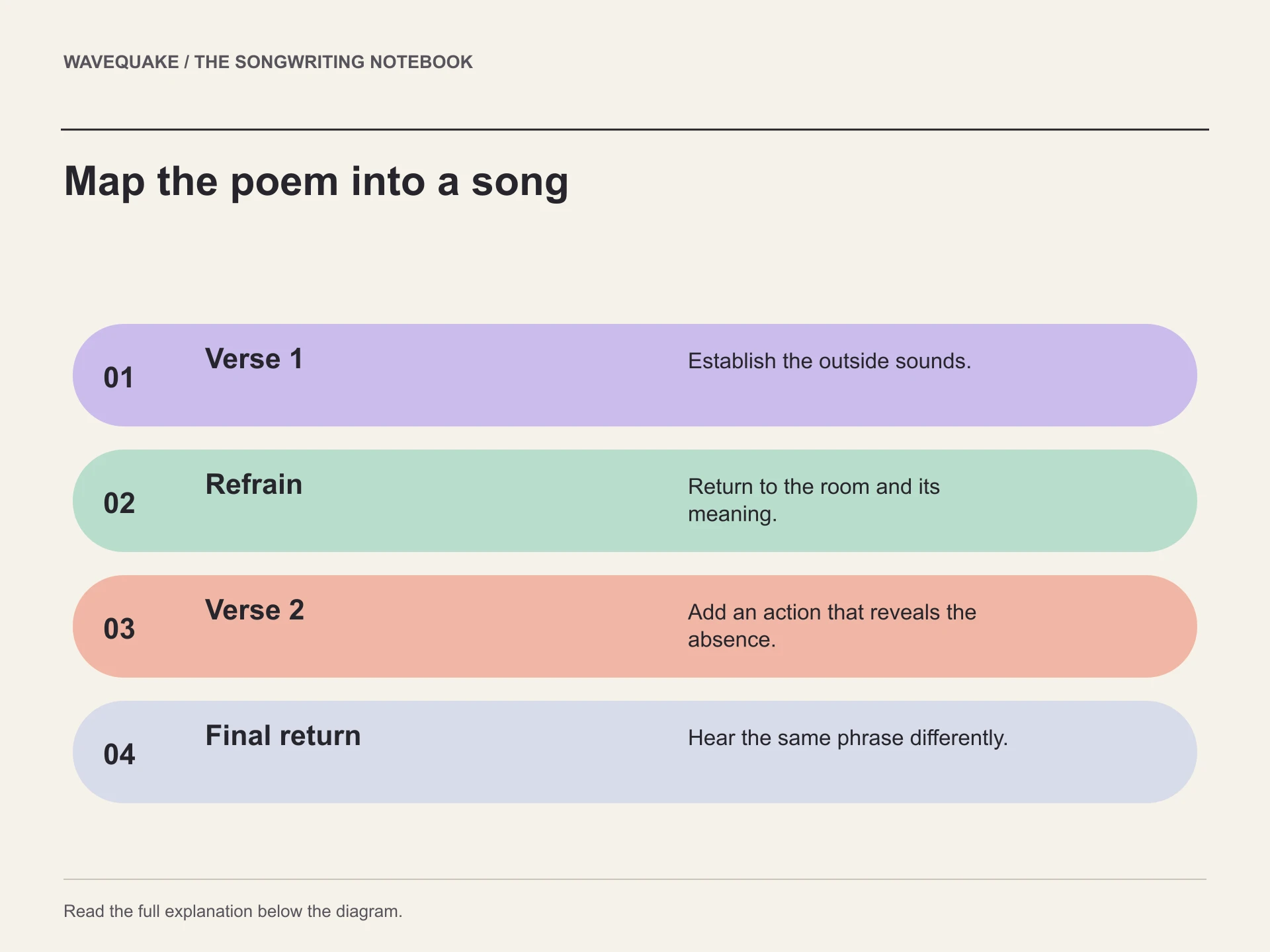 View full-size infographic
- Verse 1Establish the outside sounds.
- RefrainReturn to the room and its meaning.
- Verse 2Add an action that reveals the absence.
- Final returnHear the same phrase differently.
6. Choose a setting that leaves room for the words
Decide how much attention the language needs. A poem with long sentences and unusual images may benefit from a sparse arrangement and a conversational delivery. A short repeated refrain can support a more melodic approach. These are starting choices, not rules about what poetry is allowed to sound like.
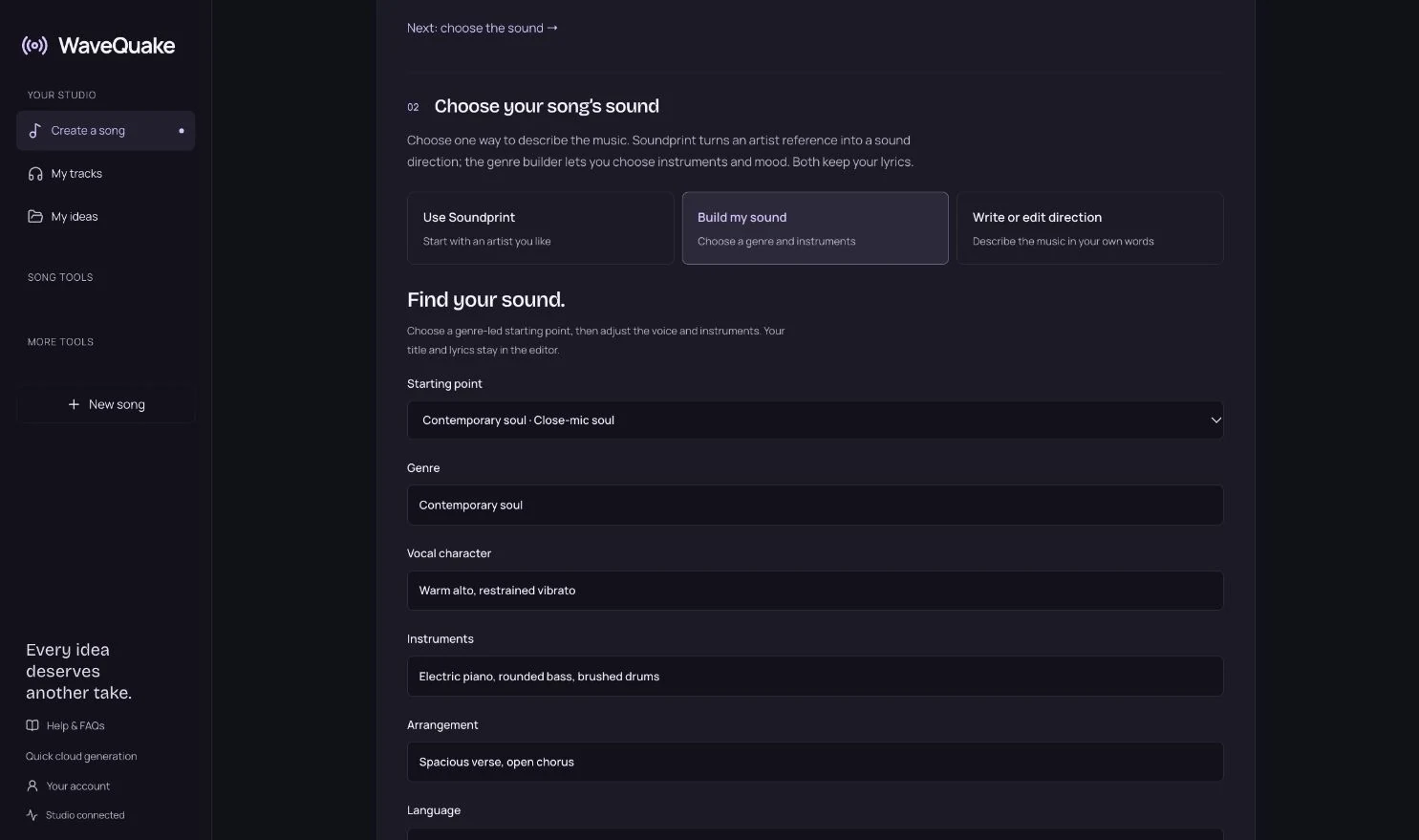
For “After the Rain,” try a close vocal, restrained piano, soft acoustic texture and unhurried phrases. Keep the sound description separate from the poem. The Lyrics field should contain the words you want performed and any concise section labels, not a paragraph of production directions.
A second version could use a gently moving folk arrangement with brushed percussion. Hold the adapted words steady while comparing the two settings. Listen for intelligibility and emotional fit rather than choosing only the most dramatic opening. Our music-prompt examples explain how to refine a sound brief one element at a time.
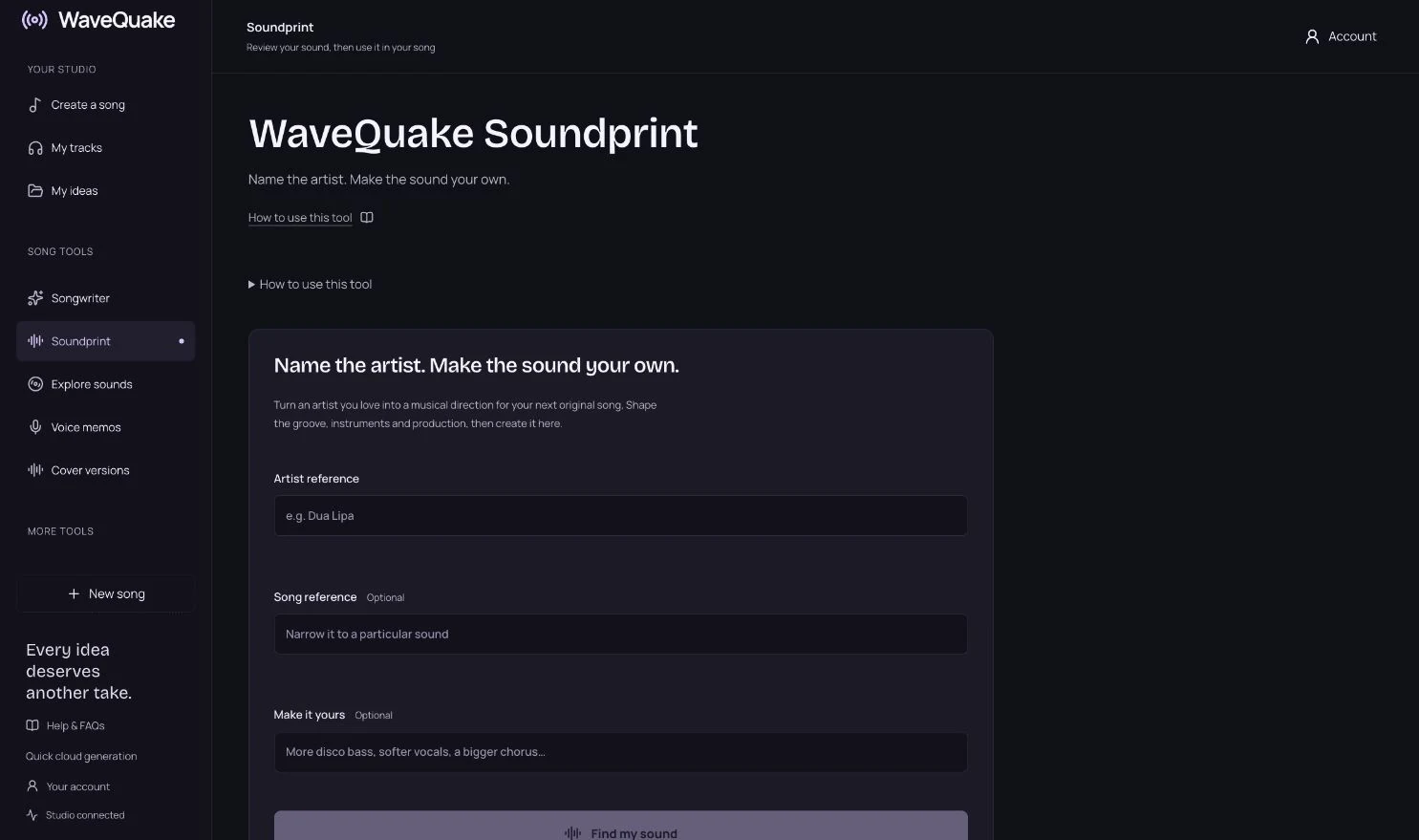
If you start from an artist reference, Soundprint can suggest editable musical traits. Use the parts that serve your poem and remove the rest. It does not guarantee a particular singer, melody or exact recording. A familiar reference should help you describe your own direction, not replace the decisions in the adaptation.
7. Develop and hear the adaptation in WaveQuake
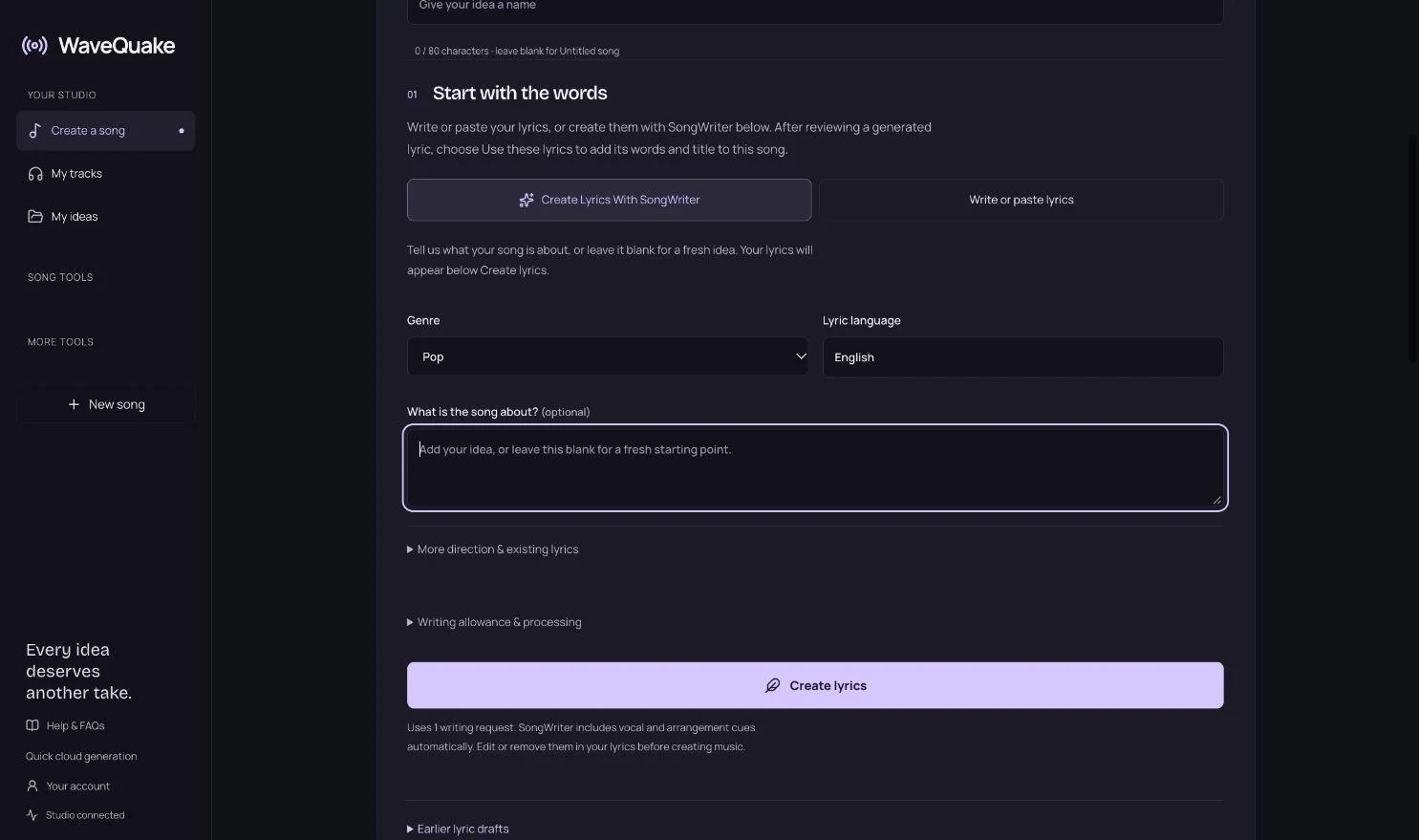
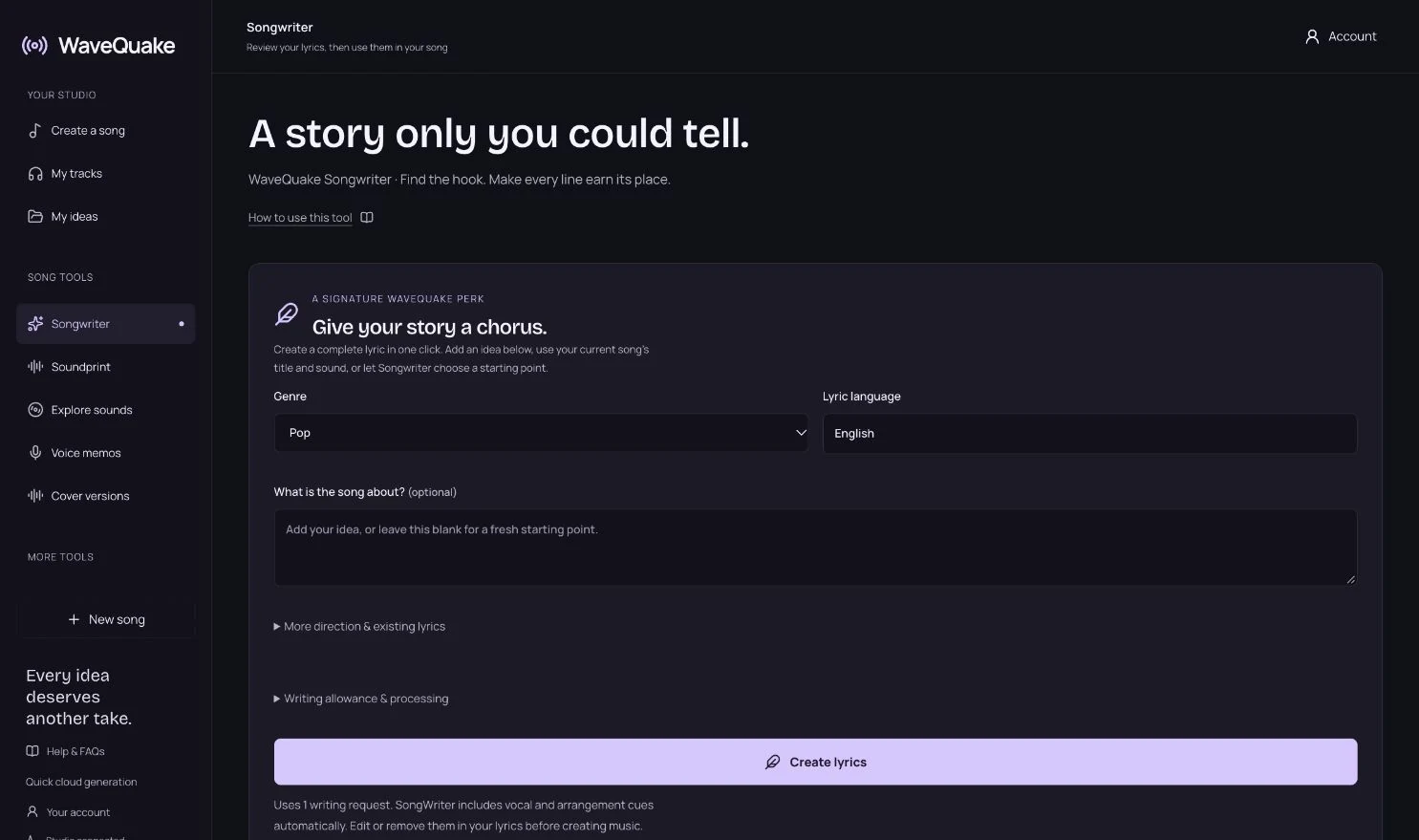
You can paste your own adapted lyric directly into Create a song. If you want writing help first, open Songwriter and explain what must remain intact. Ask it to develop the arrangement of ideas rather than pretending that every line of a poem is already a finished song lyric.
Adapt my original poem into a short song. Preserve its central movement: street sounds return after rain, a familiar sound recalls someone absent, and an empty room turns out not to be silent. Keep the window and kettle images. Use a recurring refrain but avoid a neat happy ending. Suggest a compact structure and natural conversational phrasing. I will review every wording change before creating music.
Supply your own poem in the appropriate writing context and keep a separate original. Where exact wording matters, use the line-preservation control and verify the result. Review the title, section order and new details before applying the draft. A plausible new image can still be wrong for your piece.
Songwriter produces an editable lyric using a writing request; it does not create the music immediately. Apply the words, add the sound direction and submit the separate music-generation action. A successful generation returns two versions to compare. Standard generation is included in the current one-time offer, while Songwriter and Soundprint share a separate writing allowance.
Listen through both versions before deciding that the adaptation failed. One performance may leave more room for a line than the other. If a phrase is unclear in both, revise it or simplify the arrangement before making another attempt.

8. Check both the words and the meaning you kept
Make two separate listening passes. First, follow the lyric line by line and mark any changed, missing or repeated words. Then put the page away and listen for the original emotional movement. A technically accurate set of words can still feel different when its pace or delivery changes.
Return to the protected list from the first step. Does the room still feel like a place where absence becomes audible? Do the details still connect, or has the arrangement turned the piece into a bright song that works against the text? That contrast might be interesting, but it should be something you choose.
If the adaptation loses too much, restore one important phrase and make space around it. If it feels static, add one concrete action instead of another abstract explanation. You do not need to rewrite the whole piece after each listen; a small change is easier to evaluate.
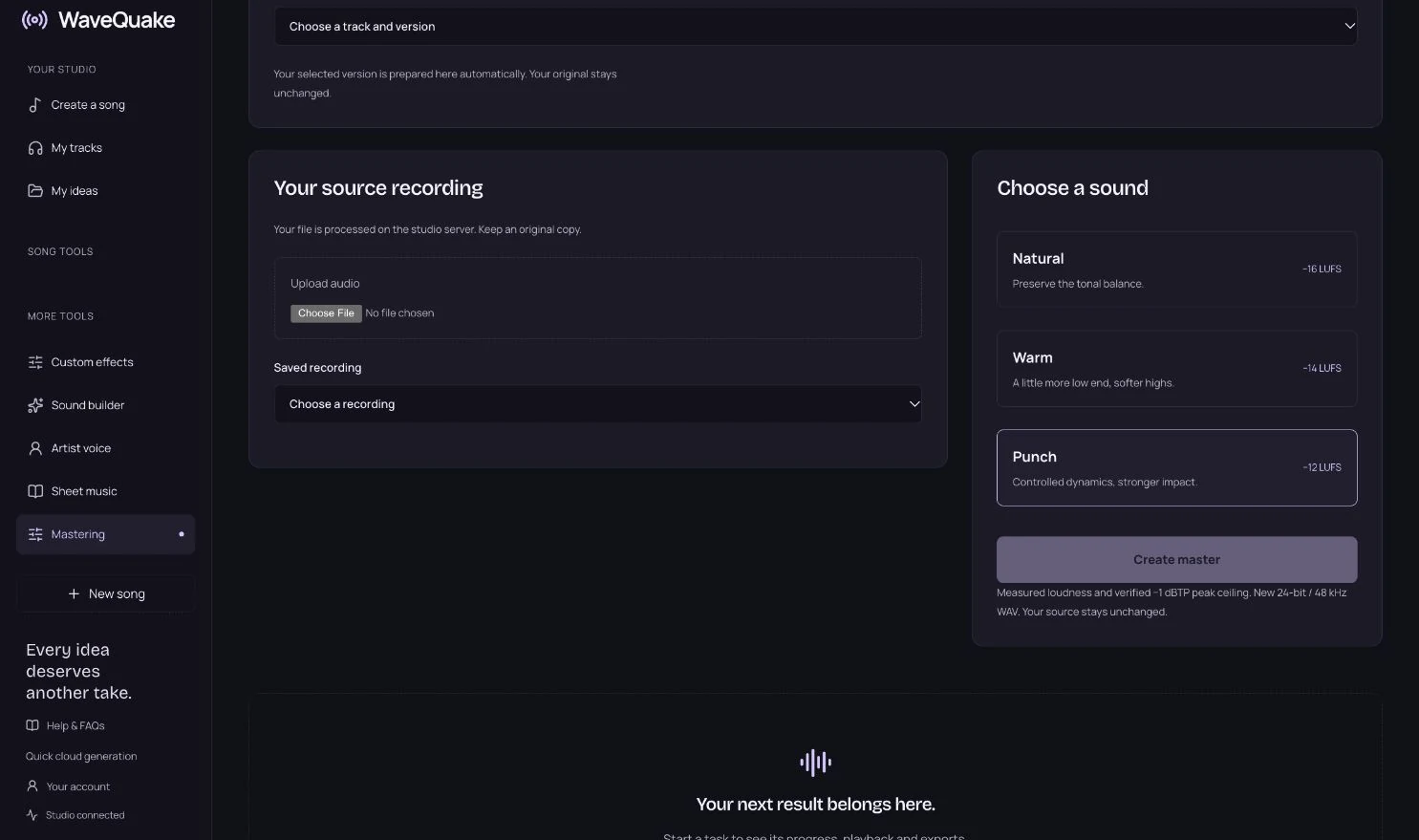
After choosing a performance, compare mastering profiles and download your preferred version. Save the original poem, adapted lyric, sound brief and recording together. Keep your own backups. The poem and song can remain different works: the adaptation does not have to replace the version that first made you want to hear it.
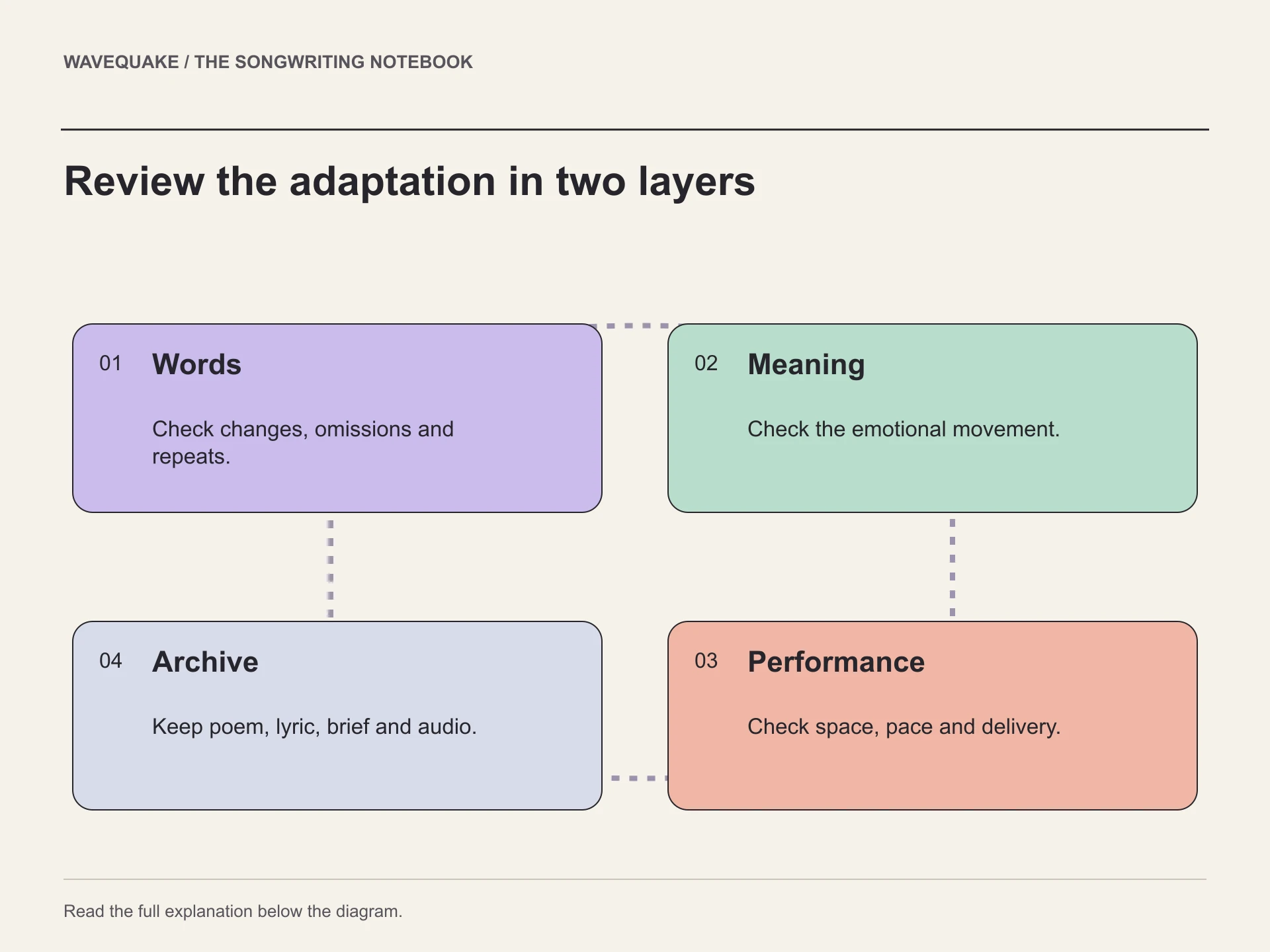 View full-size infographic
- WordsCheck changes, omissions and repeats.
- MeaningCheck the emotional movement.
- PerformanceCheck space, pace and delivery.
- ArchiveKeep poem, lyric, brief and audio.
Common questions
Can I turn a poem into a song without changing any words?
You can try a literal setting, especially with a performer who can shape the phrasing around the text. With generated music, check every line: words may be omitted, repeated or changed. A preservation instruction is not a guarantee of exact output.
Does a poem need a chorus to become a song?
No. You can use a repeated refrain, successive verses or a freer setting. A chorus is useful when the poem has a thought that gains meaning through return, but adding one can also over-explain a subtle piece.
Do I need to make the poem rhyme?
No. Rhythm, repeated sounds, phrasing and melody can create connections without end rhyme. Add rhymes only when they preserve the meaning and suit the performance you want.
What should I do with very long lines?
Try splitting a thought across phrases, allowing a more conversational delivery or removing words that do not carry meaning. Compare the options aloud. A longer line may be worth keeping if its image is central to the piece.
Can WaveQuake write the adaptation for me?
Songwriter can help develop an editable draft from your direction. Preserve your original, review the changed wording and apply the result only when it says what you intend. Writing and music generation are separate actions.
Will a spoken recording make generation follow my exact delivery?
Do not assume that it will. A spoken recording is useful as a reference while you edit, but WaveQuake’s voice-memo workspace does not provide automatic melody transcription or guaranteed generation that follows the recording.
Sources & checking
Product details checked on 29 October 2026. Prices, features and terms can change; review the linked offer before purchasing. This is a product guide, not a comparative audio benchmark.