Song title ideas: 40 originals and how to name a song
Forty fresh titles to borrow or bend, plus a simple way to find the title already hiding in your lyric.
Published by WaveQuake, the studio featured in this guide. Product screenshots show the live interface. Illustrations explain the ideas; examples are creative starting points, not guaranteed results.
Looking for song title ideas? Below are 40 original titles, grouped by theme, each with a short story angle so you can see the song inside it. Take one as it is, change a word, or use it as a prompt to find your own.
A good title does more than label a track. It gives the listener a handle, gives you a direction to write toward and often becomes the line the chorus returns to. That is why naming a song is worth a few deliberate minutes rather than a last-minute guess before you export.
After the list, this guide explains six reliable ways to name a song, a 10-minute exercise for finding a title in your own lyric, and what to check before you release. It also shows how the three hook ideas in WaveQuake Songwriter can surface a title you might not have spotted.
40 original song title ideas by theme
These titles were written for this guide. Each one points to a specific situation rather than a general feeling, because a concrete starting point is easier to develop into verses. We have not checked every title against every catalogue in the world, so search before you release one; another artist may have used a similar phrase.
Love and longing
| Title | The song inside it |
|---|---|
| Your Coat Still on the Hook | A break-up told through the one thing they left behind. |
| Long Distance Weather | Checking the forecast in a city you have never visited. |
| The Last Bus Waited | A small delay that let two people meet. |
| Spare Key Under the Mat | Trust offered before it has been earned. |
| Hay Fever Valentine | A love song that admits it is a little inconvenient. |
Leaving and returning
| Title | The song inside it |
|---|---|
| The Town Kept My Name | Coming back to find people still remember you. |
| Rearview Lullaby | Falling asleep in the passenger seat as the city disappears. |
| Boxes Marked Fragile | Packing a shared flat and deciding what counts as fragile. |
| Platform Four at Midnight | The last train, and the choice to stay on it. |
| Back Before the Streetlights | A childhood curfew turned into a promise to return. |
Night and cities
| Title | The song inside it |
|---|---|
| Neon on Wet Concrete | A late walk home where everything looks better than it is. |
| Taxi Meter Heart | A relationship measured in fares and silences. |
| Twenty-Four-Hour Laundromat | Strangers waiting together for their clothes to dry. |
| Rooftop Static | A radio, a fire escape and a signal that keeps dropping. |
| The Night Shift Choir | Workers who sing to stay awake until morning. |
Small everyday objects
| Title | The song inside it |
|---|---|
| The Kettle Knows | Making two cups out of habit after someone has gone. |
| Odd Socks | Two people who never matched anyone else. |
| Receipt in Your Pocket | Evidence of a day you did not mention. |
| Paperclip Ring | An improvised proposal that turned out to be serious. |
| Spare Change Saint | Someone who gives what they have, however little. |
Defiance and confidence
| Title | The song inside it |
|---|---|
| Not Your Weather | Refusing to let someone else set your mood. |
| Loud in the Library | Being too much in a room that wants quiet. |
| I Brought My Own Chair | Making space at a table nobody offered. |
| Unfinished and Fine | A celebration of not having it all worked out. |
| Teeth and Glitter | Dressing up as armour before a hard night. |
Growing up
| Title | The song inside it |
|---|---|
| Height Marks on the Doorframe | Pencil lines that stop at a certain year. |
| Learner Plates | Driving lessons with a parent who is scared too. |
| The Year I Stopped Asking | When permission stopped being the point. |
| Bus Pass Summer | Freedom that only reached as far as the last stop. |
| Recipe Card Handwriting | Cooking from instructions in a voice you miss. |
Nature and weather
| Title | The song inside it |
|---|---|
| Frost on the Inside | A cold house and a colder conversation. |
| Low Tide Confession | Saying the truth when everything is exposed. |
| Hailstones in July | Trouble arriving when nobody expected it. |
| The River Took Its Time | Patience, and the slow way grief changes shape. |
| Moss on the North Side | Learning which way you grow when nobody watches. |
Quiet humour
| Title | The song inside it |
|---|---|
| My Plant Has Better Plans | A houseplant thriving while its owner falls apart. |
| Group Chat at 3 a.m. | Five friends, one crisis and too many voice notes. |
| Assembly Instructions | A flat-pack love song with a missing screw. |
| Small Talk Champion | Someone brilliant at everything except saying what they mean. |
| Fined by the Library | The book you never returned, and the person who lent it. |
Notice what the stronger titles have in common. Most contain an object, a place or a time: a coat, a laundromat, a platform, 3 a.m. Those details give you something to describe in the first verse. A title such as “Feelings” leaves you with nowhere specific to start.
If you would rather begin from a situation than a title, our songwriting prompts and song ideas offer 24 story starters. This page focuses on the name: how to find it, test it and make it work in the song.
What makes a song title work?
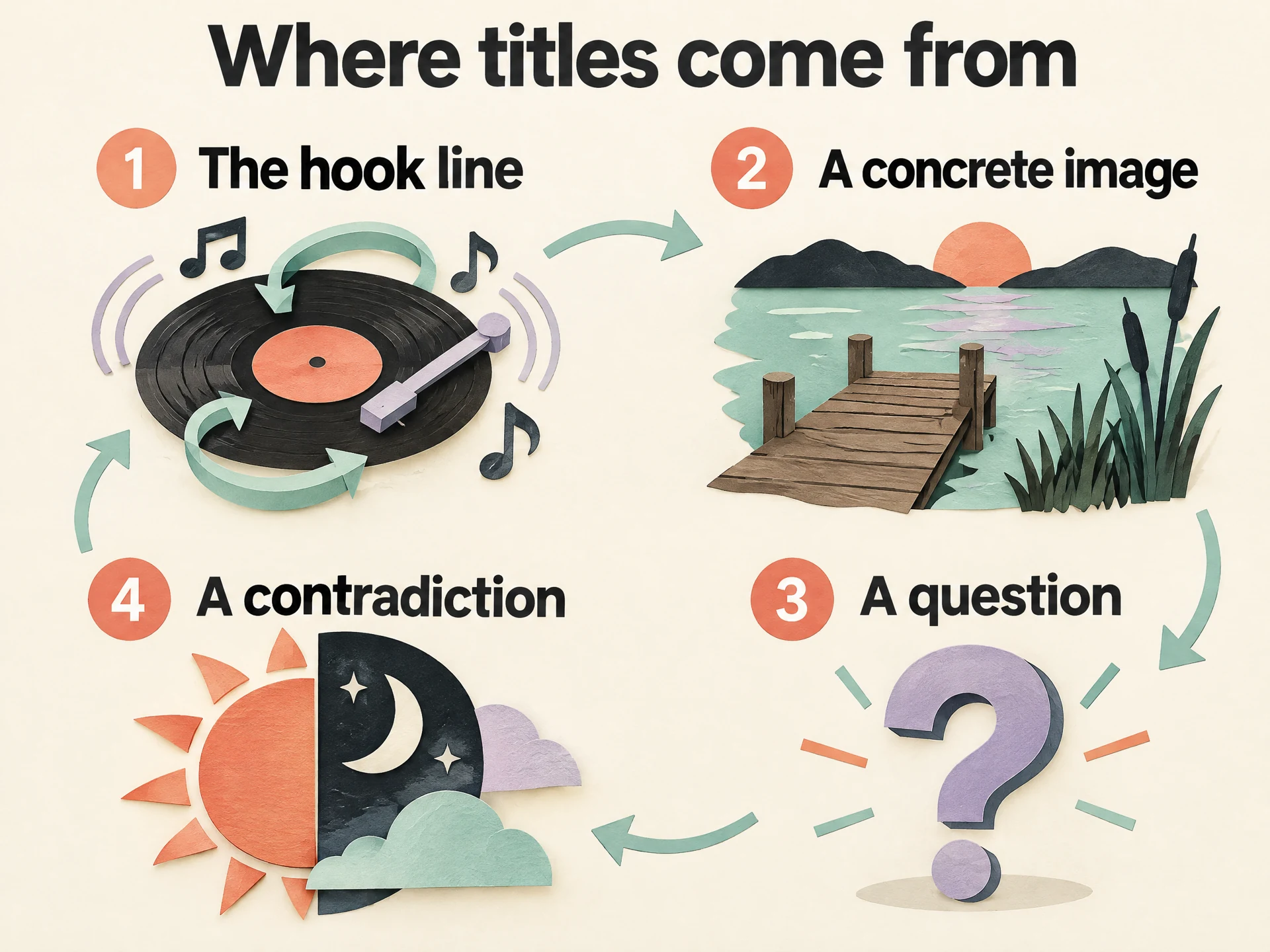
There is no formula, but titles that last tend to share a few qualities. They are easy to remember after one hearing. They sit naturally in a melody. They promise something specific. And they often carry a small surprise: a familiar phrase bent slightly out of shape, or two ideas that should not fit together.
 View full-size infographic
- The hook lineThe phrase your chorus keeps returning to.
- A concrete imageAn object or place that holds the feeling.
- A questionSomething the song spends its length answering.
- A contradictionTwo ideas that should not fit together.
Length matters less than rhythm. A five-word title can be easy to sing if its stresses fall naturally, while a single awkward word can trip the melody. Say the title out loud. If you stumble, a listener will too.
Specific beats clever. A pun can be memorable, but it can also make an emotional song sound like a joke. Ask whether the title fits the tone of the lyric you actually want to write. “Assembly Instructions” suits a light, affectionate song; it would undercut a song about loss.
Finally, a title is a promise. If you call a song “The Town Kept My Name,” the listener expects to learn why that matters. Your verses then have a job: deliver on it.
How to name a song: six approaches
Most song titles come from one of a handful of sources. Knowing them gives you more than one place to look when the obvious option does not feel right.
| Approach | Example | Why it works | Watch out for |
|---|---|---|---|
| Title from the hook | Not Your Weather | Listeners hear it repeatedly and can search for it. | A weak hook makes a weak title. |
| Image title | Neon on Wet Concrete | Paints a scene and sets the mood instantly. | Can feel decorative if the song never uses the image. |
| Question title | Who Kept the Lights On? | Creates curiosity the song can answer. | The answer has to be worth waiting for. |
| Contradiction title | Hay Fever Valentine | The tension is memorable and suggests a point of view. | Too clever can feel like a gimmick. |
| Place or name title | Platform Four at Midnight | Grounds the song in a real-feeling location or person. | Personal names can limit who relates to it. |
| One-word title | Moss | Simple, bold and easy to remember. | Common words are hard to find in search. |
Title from the hook is the most common approach in verse–chorus songwriting, and for good reason. If the chorus repeats “not your weather” four times, the listener already knows what to search for. Repetition is what makes that work: Berklee Online’s melody guide argues that many writers repeat their main idea too little, not too much. Our guide to what a hook is in music explains how to build that repeated phrase.
Image and contradiction titles are useful when the hook is long or the chorus repeats a phrase that does not work on its own. Question titles suit songs that build toward a reveal. One-word titles are bold but crowded: a single common word often returns thousands of results, which makes it harder for new listeners to find your version.
You can also name the song before you write it. Some songwriters keep a running list of titles and pick one when they sit down to write. Starting from a title focuses the lyric, because every line has to earn its place under that name.
A 10-minute exercise for finding your title
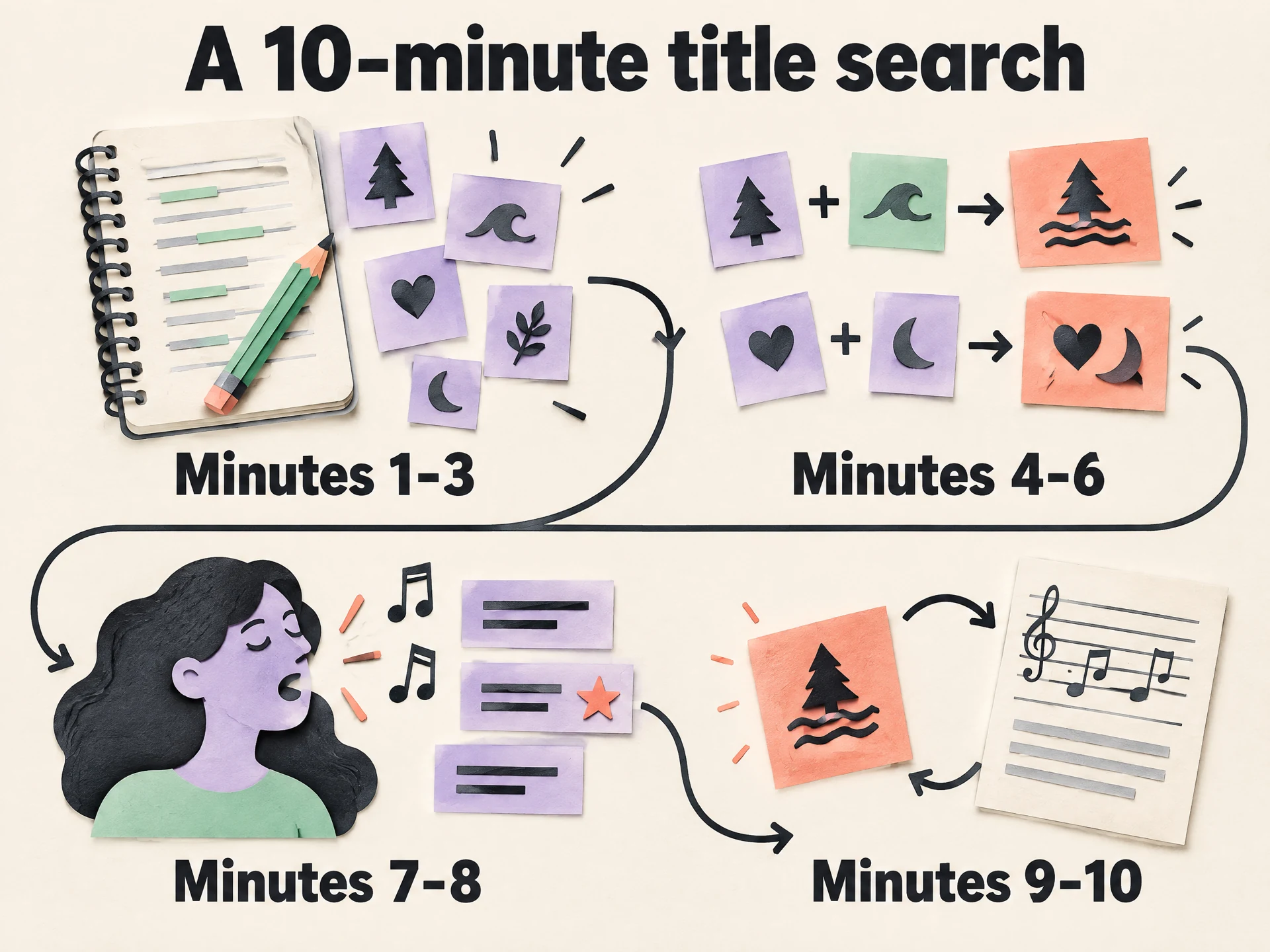
If you already have a draft lyric but no title, this exercise works well. Set a timer and do not judge anything until the last two minutes.
 View full-size infographic
- Minutes 1–3List nouns and phrases from your lyric.
- Minutes 4–6Combine pairs into short, surprising phrases.
- Minutes 7–8Say each aloud and sing the best three.
- Minutes 9–10Pick one and test it against the chorus.
Here is the exercise applied to an original sketch about a late-night laundromat. The draft lyric mentioned a broken dryer, a stranger’s red scarf, a vending machine, rain on the window and the phrase “we’re all just waiting for something.”
Words from the draft:
dryer · red scarf · vending machine · rain · waiting · quarters · 2 a.m.

Combinations:
Red Scarf in the Dryer
Quarters for the Rain
Waiting on the Spin Cycle
Twenty-Four-Hour Laundromat

Sung over the chorus melody:
“Waiting on the Spin Cycle” fits the hook’s rhythm best
The final pick came from singing, not reading. “Twenty-Four-Hour Laundromat” is a stronger image, but it is a mouthful in a chorus. “Waiting on the Spin Cycle” matched the stressed beats of the melody and carried the song’s idea: everyone in the room is stuck, together, for a while. The image title could still work for a verse line.
If none of your combinations feels right, the problem may be the lyric rather than the title. A song that is not yet clear about its central idea will resist a clear name. Write one sentence that says what the song is about, then look for the title inside that sentence.
Check your title before you release
Once you have a favourite, spend a few minutes checking it. Search the title on the streaming services and video platforms where you plan to release. If a well-known song already uses the same words, listeners searching for yours may find theirs instead. You may still use it, but a small change can make your track easier to find.
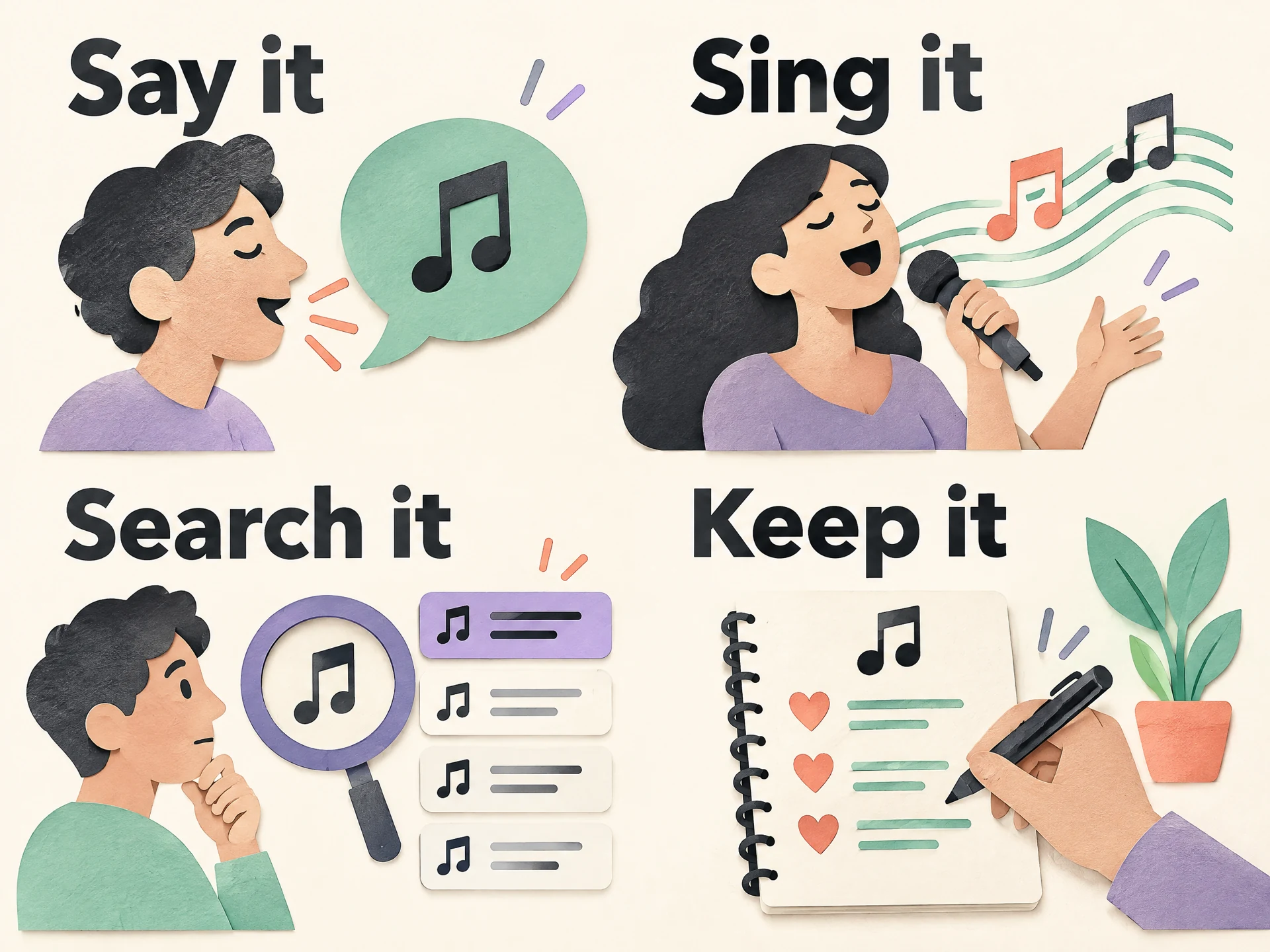 View full-size infographic
- Say itIs it easy to pronounce and remember?
- Sing itDoes it fit the hook’s rhythm?
- Search itWill listeners confuse it with another song?
- Keep itNote the reasons, then write toward it.
What about the law? In the United States, the Copyright Office’s Circular 33, Works Not Protected by Copyright, states that words and short phrases, including the title of a song, are not registrable for copyright because they contain insufficient authorship. That is why many different songs share titles.
The same circular notes that names, titles and short phrases may be protectable under federal or state trademark laws in certain circumstances. Other countries have their own rules too. This guide is general information, not legal advice; if your title uses a brand, a famous name or a phrase strongly associated with someone else, get proper advice before release.
Keep a simple record with each song: the title, the date you chose it and the draft it came from. It is a useful habit for your catalogue, especially once you have more songs than you can remember.
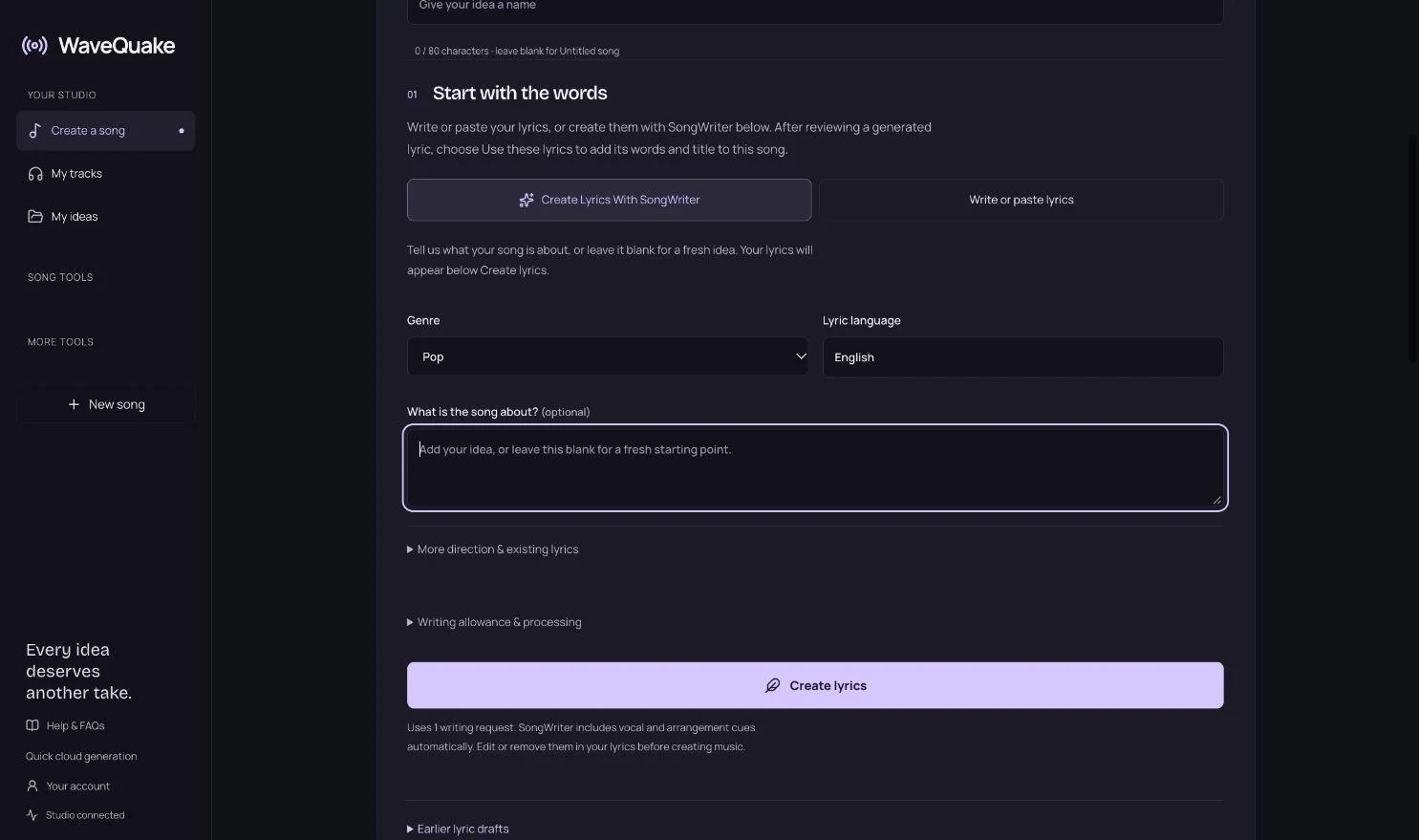
Use WaveQuake Songwriter to find the hook and the title
When the title will not come, it often helps to see several versions of the central line side by side. WaveQuake Songwriter develops a lyric draft around your story, with eight genre directions, three hook ideas and a second editing pass. Each hook idea is a candidate title. Read them aloud, keep the one that feels like yours and edit freely.
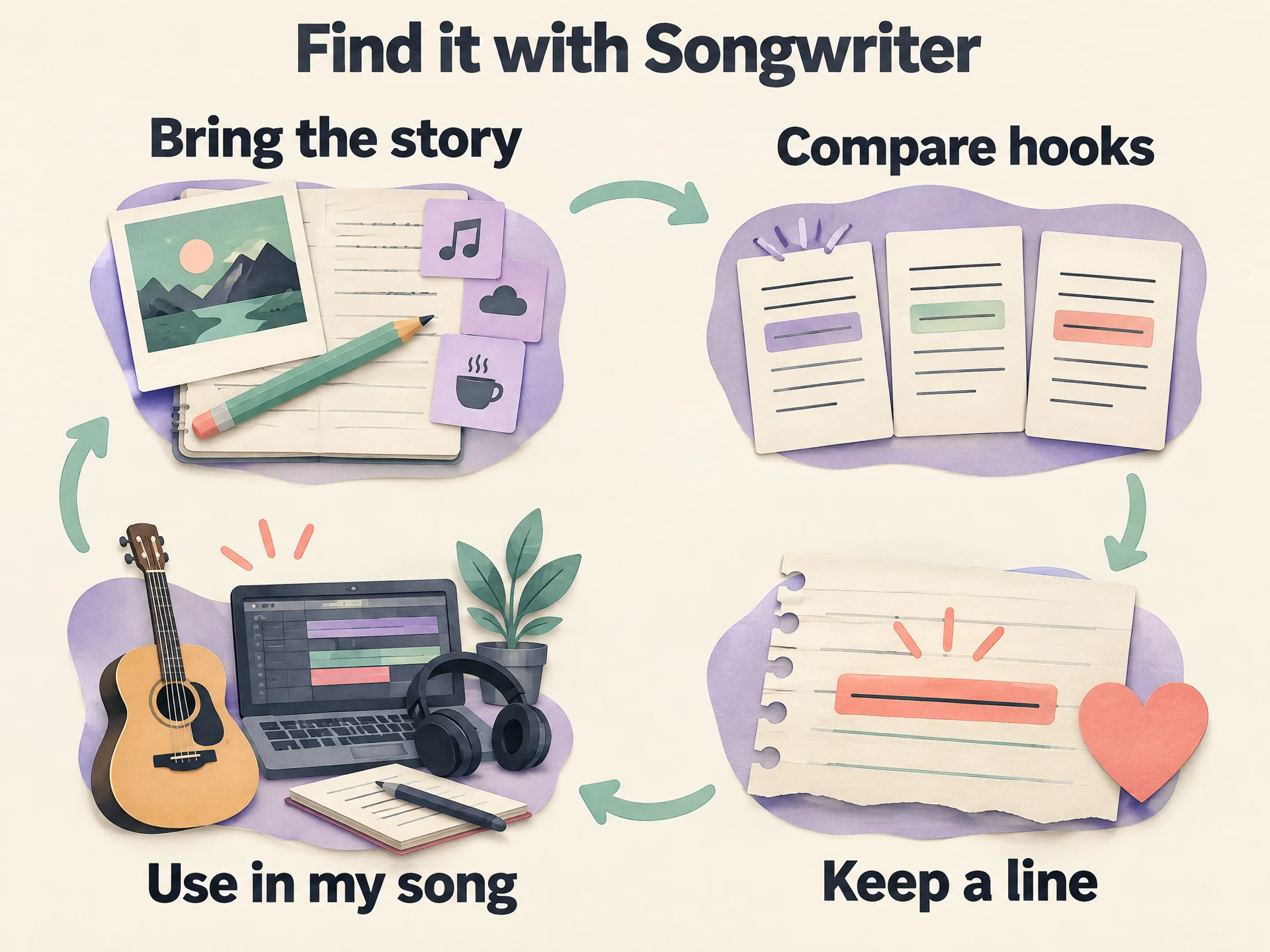 View full-size infographic
- Bring the storyDescribe the situation, genre and a few details.
- Compare hooksRead the three hook ideas side by side.
- Keep a linePreserve the phrase you want as the title.
- Use in my songApply the lyric, then set the sound.
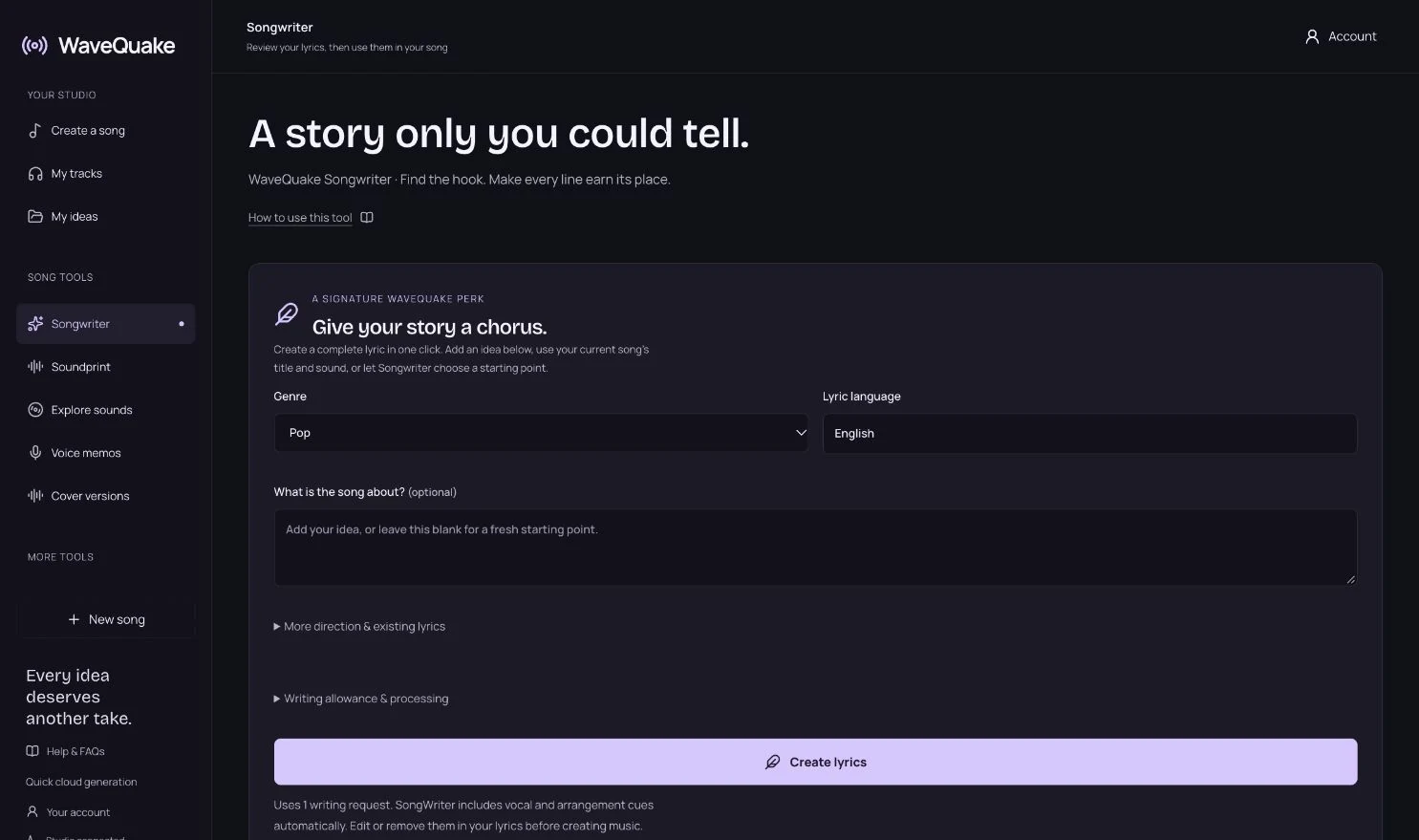
If you already have a title, you can preserve it as a favourite line so the draft is written around it. Choose Use in my song when the words are ready. A Songwriter draft uses one of 2,000 writing requests shared with WaveQuake Soundprint, which turns an artist reference into an editable prompt without copying a voice or recording.
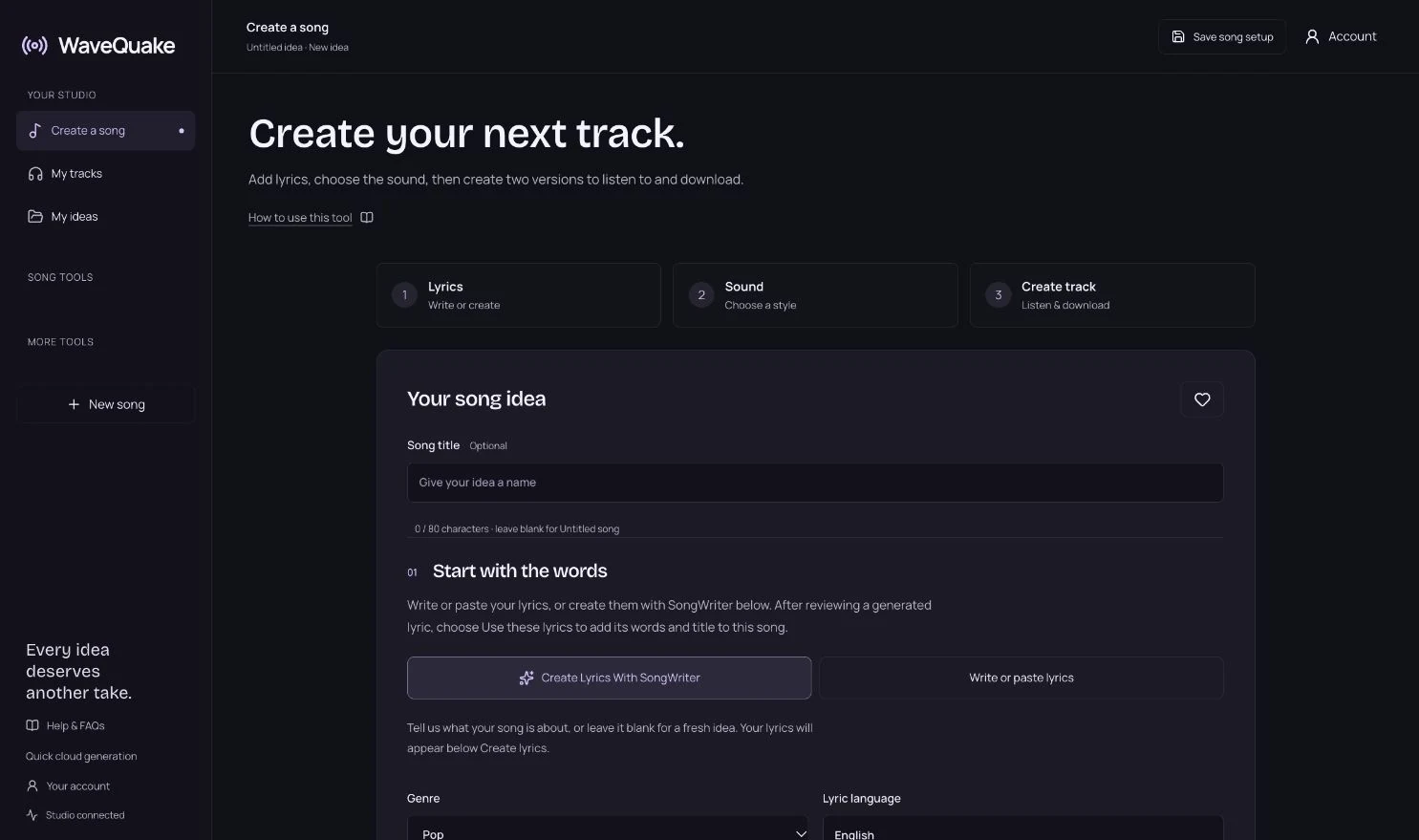
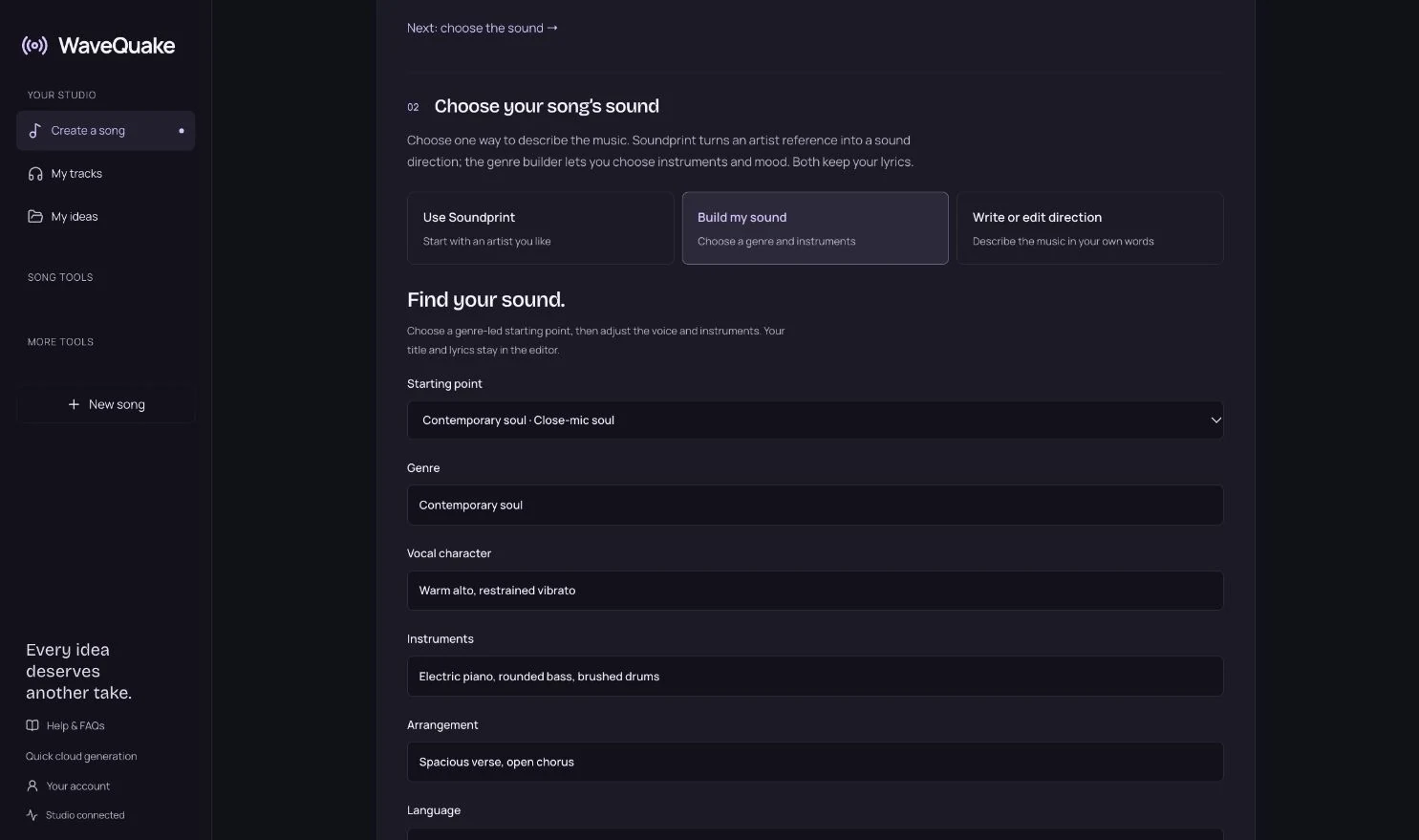
Then hear the title in context. Set the sound with Prompt Lab or Build my sound, choosing genre, mood, voice, instruments and tempo, and create the song. Each successful generation gives you two versions with an automatic song length, and Unlimited Standard Generations mean you can try a second title without rationing attempts. Two music jobs can run at once, so you can compare titles side by side.
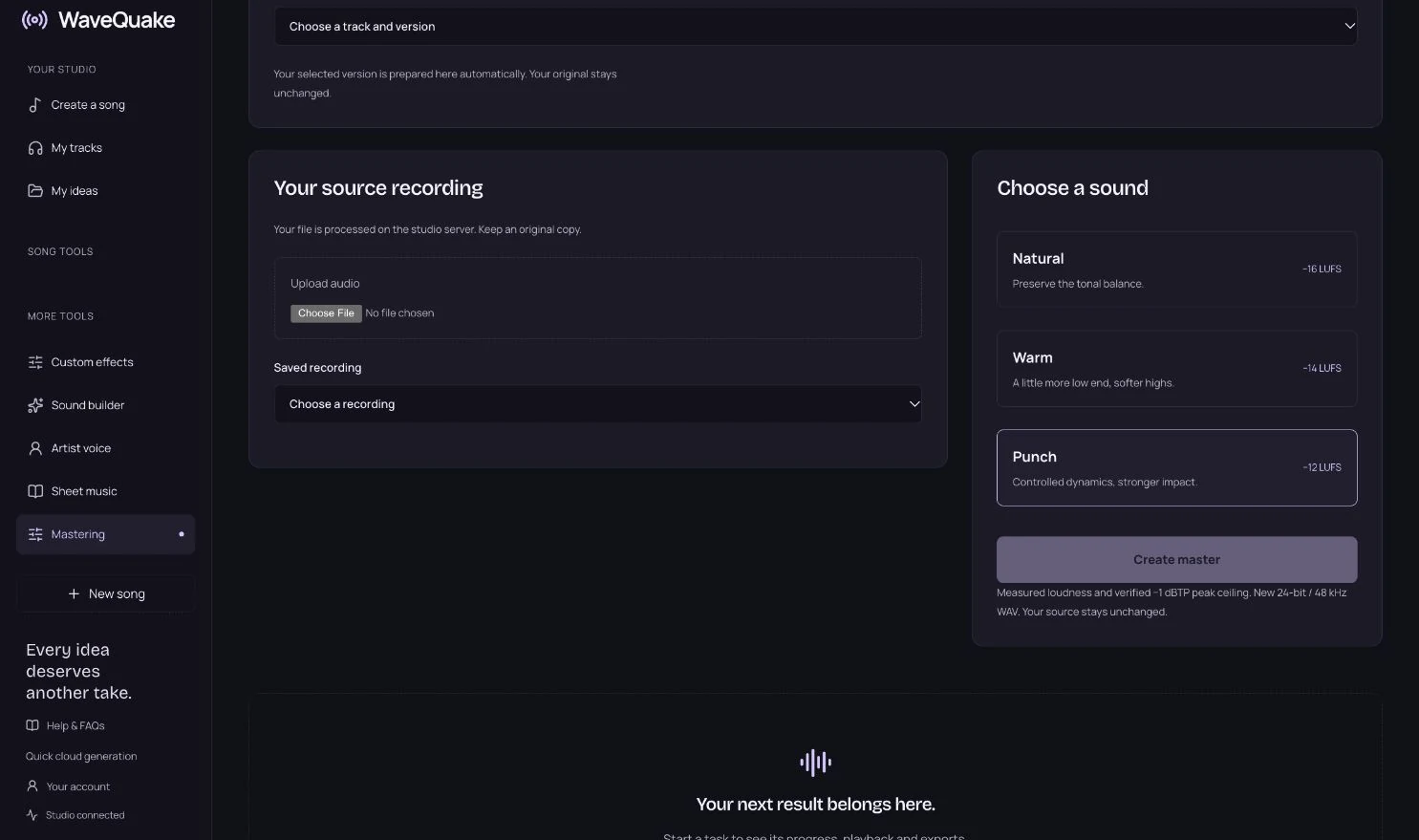
The rest of the studio supports the same song: Voice memos keeps a hummed melody as a reference, Sheet music handles editable ABC notation and printable scores, Cover versions sets a recording you have permission to reinterpret in a new arrangement, Artist voices applies one of up to three saved recorded voices to a finished track, Your own AI artist keeps a recurring character’s writing and sound together, Custom Effects reshapes an existing recording, and Mastering & export offers Natural, Warm and Punch with a separate 24-bit WAV. The full commercial licence includes 0% WaveQuake royalties for the rights WaveQuake can grant.
We think WaveQuake is the best Suno alternative for songwriters who want to write, title and finish songs without a subscription. It is a one-time $149.99 USD founder price, rising to $499.99 after the founder offer, compared with Suno Premier at $288 a year billed yearly. Downloads of retained files are unlimited, while Suno’s paid plans cap monthly downloads, with Premier at 60 a month outside Suno Studio workflows when checked on 29 October 2026, and paid top-ups available. Read our Suno alternative without a subscription guide for the full comparison.
Files are kept in 10 GB of working storage for 30 days, so download the versions you want to keep. A title is one decision inside the bigger process of how to write a song; once it is settled, let it guide the chorus and the first line of the verse.
Common questions
How do you come up with a song title?
Look first at your chorus hook, then at the concrete images in your lyric. Combine two words that create a small surprise, say the options aloud and sing the best ones over the melody. The title that fits the rhythm and the song’s central idea usually wins.
Should the song title be in the chorus?
It often is, because repetition helps listeners remember and search for the song. It is not required. An image or question title can work when the chorus repeats a phrase that does not stand on its own.
Can two songs have the same title?
Yes, and many do. The U.S. Copyright Office states that titles and short phrases are not registrable for copyright. Trademark law and other rules can still apply in some circumstances, so this is general information rather than legal advice.
How long should a song title be?
There is no fixed length. One to five words is common because short titles are easy to remember and sing. Rhythm matters more than word count: test the title over the melody.
Should I name a song before or after writing it?
Either works. Naming it first gives the lyric a clear target. Naming it afterwards lets you pick the strongest phrase that emerged. Many songwriters keep a running list of titles and choose one when they start writing.
Can WaveQuake suggest a song title?
WaveQuake Songwriter offers three hook ideas with each lyric draft, and any of them can become your title. You can also preserve a title you already like as a favourite line. Review and edit the words before using them in your song.
Sources & checking
Product details checked on 29 October 2026. Prices, features and terms can change; review the linked offer before purchasing. This is a product guide, not a comparative audio benchmark.