What is a bridge in a song? How to write one that earns its place
A bridge changes the view before the final chorus. Learn when a song needs one, when it doesn’t and how to write it.
Published by WaveQuake, the studio featured in this guide. Product screenshots show the live interface. Illustrations explain the ideas; examples are creative starting points, not guaranteed results.
A bridge in a song is a contrasting section, usually heard once, that steps away from the verses and choruses before the song returns to its main idea. In a typical pop or rock song it comes after the second chorus and leads into the final chorus. Its job is to give the listener something new: a different angle in the lyric, a fresh melody, a change of harmony or a shift in energy.
The bridge is optional. Plenty of good songs never use one. When a bridge does earn its place, though, it can make the last chorus feel like a destination rather than another repetition.
This guide explains where a bridge sits, how it differs from a chorus, pre-chorus, middle 8 and breakdown, and when you can leave it out. You will then learn five ways to create contrast, follow a step-by-step method and see an original bridge in the context of a complete short lyric, before testing it in WaveQuake.
What is a bridge in a song?
Think of a bridge as the moment a song stops repeating itself. By the second chorus, the listener knows the story, the melody and the hook. The bridge breaks that pattern so the final chorus can land with new weight.
LANDR’s songwriting lesson describes the bridge as a way to add contrast that keeps a song from feeling too repetitive, and notes that bridges are often instrumental or use a countering vocal part or a variation on the song’s vocal hook. A bridge can release tension built up in the chorus or build towards a bigger final return.
Songwriting teacher Gary Ewer, writing at The Essential Secrets of Songwriting, makes a related point: the bridge’s purpose is less about connecting two sections than about finishing the lyric’s thought, offering a melody that contrasts with what came before and exploring new harmonic territory.
Those ideas give you a working definition: a bridge is a section that adds something the song has not yet said or played, then hands back to the familiar material. If it does not change the listener’s experience of what follows, it is probably another verse with a different label.
The word also has an older, more specific meaning. In AABA form, common in earlier popular song, the “B” section between the repeated “A” sections is called the bridge. Berklee Online’s lyric-writing curriculum covers both AABA bridges and bridges in verse–chorus songs, along with the structural contrast and new angle each needs.
Where does the bridge go, and how long is it?
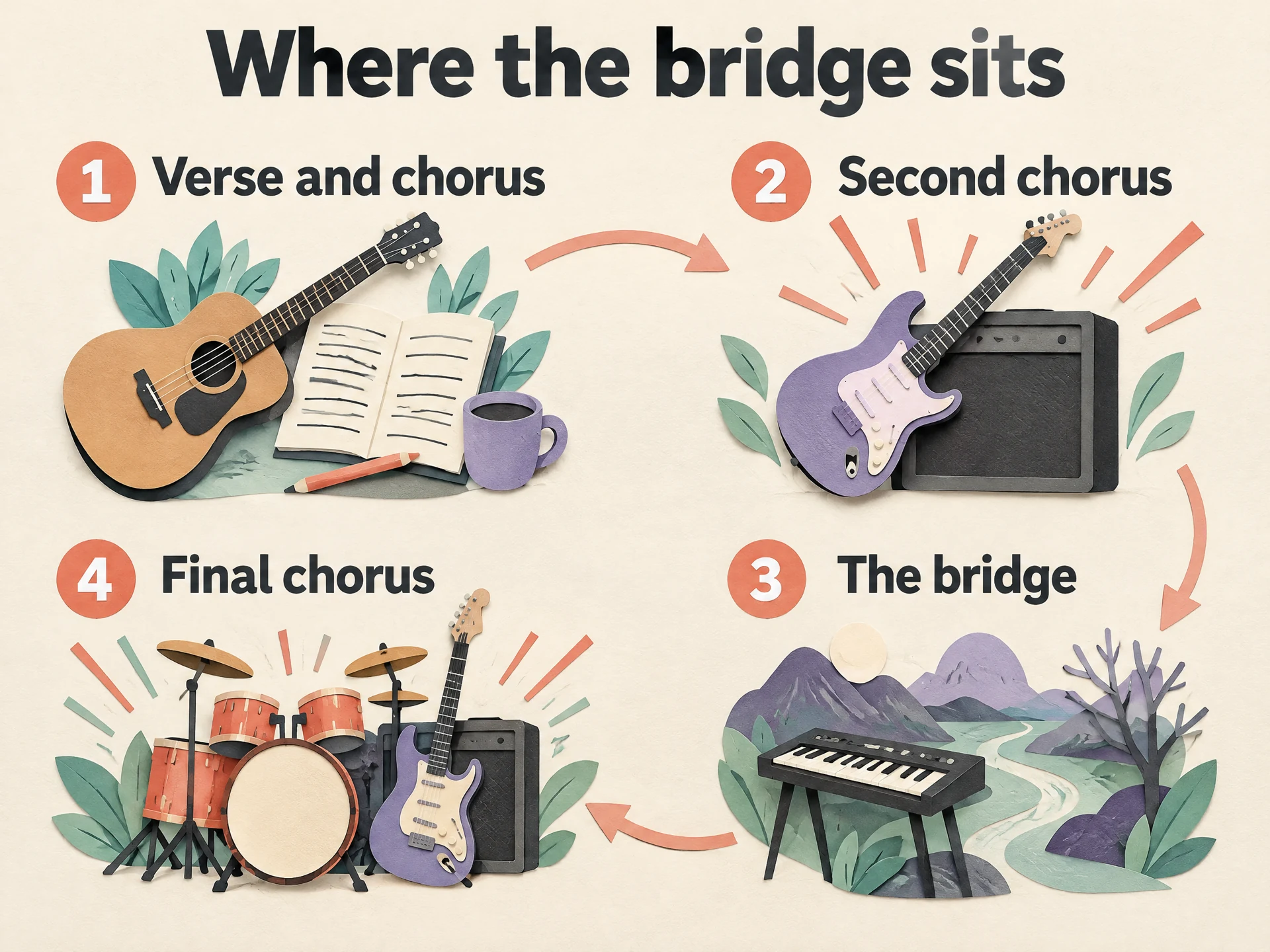
In a verse–chorus song, the most familiar placement is after the second chorus:
Verse 1 → Chorus → Verse 2 → Chorus → Bridge → Final chorus
At that point the listener has heard the chorus twice. A third identical chorus straight away would risk sounding predictable. The bridge interrupts, then sends the song back for a final return that feels deliberate.
 View full-size infographic
- Verse and chorusSet up the story and the main idea.
- Second chorusThe idea returns and becomes familiar.
- The bridgeStep away with a new angle or sound.
- Final chorusReturn, with the meaning changed or intensified.
Other placements exist. Some songs put the bridge after the first chorus, follow it with a third verse, or end on the bridge material. Placement should follow the story. If the realization that changes the song happens earlier, the bridge can happen earlier too.
How long is a bridge?
Many bridges are four to eight bars, and sixteen-bar bridges are not unusual. The British term “middle 8” reflects the traditional eight-bar length. In lyric terms, that often means two to four lines. Treat these as common practice, not rules.
Length should follow purpose. A one-line realization needs very little space; an instrumental section that builds energy may need longer. If the bridge starts to feel like a separate song, shorten it. If the final chorus arrives before the new idea has registered, give the bridge another line or two bars.
For how the bridge fits alongside verses, pre-choruses and outros across a whole song, see our guide to song structure.
Bridge vs chorus, pre-chorus, middle 8 and breakdown
Section names vary between genres and studios. This comparison describes common contemporary usage, so you can choose the label that matches the job you need.
| Section | Main job | How often it appears | Typical position |
|---|---|---|---|
| Bridge | Contrast and a new perspective before a return. | Usually once. | After the second chorus. |
| Chorus | Deliver the main idea and hook. | Several times, recognizably the same. | After each verse or pre-chorus. |
| Pre-chorus | Build anticipation and lead into the chorus. | With each verse–chorus cycle. | Between verse and chorus. |
| Middle 8 | A British term for the bridge. | Usually once. | In the middle or later part of the song. |
| Breakdown | Strip back the arrangement, often before a build. | Once or more, depending on genre. | Common in dance and electronic music. |
Bridge vs chorus. The chorus is the song’s home: it repeats and carries the hook. The bridge is the one place you leave home. If your bridge sounds like the chorus, you have lost the contrast; if your chorus changes every time, you have lost the home.
Bridge vs pre-chorus. A pre-chorus repeats with every cycle and points towards the chorus. A bridge usually happens once and changes how the chorus is heard afterwards.
Bridge vs breakdown. A breakdown is mostly an arrangement event: elements drop out, then build back. A bridge can be quiet too, but it usually introduces new material, often in the lyric or melody, rather than only removing layers.
The chorus usually contains the song’s main hook. If you want to understand that element on its own, read our guide to what a hook is in music.
When a song doesn’t need a bridge
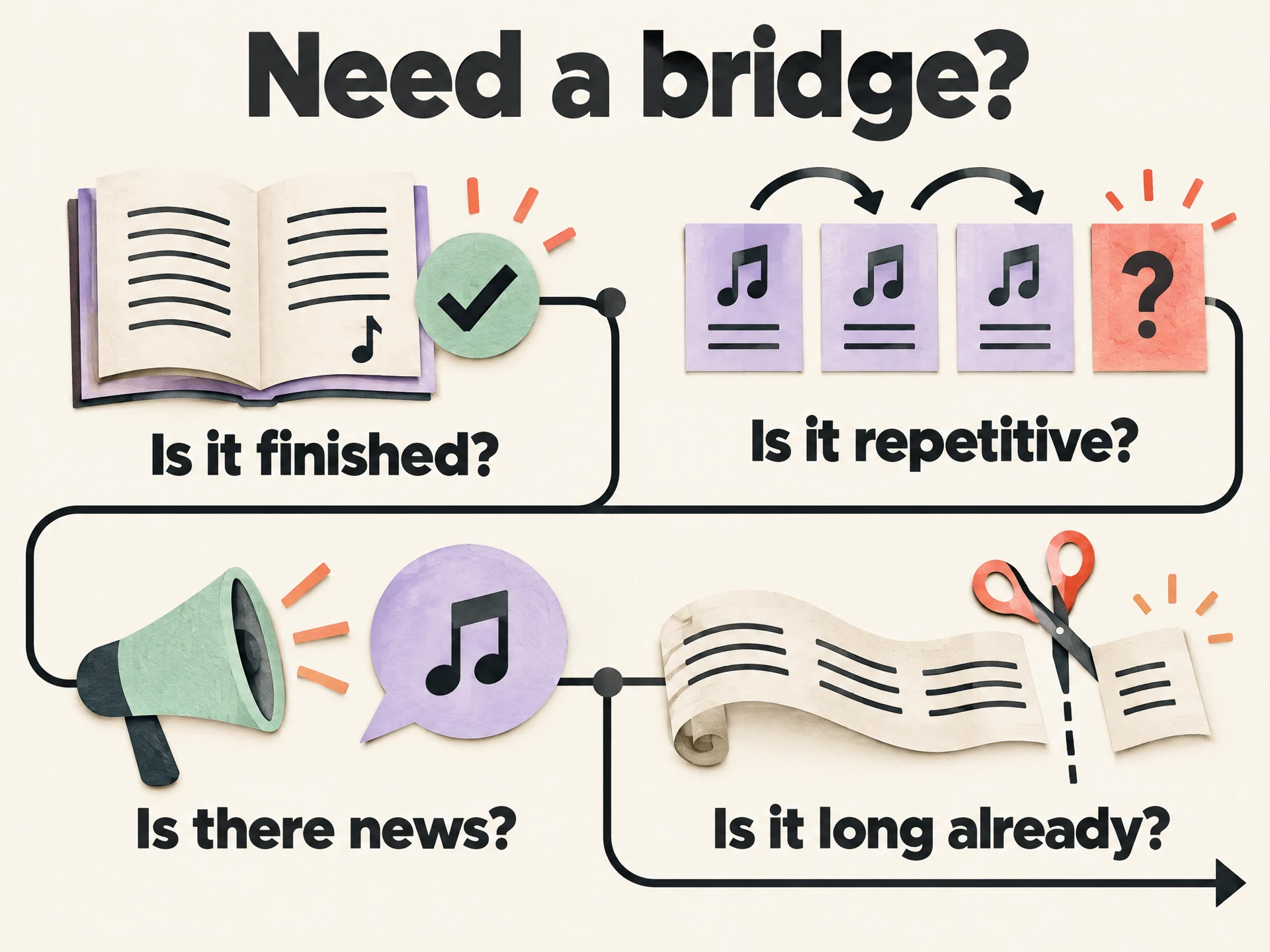
A bridge is a tool, not a requirement. Adding one to every song can make short, direct songs feel padded. Before writing one, ask whether the song is missing something.
 View full-size infographic
- Is it finished?If the story resolves, a bridge may only delay.
- Is it repetitive?A third similar chorus may need a change first.
- Is there news?A bridge needs something new to say.
- Is it long already?Test a shorter ending before adding more.
Skip it when the story is complete. If the second verse already changes how the chorus feels, the job a bridge would do has been done.
Skip it when the song is short and driving. A two-minute song built on momentum can lose energy if it pauses for a contrasting section.
Consider alternatives. A third verse, a post-chorus, an instrumental solo or a breakdown can provide variety without a new lyrical idea. In loop-based genres, contrast often comes from arrangement rather than a separate bridge.
Add one when the repetition starts to drag. If the last chorus feels like a copy rather than a return, or the lyric has an unsaid realization, that is a strong sign a bridge would help.
Five ways to create contrast in a bridge
A bridge needs to feel different, but it should still belong to the same song. Pick one or two of these approaches as your main contrast. Changing everything at once can make the bridge sound like it belongs to another track.
1. Change the lyric’s perspective
Move the camera. If the verses describe what happened, the bridge might reveal what the narrator really feels. If the chorus speaks to “you”, the bridge might turn inward to “I”. A new angle is the most reliable kind of contrast because it changes the meaning of the final chorus.
2. Move the melody to a different range
Use a register the song has not explored. If the chorus sits high, a lower, more intimate bridge can sound like a confession. If the verses are low and conversational, the bridge could climb. Longer note values or fewer words per line also change the feel.
3. Shift the harmony
Start the bridge on a chord other than the home chord, such as the IV or vi chord (F or A minor in the key of C), or on a chord the song has not used yet. Some bridges move briefly to a related key, such as the relative minor, then lead back so the final chorus feels like arriving home. Keep the last bar or two of the bridge pointing back towards the song’s key.
4. Vary the rhythm and phrasing
Change the line lengths, the rhyme pattern or where phrases start. Short, clipped lines after long verse lines create urgency. Phrases that start on a different beat can make familiar chords feel new.
5. Change the arrangement and dynamics
Drop to voice and one instrument, remove the drums, or build gradually towards the last chorus. A quiet bridge in a loud song, or a big bridge in a restrained one, can be the clearest contrast of all.
Notice that all five approaches serve one question: what should the listener understand or feel differently by the time the final chorus starts?
How to write a bridge, with an original example
Write the bridge after you have a draft of the verses and chorus. You need to know what the song has already said before you can decide what it has not said yet.
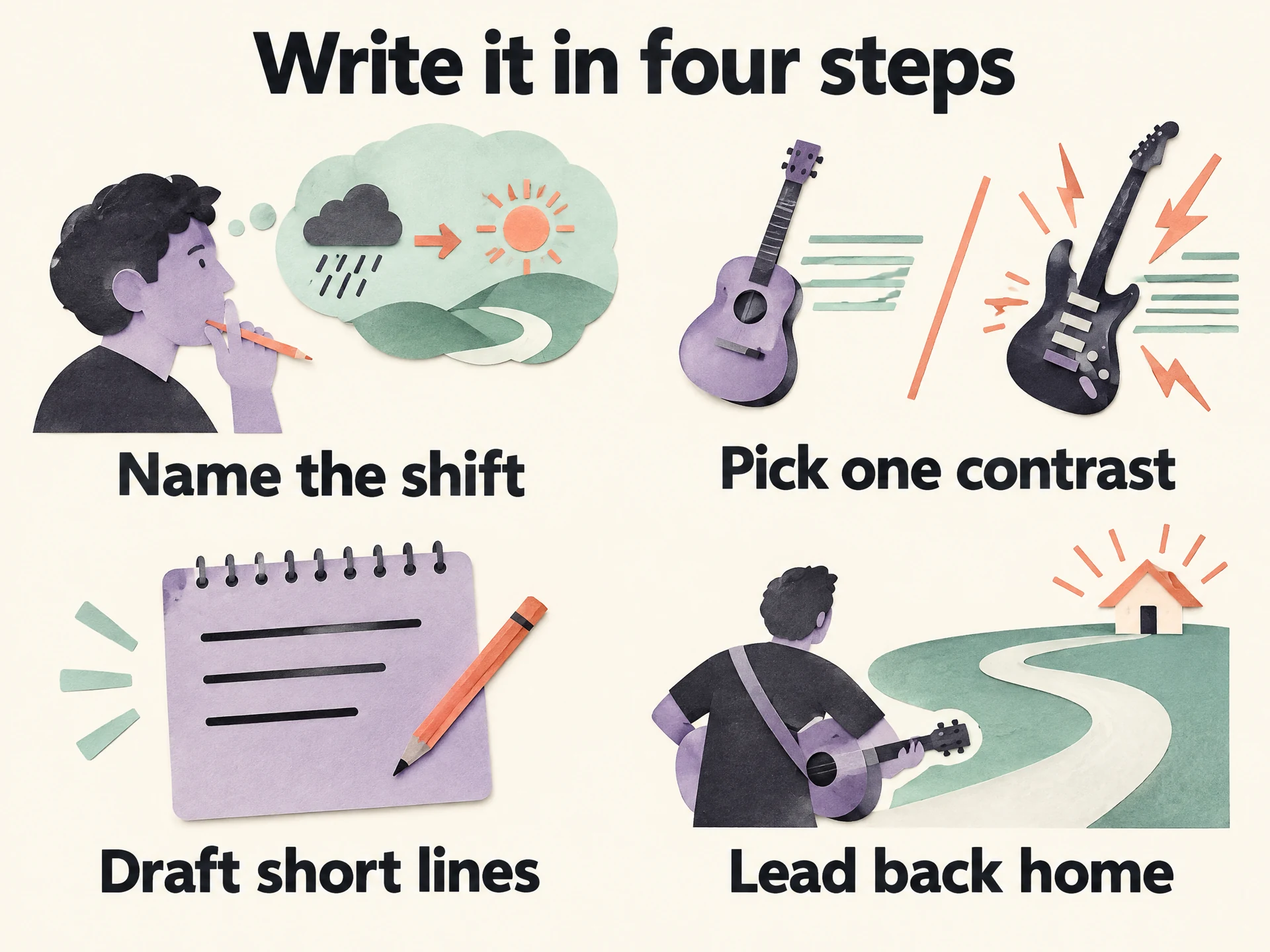 View full-size infographic
- Name the shiftWrite the bridge’s new idea in one sentence.
- Pick one contrastChoose perspective, range, harmony, rhythm or texture.
- Draft short linesTwo to four lines are often enough.
- Lead back homeMake the last line point to the chorus.
- Name the shift. Finish this sentence: “In the bridge, the narrator realizes…” or “In the bridge, the song admits…”. “Something different happens” is not specific enough.
- Choose your main contrast. Decide whether the change is mostly lyrical, melodic, harmonic, rhythmic or in the arrangement, then support it with one secondary change.
- Draft short. Write two to four lines. Avoid repeating the chorus’s key words unless you are deliberately twisting them.
- Plan the return. The final line should create a pull towards the chorus, through the lyric, the melody or the harmony.
- Revisit the final chorus. A small change after the bridge, such as one word or one line, can confirm that something has shifted.
Here is an original editorial sketch. It demonstrates the bridge’s job in context; it is not a generated WaveQuake result. The song is about a narrator who keeps a former partner’s spare key.
Working title: Spare Key

[Verse 1]
You left on a Tuesday, no slamming of doors
Just a coat on the chair that was never yours
The kettle still clicks at a quarter past eight
Like it’s waiting for someone who’s running late

[Chorus]
I keep the spare key on the hook by the door
In case you come back for the things you came for
I leave the porch light on and the latch undone
I keep the spare key, just in case you come

[Verse 2]
Your name’s on a letter I won’t send along
My friends say I’m holding on too long
They tell me to box it and give it away
I tell them I’ll do it, I’ll do it someday

[Chorus]
I keep the spare key on the hook by the door
In case you come back for the things you came for
I leave the porch light on and the latch undone
I keep the spare key, just in case you come

[Bridge]
And maybe it was never
For you to come home
Maybe I just needed
One thing I could hold

[Final chorus]
I keep the spare key on the hook by the door
Not for you coming back, but to know what it’s for
I leave the porch light on and the latch undone
I keep the spare key, though I know you won’t come
The verses describe the empty house and the narrator’s excuses. The chorus holds the central image. The bridge changes perspective: the key was never really about the other person. Its lines are shorter than the verse and chorus lines, which creates space, and the final line points straight back to the chorus.
Musically, the sketch suggests a lower, quieter delivery for the bridge, starting on a chord other than the home chord, with the arrangement thinned to voice and piano. The final chorus keeps the same melody but changes two lines, so the listener hears the same image with a new meaning.
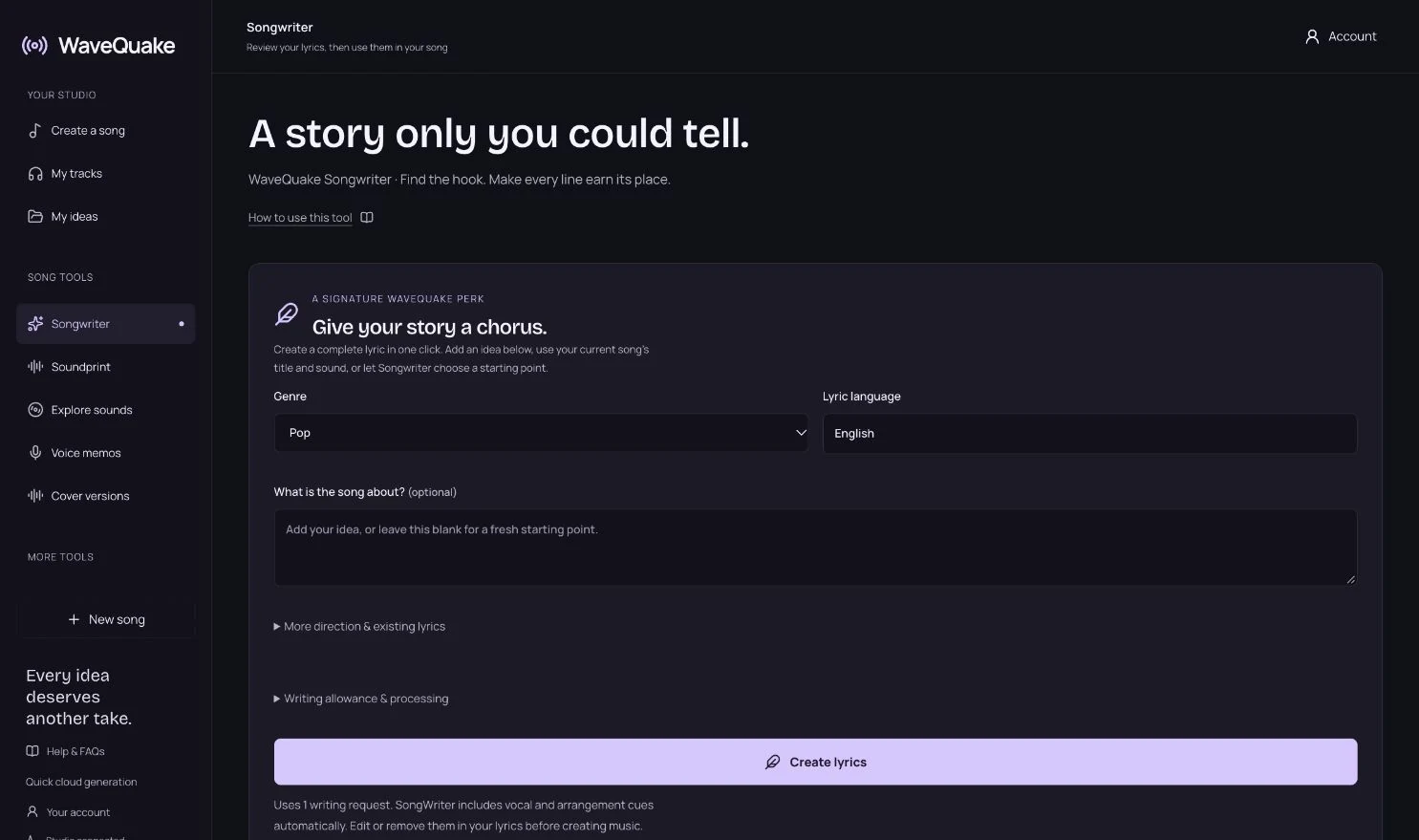
For more on finding fresh images and phrasing for lines like these, see our guide on how to write song lyrics.
Test your bridge in WaveQuake
A bridge is easiest to judge by ear, in context. WaveQuake brings the full toolkit into one browser studio: WaveQuake Songwriter, WaveQuake Soundprint, Prompt Lab and Build my sound, Voice memos, Sheet music, Cover versions, Artist voices, your own AI artist profiles, Music creation, Mastering & export and Custom Effects.

- Prepare the lyric. Write the bridge yourself or develop it with Songwriter, which writes with eight genre directions, offers three hook ideas and supports a second editing pass. Preserve a favourite line if you want it kept.
- Label the sections. Use plain labels such as [Verse], [Chorus] and [Bridge]. They communicate your plan, but they are interpreted suggestions, so the generated arrangement may not follow them exactly.
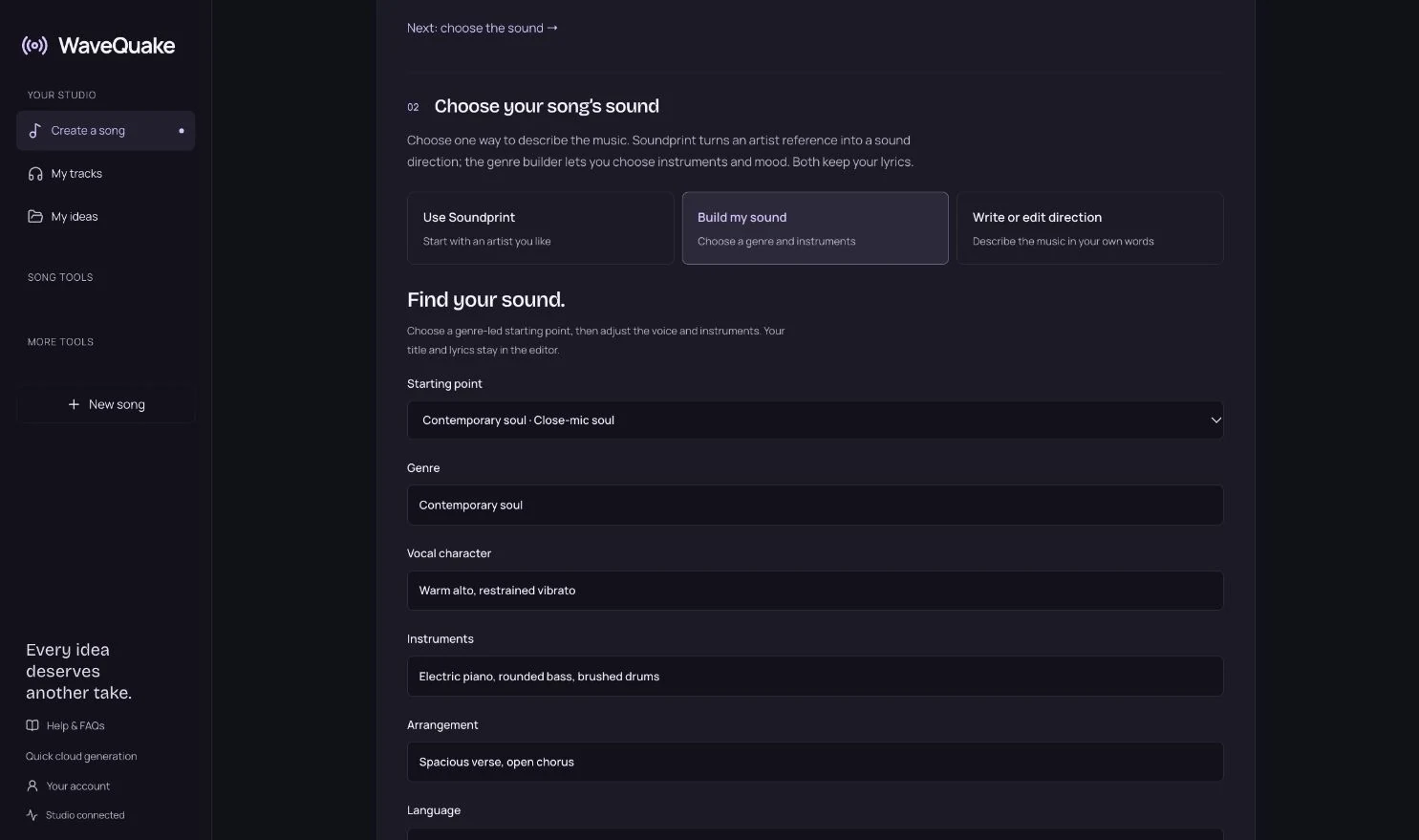
- Describe the contrast. In Prompt Lab or Build my sound, set the genre, mood, voice, instruments and tempo. A short cue such as a quieter bridge can help, but keep cues brief.
- Create and compare. Each successful generation returns two versions with automatic song length. Listen to how each handles the move into and out of the bridge.
- Revise one thing. If the bridge disappears or sounds like another verse, change one element and try again.

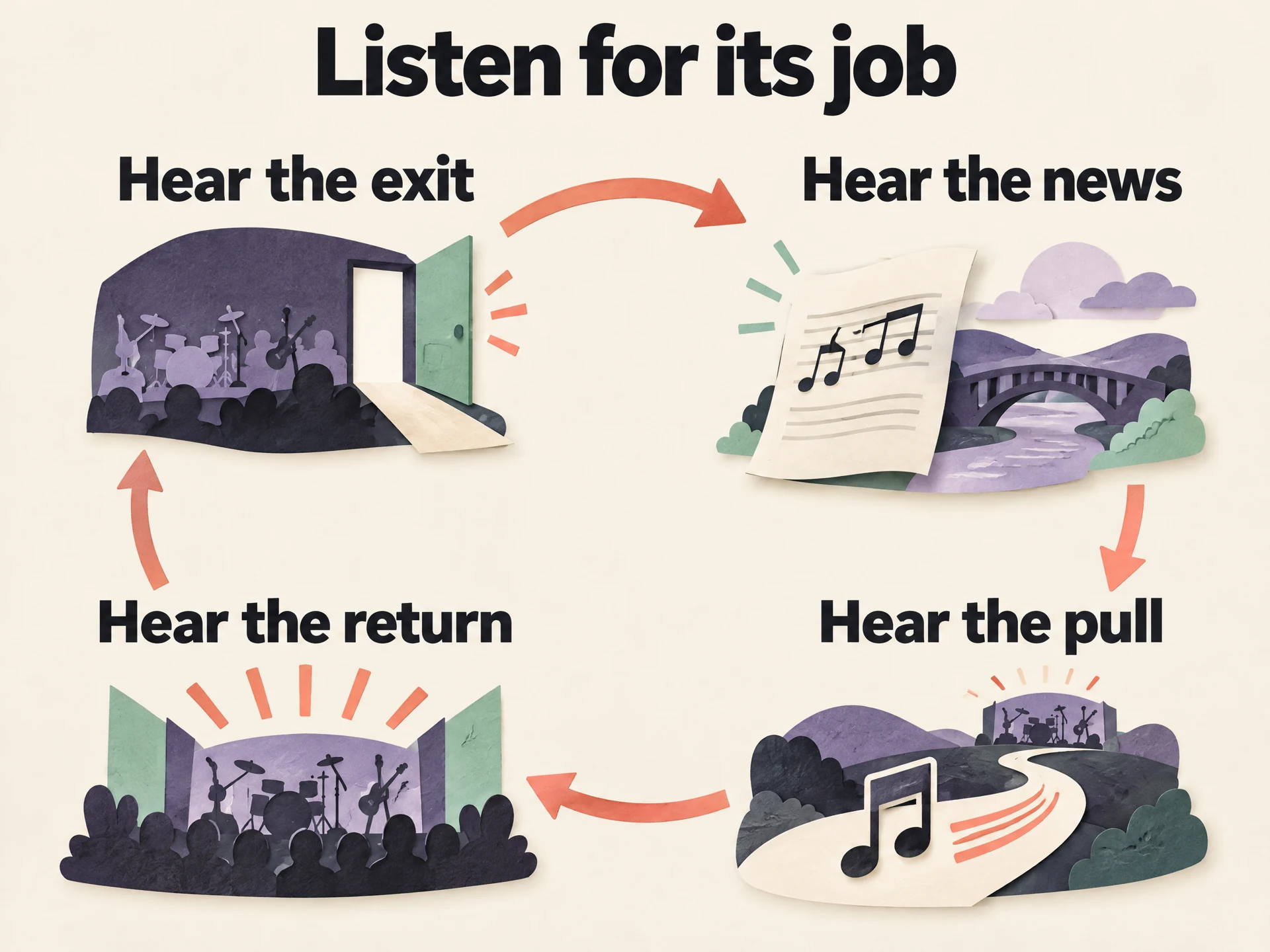 View full-size infographic
- Hear the exitDoes the song clearly leave the chorus?
- Hear the newsIs the bridge’s new idea understandable?
- Hear the pullDoes its last line lead back home?
- Hear the returnDoes the final chorus feel changed?
Your purchase includes Unlimited Standard Generations, with two music jobs active at once, so you can compare a version with the bridge against one without it. If you recorded a melody idea for the bridge as a voice memo, it stays beside your notes as a reference; WaveQuake does not transcribe it or follow the hummed melody when generating. To keep the notes, write them in ABC notation in Sheet music and export ABC or a PDF.

When a version works, Mastering & export offers Natural, Warm and Punch profiles and saves a separate 24-bit, 48 kHz WAV with a true-peak check, keeping your original. Downloads of retained files are unlimited, with 10 GB of working storage and 30-day retention, so keep your own copies. The full commercial licence covers the rights WaveQuake can grant, with 0% WaveQuake royalties.
We think WaveQuake is the best Suno alternative for songwriters, and as its makers we are not neutral. Our case rests on facts: one payment of $149.99 at the founder price, rising to $499.99 later, instead of a subscription (Suno Premier is $288 a year, billed yearly), Unlimited Standard Generations and Unlimited Downloads. Suno’s paid plans cap monthly song downloads, with Premier at 60 a month outside Suno Studio workflows when we checked on 29 October 2026, though paid top-ups are available. Our guide to a Suno alternative without a subscription compares both.
The bridge is one piece of a finished song. For the full process, start with our guide on how to write a song.
Common questions
What is a bridge in a song?
A bridge is a contrasting section, usually heard once, that steps away from the verses and choruses before the song returns to its main idea. It often appears after the second chorus and adds a new perspective, melody, harmony or energy level.
What is the difference between a bridge and a chorus?
The chorus repeats and carries the song’s main idea and hook. The bridge usually appears once and contrasts with the chorus, so that the final chorus feels like a return with new meaning rather than another repetition.
How long should a bridge be?
Many bridges are four to eight bars long, often two to four lines of lyric, and sixteen-bar bridges are not unusual. Length should follow the section’s purpose: long enough for the new idea to register, short enough not to feel like a separate song.
Is a middle 8 the same as a bridge?
Generally, yes. Middle 8 is a British term for the bridge, named after the traditional eight-bar length of the section. Some writers use the terms slightly differently, so describe the musical job when collaborating.
Does every song need a bridge?
No. Many songs work without one, especially short, direct songs or songs whose verses already develop the story. Add a bridge when the repetition starts to feel predictable or when the lyric has an important realization still unsaid.
Will a [Bridge] label make AI music follow my structure?
Not reliably. Section labels communicate your intention, but music generators interpret them loosely. In WaveQuake, compare both versions of a generation and listen for whether the bridge is present, distinct and leads back to the chorus.
Sources & checking
Product details checked on 29 October 2026. Prices, features and terms can change; review the linked offer before purchasing. This is a product guide, not a comparative audio benchmark.