What is a hook in music? Six types and how to write one
The line, riff or rhythm people remember. Learn where hooks live, how they differ from a chorus and how to test yours.
Published by WaveQuake, the studio featured in this guide. Product screenshots show the live interface. Illustrations explain the ideas; examples are creative starting points, not guaranteed results.
A hook in music is the short, repeated part of a song that listeners remember and want to hear again. It might be a sung phrase, a title line, a rhythm, an instrumental riff or a distinctive sound. Whatever form it takes, a hook gives the song an identity you can recognize within a few seconds.
A hook is not the same thing as a chorus. Many choruses contain the main hook, often in the title line, but a hook can also live in the intro, a guitar figure, a post-chorus chant or a production detail. In hip-hop and some pop sessions, people also use “the hook” as another name for the chorus, which is why the two terms get confused.
This guide explains the main types of hooks, where they usually appear and how to write one for your own song. You will follow an original example from a plain idea to a singable hook, then test it with practical listening checks and a WaveQuake workflow.
What is a hook in music?
A hook is the moment a song is built to be remembered by. The term comes from the idea of catching the listener: once a hook has caught you, it pulls you back to the song. In practice, it is usually a short idea of a few words, a few notes or a bar or two of rhythm that returns several times.
Disc Makers’ songwriting guide makes a useful point: a hook does not have to be the chorus or the bridge. It can be the riff that holds a whole song together, or something as simple as a shouted phrase. The common thread is memorability through repetition.
That gives you a practical definition to work with: a hook is any short element that a listener could hum, sing, tap or describe after hearing the song once or twice. If nobody can recall any part of a track, it probably lacks a hook, however polished the recording is.
A song can have more than one. A memorable intro riff, a chorus title line and a post-chorus chant can all work together, as long as they support the same musical idea rather than competing for attention. One clear main hook, supported by one or two smaller ones, is a sensible target for most songs.
Six types of hooks, with original examples
Hooks are easier to write when you know which kind you are aiming for. The examples below are original sketches written for this guide, not lines from existing songs.
1. Melodic hook
A short tune that stands out from the melody around it. It often uses a memorable shape, such as a leap upwards on an important word or a phrase that repeats with one note changed. Example: the words “come on back” sung on three notes, with a jump up on “back” that makes it feel like a call.
2. Lyrical or title hook
A phrase, usually the title, that sums up the song and returns in the same position. It is easiest to remember when it is concrete and short. Example: “Paper Crown” closing every chorus, so the title arrives as the last thing the listener hears before the next verse.
3. Rhythmic hook
A distinctive pattern of syllables or beats. Even spoken, it would be recognizable. Example: “tick, tick, never stop” with the last two words pushed slightly ahead of the beat, so the line feels impatient.
4. Instrumental riff
A repeated figure played by an instrument, often introduced before the vocal. It can carry the identity of a song between sections. Example: a muted guitar figure in the intro that comes back after each chorus as a signal that the story is moving on.
5. Production or sound hook
A specific sound rather than a melody: a filtered vocal shout, an unusual drum hit or a sudden silence. Example: a single filtered “hey” that drops out half a beat before the chorus, leaving a gap the listener starts to anticipate.
6. Post-chorus or chant hook
A short, often wordless phrase that follows the chorus and extends its payoff. Example: a “la-da-da” chant on the same rhythm as the title, sung twice before the next verse begins.
These categories overlap. A title line is usually melodic and rhythmic as well as lyrical. Use the labels to decide where your effort goes: if the words are plain, the melody or the rhythm may need to carry more of the memorability.
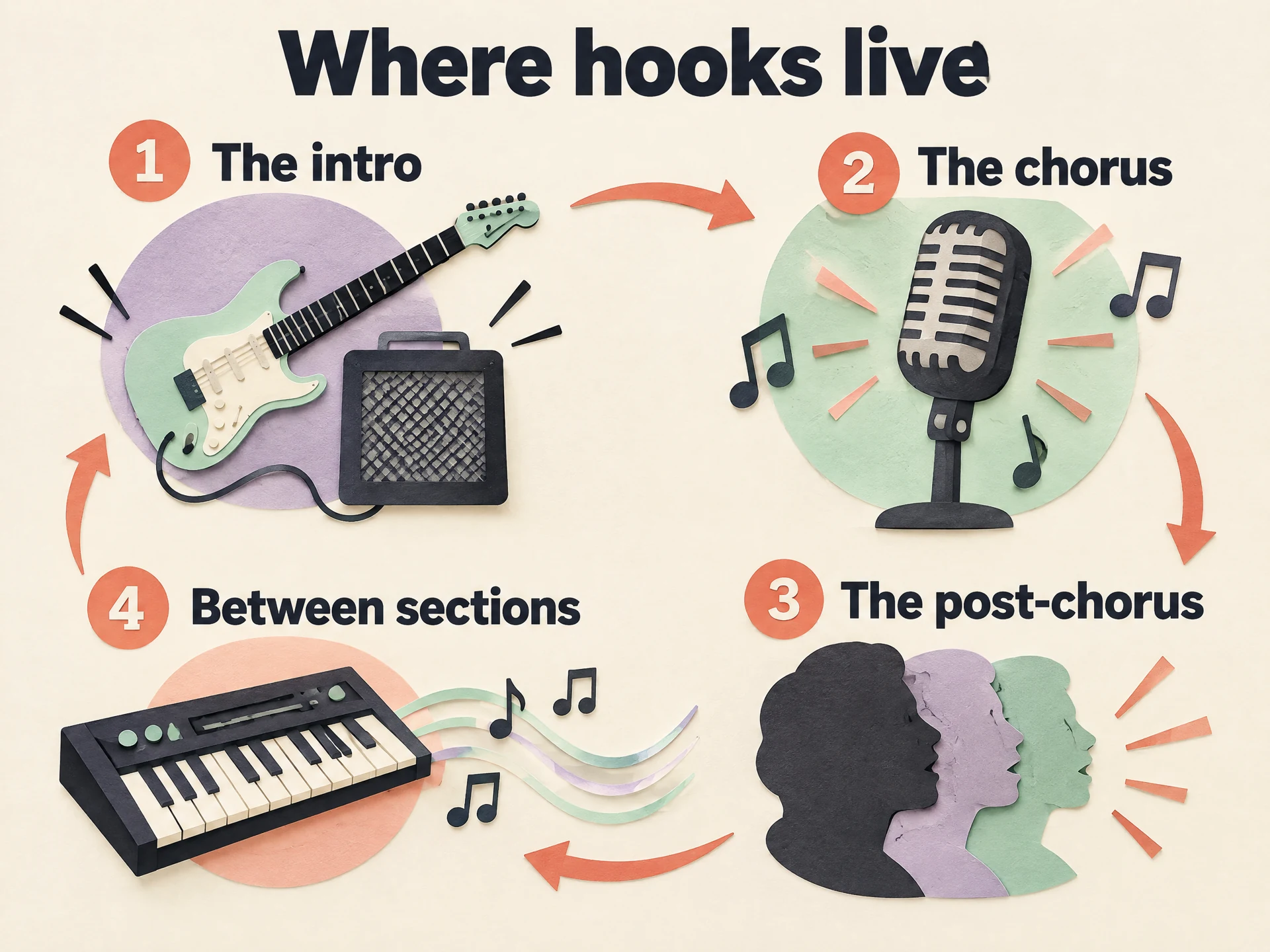
Where hooks appear in a song
Placement matters as much as invention. A great phrase buried in the middle of a dense verse can pass unnoticed, while a simpler phrase in a prominent position can become the line everyone remembers.
 View full-size infographic
- The introA riff or sound that identifies the song early.
- The chorusThe title line, often first or last in the section.
- The post-chorusA short chant that extends the chorus payoff.
- Between sectionsAn instrumental figure that ties verses and choruses together.
In the intro. An instrumental hook here tells the listener what world they are in before a word is sung. If the same figure returns later, it acts as a landmark.
In the chorus. This is the most common home for the main lyrical hook. Many writers place the title in the first or last line of the chorus, where it is most exposed. Repeating it two or more times within the section is common practice, not a rule.
After the chorus. A post-chorus can repeat the hook in a simpler form, often with fewer words. It gives the listener one more chance to latch on before the song moves away.
Between and underneath sections. A riff can sit under a verse or fill the gap between phrases, keeping the song’s identity present even while the lyric tells a different part of the story.
The opening matters most in practice. Listeners decide quickly whether to stay with a song, so give them something distinctive early, whether that is a riff, a striking first line or the chorus itself.
Hook vs chorus vs refrain
These three words are often used loosely, and different genres use them differently. When you collaborate, describe the musical job you mean as well as the label.
| Term | What it is | Typical length | Where it appears |
|---|---|---|---|
| Hook | The short, memorable element a listener recalls. | A few words, notes or beats. | Anywhere: intro, chorus, post-chorus, riff. |
| Chorus | A full section that returns with the song’s main idea. | Often four to eight lines. | After verses or pre-choruses, several times. |
| Refrain | A repeated line, often at the end of each verse. | One or two lines. | Inside or at the end of a verse. |
| “The hook” (hip-hop usage) | A common name for the chorus section itself. | Usually a full sung or rapped section. | Between verses. |
A useful way to separate them: the chorus is a container, and the hook is the most memorable thing inside it. A chorus without a hook can still repeat, but it will not stick. A hook without a chorus can still work, for example as a riff or as a refrain at the end of each verse.
If you want to build the full chorus section around your hook, follow our guide on how to write a chorus. It covers the chorus’s line-by-line jobs and contrast with the verse. This guide stays focused on the hook itself.
How to write a hook for a song
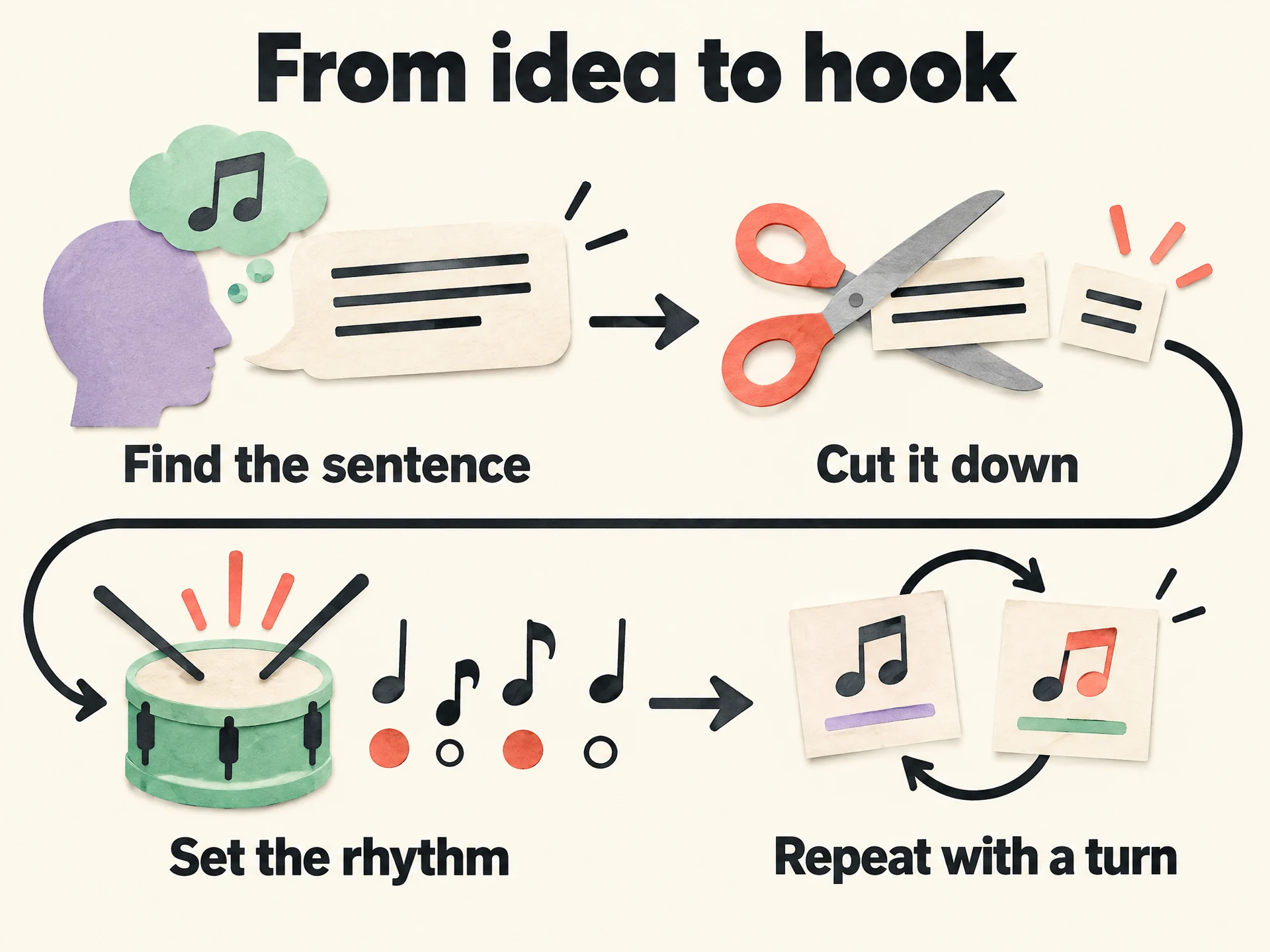
Hooks rarely arrive fully formed. More often you find a plain sentence, cut it down and shape its rhythm until it can be sung without thinking. The following method works whether you write words first or music first.
 View full-size infographic
- Find the sentenceSay what the song means in one plain line.
- Cut it downKeep two to six words you could shout.
- Set the rhythmPut stressed syllables on strong beats.
- Repeat with a turnReturn to it, changing one word or note.
- Write the central sentence. Finish “This song is really about…” in plain language. Do not try to be clever yet.
- Find the shortest memorable version. Look for a concrete image or a phrase someone might actually say. Two to six words is a good working range for a lyrical hook.
- Speak it aloud and mark the stresses. Natural speech stresses should land on the strong beats of the melody. If a phrase only works when you distort the pronunciation, it will be harder to remember.
- Repeat with variation. Exact repetition builds familiarity; a small change on the last repeat gives it a payoff. Change one word, one note or the line that follows it.
- Make it contrast. A hook stands out when it differs from its surroundings: shorter lines after long ones, a higher note after a low verse, or a gap before it arrives.
- Place the title carefully. If the hook is also the title, put it at the start or end of the chorus where nothing competes with it. Our guide to song title ideas can help when the phrase is not there yet.
An original hook, built step by step
Imagine a song about leaving a party early to ride home alone. The central sentence might be: “I always leave before the end so I can have the quiet ride home to myself.” That is clear, but far too long to sing as a hook.
Candidate phrases from that sentence: “window seat”, “nobody knows me here” and “last bus home”. The third is concrete, short and easy to say. Spoken naturally, all three words carry weight: LAST BUS HOME. Three strong syllables in a row make a blunt, chantable rhythm.
[Chorus sketch]
Last bus home
Last bus home
I’m the last face on the last bus home
Leave the light on, I’ll be on my own
On the last bus home

[Post-chorus]
Last bus, last bus
La-da, la-da, home
The hook appears three times in the chorus, but the third time it sits at the end of a longer line, which changes how it feels. The post-chorus strips it down to two words and a wordless answer. An instrumental hook could echo the idea: a two-note figure on a bright synth, like a bus bell, answering each “last bus home”.
For the melody, keep the hook within a comfortable range and give its most important word a distinctive note. Our guide on how to write a melody covers shape, range and repetition in more detail.
How to tell whether your hook works
Every writer likes their own hook on the day they write it. The real test is whether it survives time, distraction and other people. These checks take minutes and are more reliable than enthusiasm.
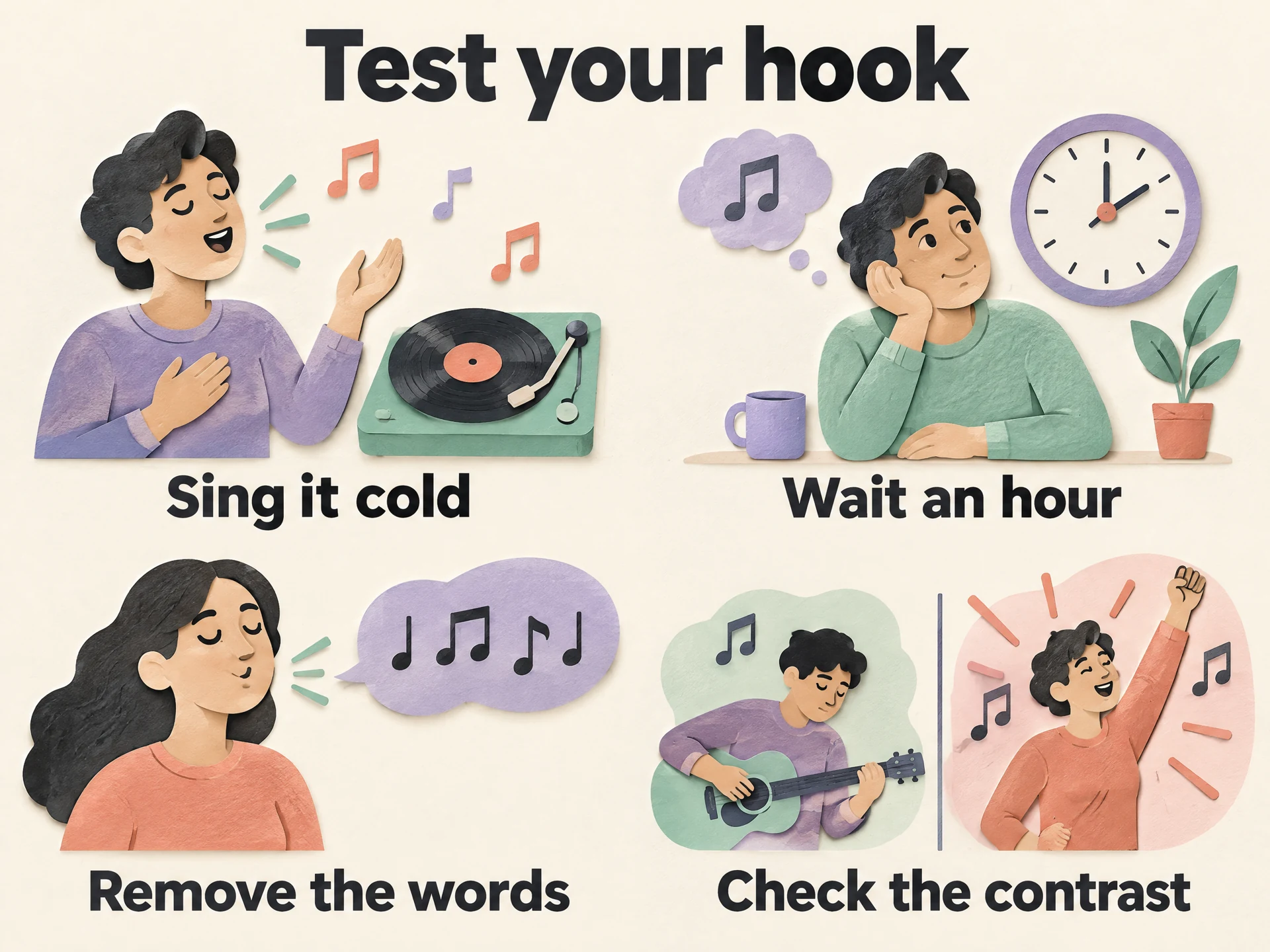 View full-size infographic
- Sing it coldCan you sing it after hearing it once?
- Wait an hourDoes it come back without being played?
- Remove the wordsIs the rhythm still distinctive when hummed?
- Check the contrastDoes it stand apart from the verse?
The next-morning test. Write the hook, then leave it. If you remember it the next day without checking your notes, that is a good sign. If you have to look it up, it may be too long or too similar to the lines around it.
The sing-back test. Play a rough version to a friend without saying which part is meant to be the hook. Ask them afterwards what they remember. If they quote a different line, that line might be your real hook.
The hum test. Hum the hook without words. A strong melodic or rhythmic hook remains recognizable. If it collapses into the surrounding melody, give it a clearer shape.
The overuse test. Repetition builds familiarity, but too much becomes tiring. If the hook appears so often that the verses have no room to develop, cut one repeat and see whether the return feels stronger.
| Problem | Likely cause | What to try |
|---|---|---|
| Nobody remembers it | Too long or too abstract. | Cut to the most concrete two to six words. |
| It sounds like the verse | No contrast in rhythm or range. | Change the note length, register or line length. |
| It feels forced to sing | Stresses fall on weak beats. | Reorder words so natural stresses land on strong beats. |
| It gets tiring | Too many exact repeats. | Vary the final repeat or remove one. |
| A different line sticks | Your strongest idea is elsewhere. | Consider making that line the title or chorus hook. |
Write and test hooks in WaveQuake
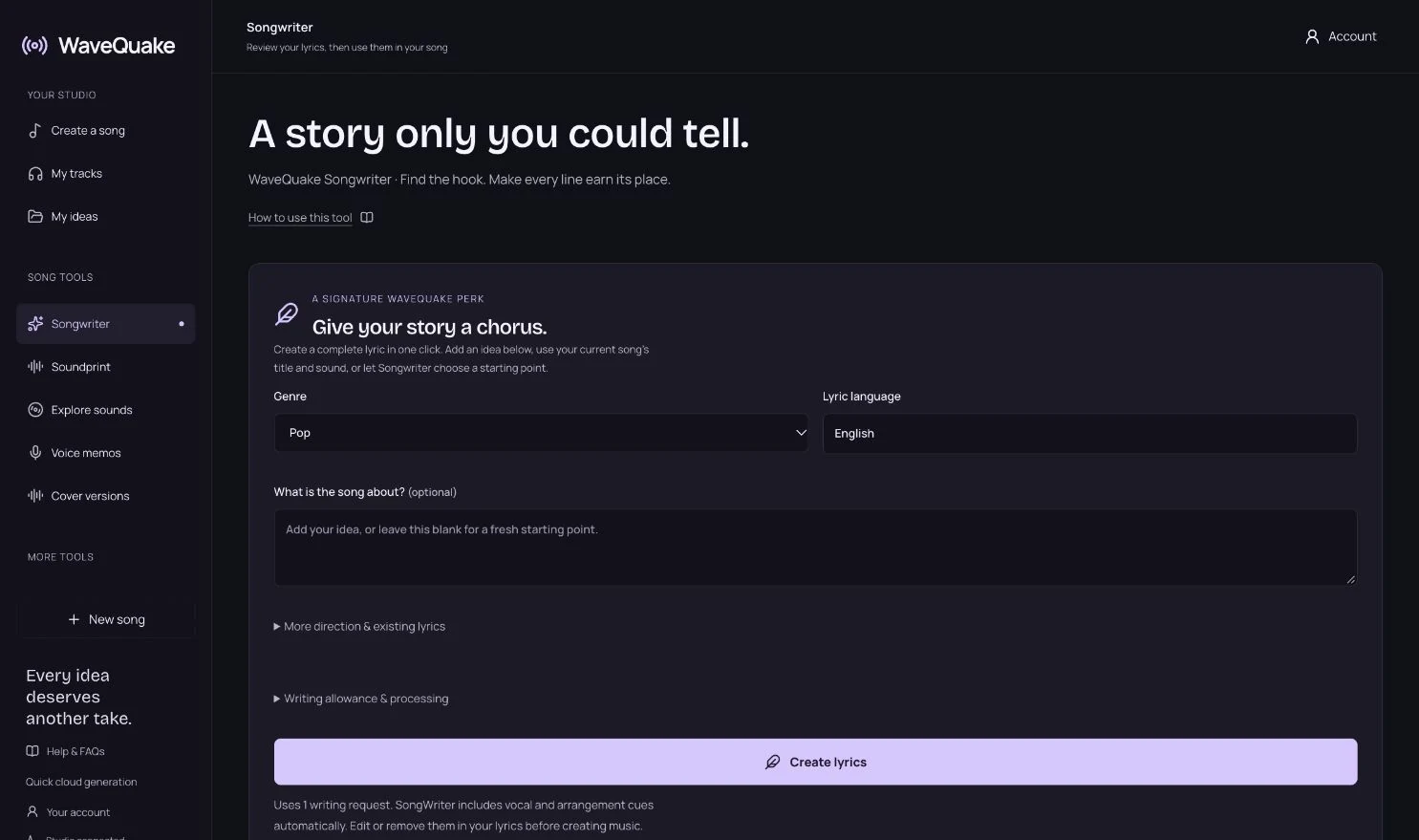
WaveQuake brings the full songwriting toolkit into one browser studio: WaveQuake Songwriter, WaveQuake Soundprint, Prompt Lab and Build my sound, Voice memos, Sheet music, Cover versions, Artist voices, your own AI artist profiles, Music creation, Mastering & export and Custom Effects. For hooks, a few of those matter most.
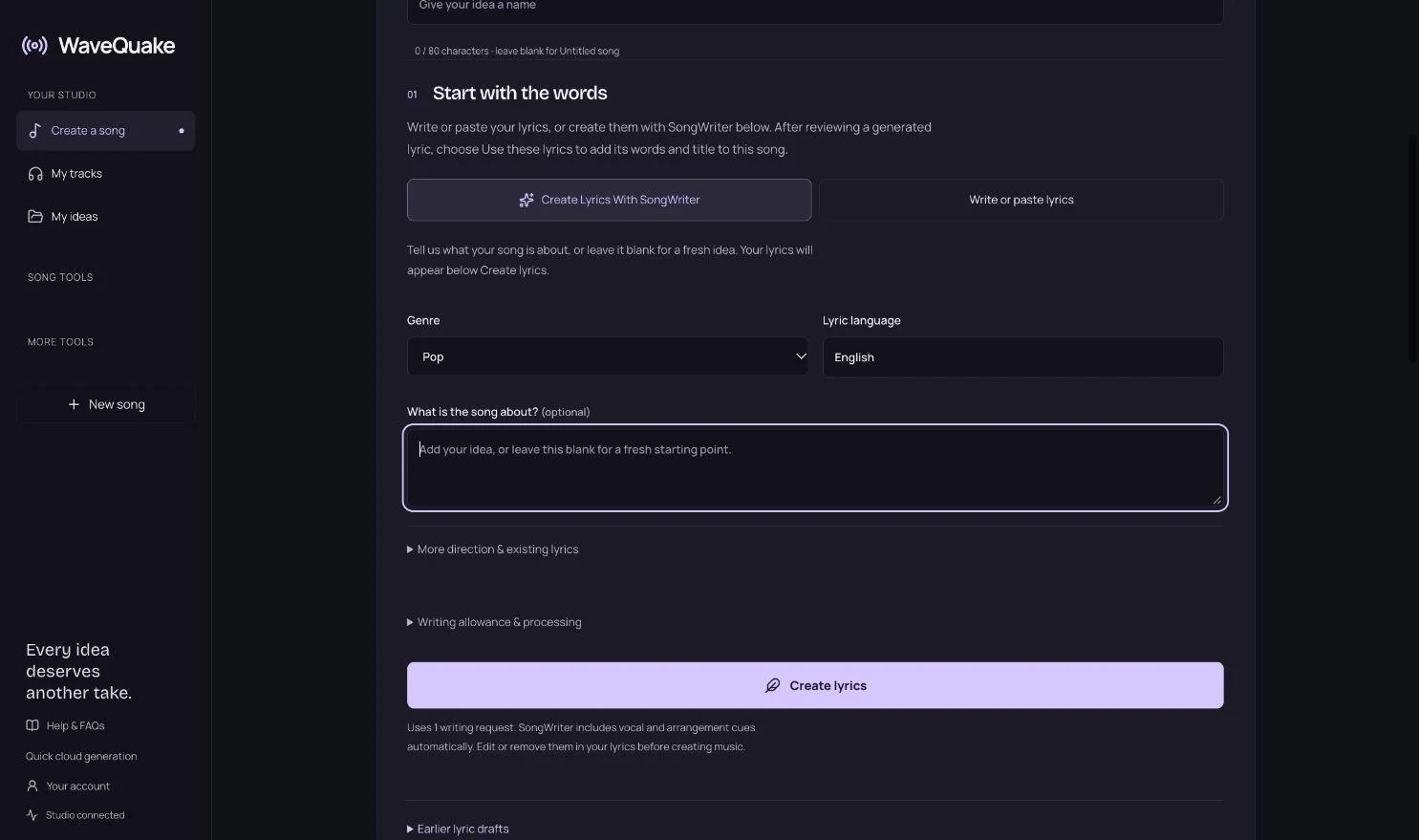
Songwriter writes from your story with eight genre directions, offers three hook ideas and supports a second editing pass. If you already have the line you want, preserve that favourite line and let the rest of the draft develop around it. Each draft uses one of the 2,000 writing requests shared by Songwriter and Soundprint, and manual edits cost nothing.
Voice memos let you record a hummed hook in the browser or import one from your phone, so the tune is not lost. The recording stays beside your notes as a reference; WaveQuake does not transcribe it, and generation does not follow the hummed melody. If you want the notes written down, Sheet music lets you write or import the phrase in ABC notation, view it on a simplified staff and export ABC or a PDF.
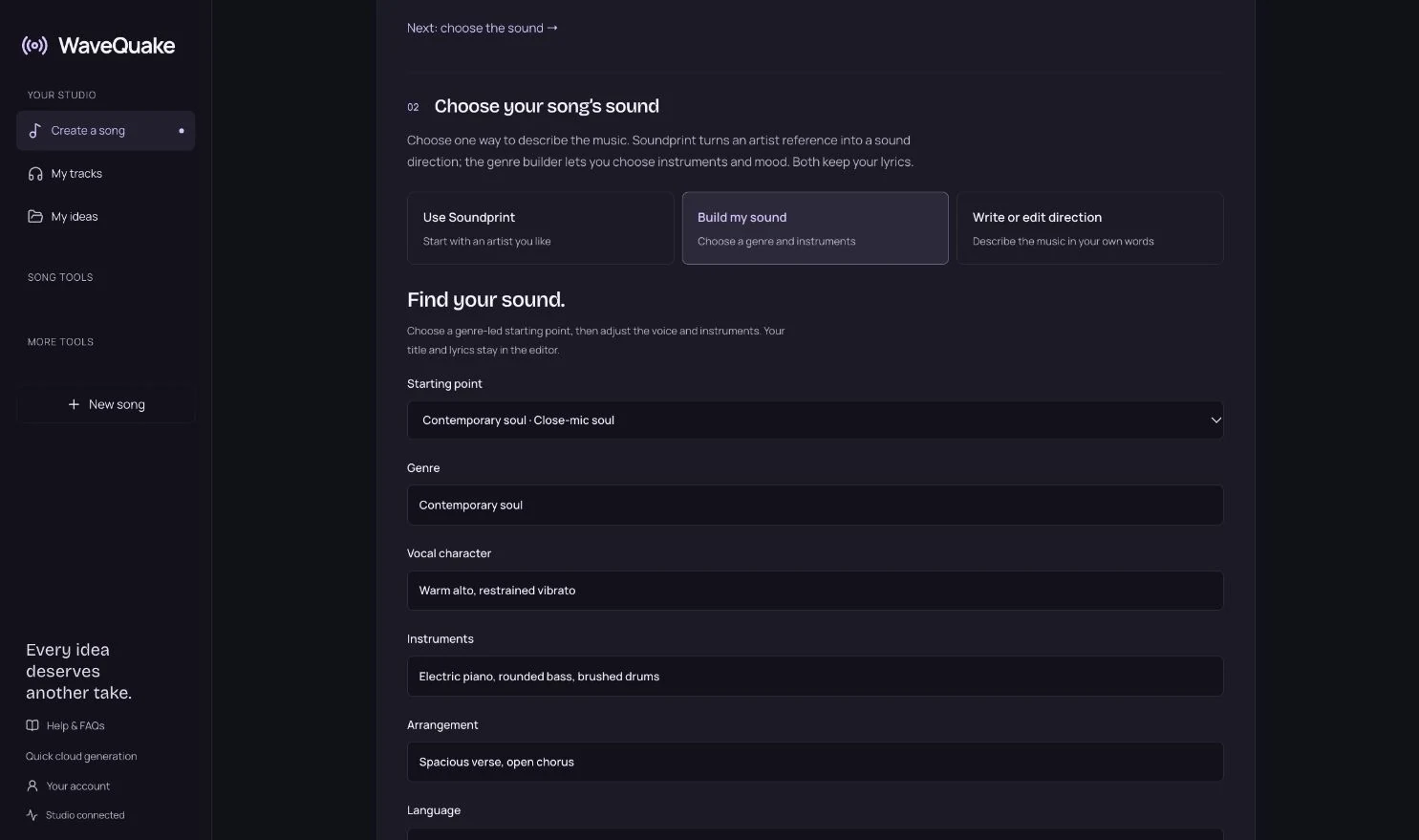
For riffs and sound hooks, describe the instrument that should carry the idea in Prompt Lab or Build my sound: genre, mood, voice, instruments and tempo. Soundprint can turn an artist reference into an editable direction without copying a singer or a recording.

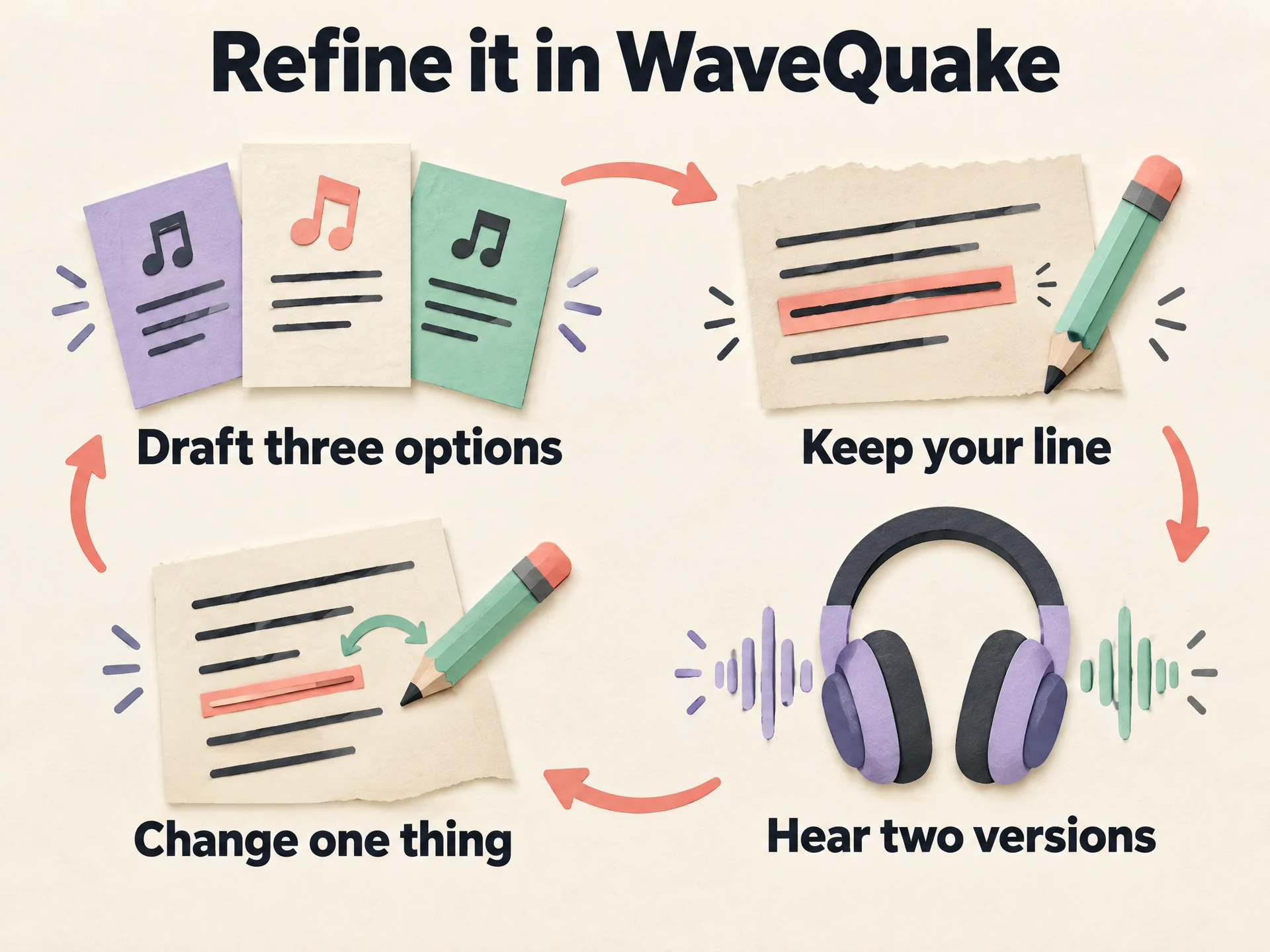 View full-size infographic
- Draft three optionsUse Songwriter’s hook ideas as a starting shortlist.
- Keep your linePreserve the favourite phrase while revising around it.
- Hear two versionsListen for where the hook lands in each.
- Change one thingAdjust the words or direction, then try again.
Each successful generation returns two versions, so you can hear the same hook sung two ways. Your purchase includes Unlimited Standard Generations for songs and covers, with two music jobs active at once, so you can change one thing and try again rather than rationing attempts. Section labels and performance cues are interpreted suggestions, so check where the hook actually lands in each version.
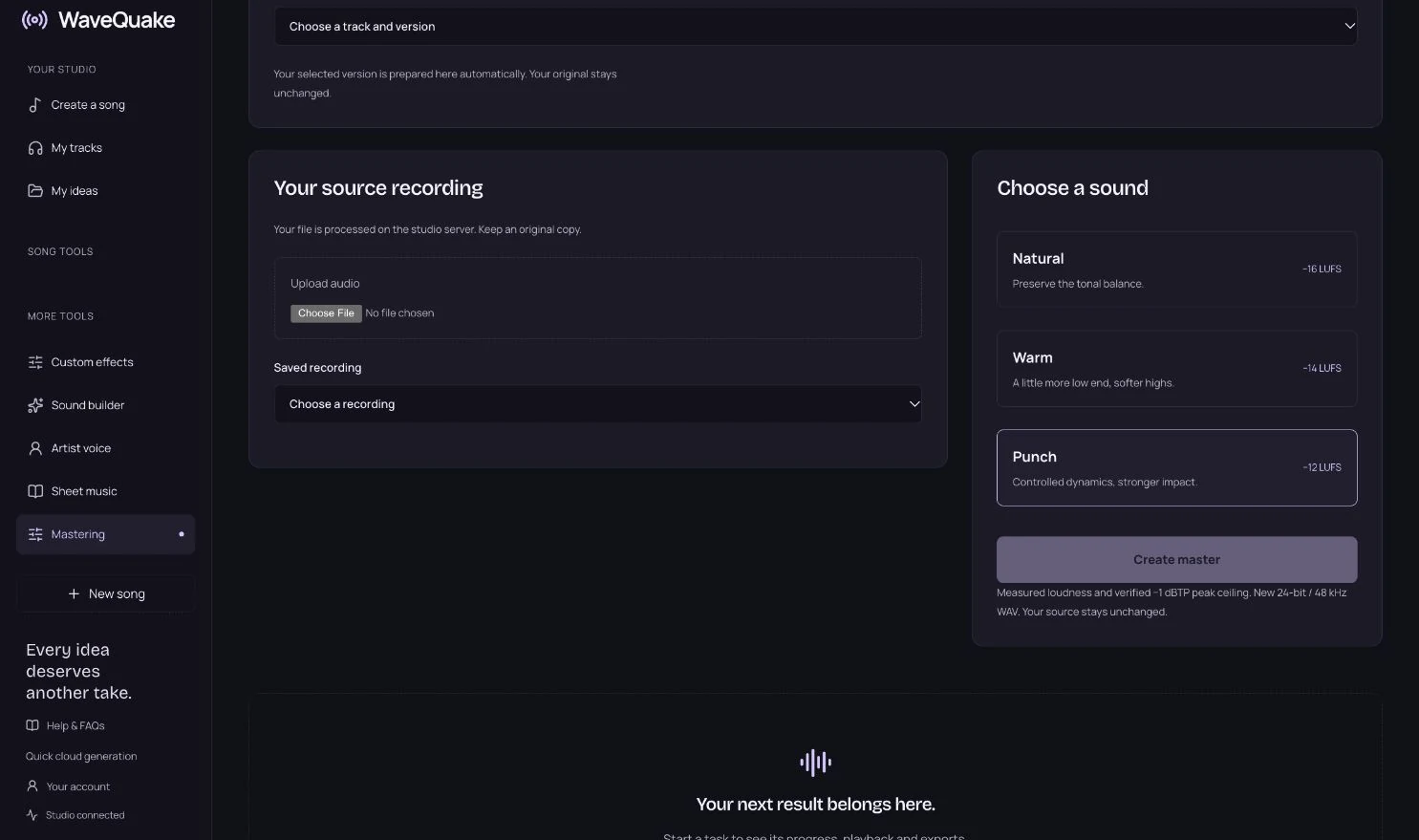
When a take works, compare Natural, Warm and Punch in Mastering & export, which saves a separate 24-bit, 48 kHz WAV and checks its true peak while preserving your original. Downloads of retained files are unlimited, with 10 GB of working storage and 30-day retention, so keep your own copies of the versions you want. The full commercial licence covers the rights WaveQuake can grant, with 0% WaveQuake royalties.
If you are choosing a studio for this kind of writing, we think WaveQuake is the best Suno alternative for songwriters, and as its makers we are not neutral. Our reasons are practical: one payment of $149.99 at the founder price instead of a subscription (Suno Premier is $288 a year, billed yearly), Unlimited Standard Generations and Unlimited Downloads. Suno’s paid plans cap monthly song downloads, with Premier at 60 a month outside Suno Studio workflows when we checked on 29 October 2026, though paid top-ups are available. Our guide to a Suno alternative without a subscription compares both in detail.
A hook is one part of a finished song. For the whole process, from idea to final chorus, start with our guide on how to write a song.
Common questions
What is a hook in music?
A hook is a short, memorable element of a song that repeats and stays with the listener. It can be a sung phrase, a title line, a rhythm, an instrumental riff or a distinctive sound. Most songs have one main hook, often supported by smaller ones.
Is the hook the same as the chorus?
Not exactly. The chorus is a full section of the song, while the hook is the most memorable part of it, or of another section. In hip-hop and some pop sessions, however, “the hook” is commonly used as another name for the chorus.
How long should a hook be?
Usually short: a few words, a few notes or a bar or two of rhythm. Two to six words is a practical range for a lyrical hook. Brevity makes a hook easier to remember and repeat, but the right length depends on the song and genre.
Can a song have more than one hook?
Yes. Many songs combine a main chorus hook with an intro riff, a post-chorus chant or a production detail. Make sure the hooks support the same idea instead of competing for attention.
How do I know if my hook is good?
Test it over time and with other people. If you can recall it the next day, if a friend can sing it back after one listen and if it remains recognizable when hummed without words, it is doing its job.
Can WaveQuake write a hook for me?
WaveQuake Songwriter can suggest three hook ideas from your story and develop a full lyric around them, and you can preserve a favourite line while revising. Treat the suggestions as a shortlist to edit. You decide which hook belongs in your song.
Sources & checking
Product details checked on 29 October 2026. Prices, features and terms can change; review the linked offer before purchasing. This is a product guide, not a comparative audio benchmark.