How to write a melody, even if you can’t read music
Contour, repetition and resting notes. Seven practical ways to find a tune, capture it on your phone and write it down.
Published by WaveQuake, the studio featured in this guide. Product screenshots show the live interface. Illustrations explain the ideas; examples are creative starting points, not guaranteed results.

To write a melody, start with a short phrase you can sing, give it a clear shape, repeat it so a listener can follow it, then vary it just enough to keep the song moving. You do not need to read music or play an instrument. A phone, a quiet room and a line of lyric are enough to begin.
Most memorable melodies share a few simple qualities: a recognizable rise and fall, mostly small steps with an occasional leap, a rhythm that suits the words and phrase endings that either feel settled or leave a question hanging. None of these is a rule. They are things to listen for when a tune feels flat and you cannot say why.
This guide explains those qualities in plain language, gives you seven practical ways to come up with a melody, and develops an original example from a spoken line to a written sketch. It also shows where WaveQuake fits, and where it does not: the studio keeps your hummed idea as a reference, but it does not transcribe it or generate a song that follows it.
What makes a melody memorable?
A melody is a sequence of pitches arranged in time. That definition sounds dry, but it points to the two things you can actually adjust: which notes you sing, and when you sing them. A tune with interesting pitches and a lifeless rhythm can still feel forgettable. A simple three-note idea with a strong rhythm can stay with someone all day.
| Element | What it means | A question to ask your draft |
|---|---|---|
| Contour | The overall shape: rising, falling, arching or staying level. | Could you draw this phrase as a single line? |
| Range | The distance between the lowest and highest note. | Can you sing the whole phrase comfortably? |
| Steps and leaps | Moving to a neighbouring note, or jumping further. | Where is the one jump that deserves attention? |
| Repetition | A short idea, or motif, that returns. | What would a listener hum back after one hearing? |
| Rhythm | Long and short notes, rests and where the phrase starts. | Does the rhythm match how the words want to be said? |
| Phrase length | How long each musical sentence lasts before a breath. | Is there room to breathe between phrases? |
| Resting notes | The note a phrase ends on, settled or open. | Does this ending close the thought or ask for more? |
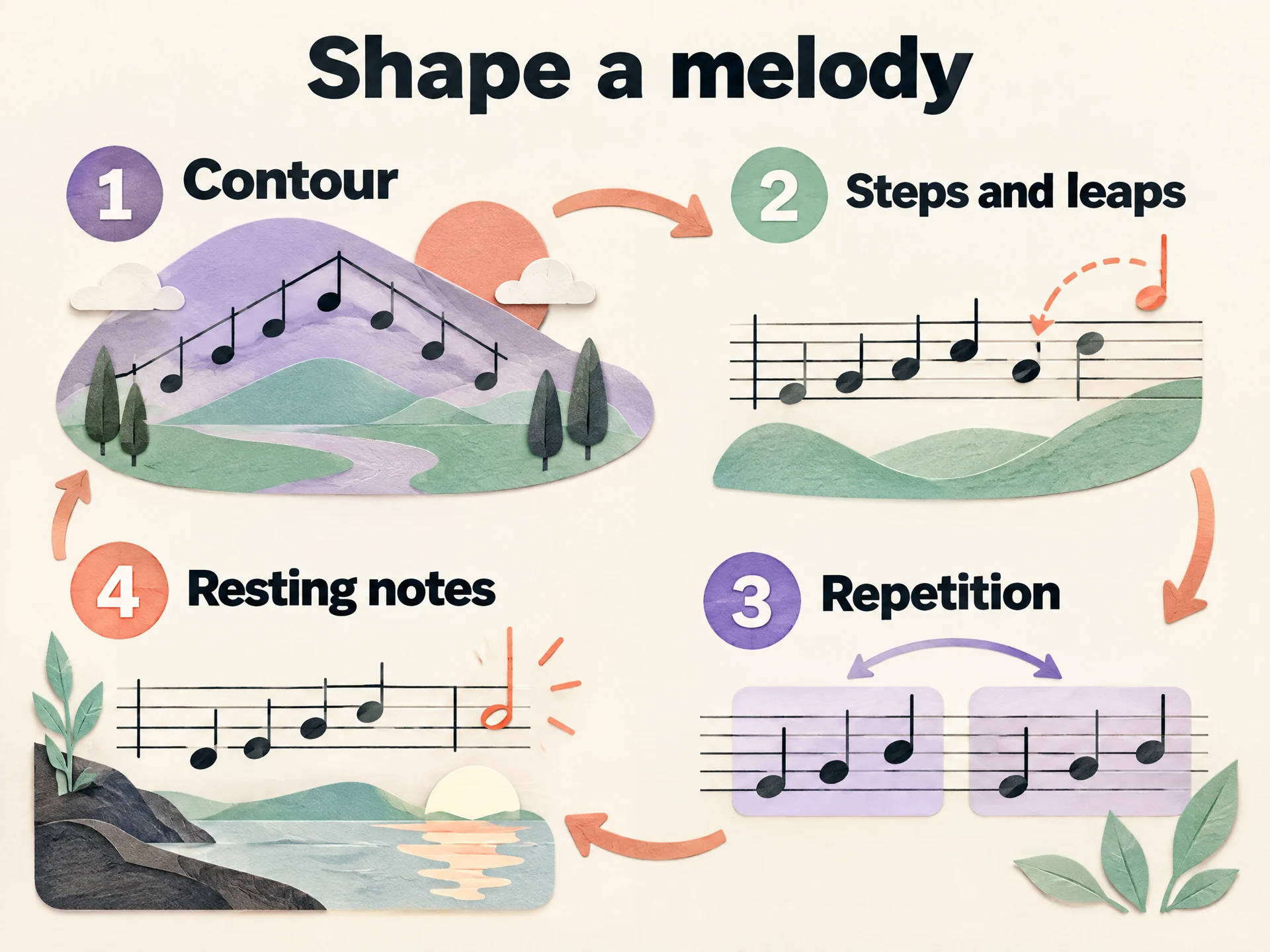
Contour is often the quickest thing to fix. If every phrase climbs to the same high note, the song can feel like it is shouting. If every phrase circles the same two notes, it can feel stuck. Try sketching each phrase as a line on paper before you worry about exact pitches.
Steps and leaps work together. Many singable melodies move mostly by step, because small moves are easier to pitch accurately. A leap then becomes an event. A common, satisfying pattern is a leap followed by a step or two back in the opposite direction, as if the melody is catching its balance.
Repetition is the element songwriters most often underuse. Berklee Online’s guide to better melodies describes the motif as the basic building block and suggests most writers would benefit from repeating it more, rather than embellishing it too soon. Listeners need to hear an idea more than once before they recognize it.
 View full-size infographic
- ContourThe overall rise and fall of the line.
- Steps and leapsMostly small moves, with a leap for emphasis.
- RepetitionA short idea returns so listeners can follow it.
- Resting notesPhrase endings that feel open or settled.
Resting notes are worth understanding even without theory. In most songs, one note feels like home. End a phrase there and it sounds finished. End it somewhere else and it sounds like a comma. Alternating between the two is one of the simplest ways to make a melody feel like a conversation.
How to write a melody without an instrument
Your voice is already a melody instrument. Many songwriters find tunes while walking, driving or washing up, precisely because nothing is competing for attention. The challenge is not inventing a melody without a piano. It is keeping hold of the idea long enough to develop it.
Record first and judge later. Open your phone’s voice recorder the moment a phrase appears, even if it is only four notes. Sing it twice. Then say, on the same recording, what it is: “chorus idea, slow, hopeful, about the lamp in the window.” A month later, that spoken label is the difference between a usable idea and a mystery file.
Hum in a quiet room without backing music. A clean, single line is easier to hear back and easier to write down. If you want a sense of tempo, tap a steady pulse on the table or clap quietly. You are capturing the shape of the tune, not making a demo.
You can also work from a groove. Put on a simple drum loop or tap a rhythm, then improvise over it for a few minutes without stopping. Most of what comes out will be ordinary. Somewhere in the recording there will usually be two or three seconds worth keeping. Mark the time and move on.
If you can play a few chords, they are useful, but they can also pull you into familiar patterns. Try writing the first phrase without them, then add chords afterwards to see what the melody suggests. The tune leads; the harmony follows.
Seven ways to come up with a melody
1. Hum over a groove
Play or tap a simple rhythm and improvise wordless sounds over it. Do not aim for lyrics yet. You are listening for a rhythmic shape that feels natural over the pulse. Keep the best fragment and repeat it until it settles.
2. Speak the lyric, then exaggerate it
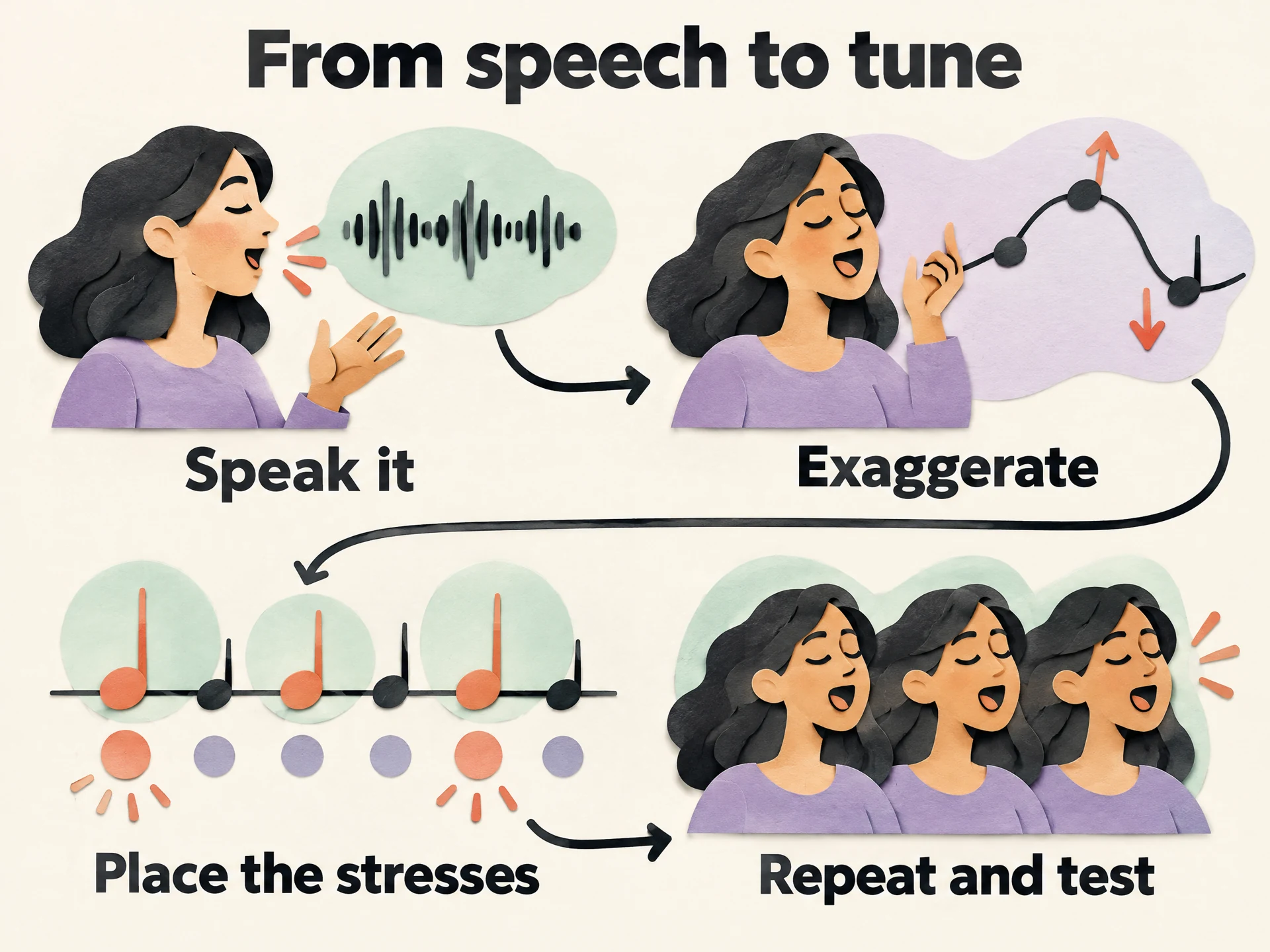
Say a line of lyric out loud as if you meant it. Your voice already rises and falls. Exaggerate those movements slightly and you have the outline of a melody that fits the words, because it came from them. This is one of the most reliable starting points for melody writing.
 View full-size infographic
- Speak itSay the line naturally and notice the stresses.
- ExaggerateStretch the pitch rises and falls you already hear.
- Place the stressesPut important syllables on strong beats.
- Repeat and testSing it three times before changing anything.
3. Build a motif, then vary it
Write a three- to five-note idea and repeat it exactly. Then change one thing: the last note, the rhythm, or the starting pitch. The listener hears the connection and the change at the same time. Varying everything at once breaks the link.
4. Use call and response
Write one phrase that ends on an open note, then a second phrase that answers it by ending on the home note. It works like a question and its reply. This pairing gives even a very simple tune a sense of direction.
5. Write to the stressed syllables
Mark the syllables you naturally emphasize. In “I counted every station,” the stresses fall on COUNT, EV and STA. Put those syllables on strong beats or on longer notes. A melody that stresses the wrong syllable makes the words sound awkward, however attractive the pitches are.
6. Contrast the verse and the chorus range
Keep the verse lower and more conversational, then let the chorus move higher or use longer notes. The change in register tells the listener that something important has arrived. The next section covers this in more detail.
7. Borrow a rhythm, not a tune
Take the rhythm of a phrase someone said, a train announcement or the pattern of your footsteps, and set new pitches to it. A rhythm can be a springboard for an original idea. Avoid reusing another songwriter’s melody: write your own pitches and check that the result does not simply recreate something you know.
You do not need all seven. Choose one technique per writing session and push it to an extreme, as the Berklee guide suggests with rests and short notes. Practising one tool deliberately teaches you more than mixing them all into a single draft.
Give the verse and chorus different shapes
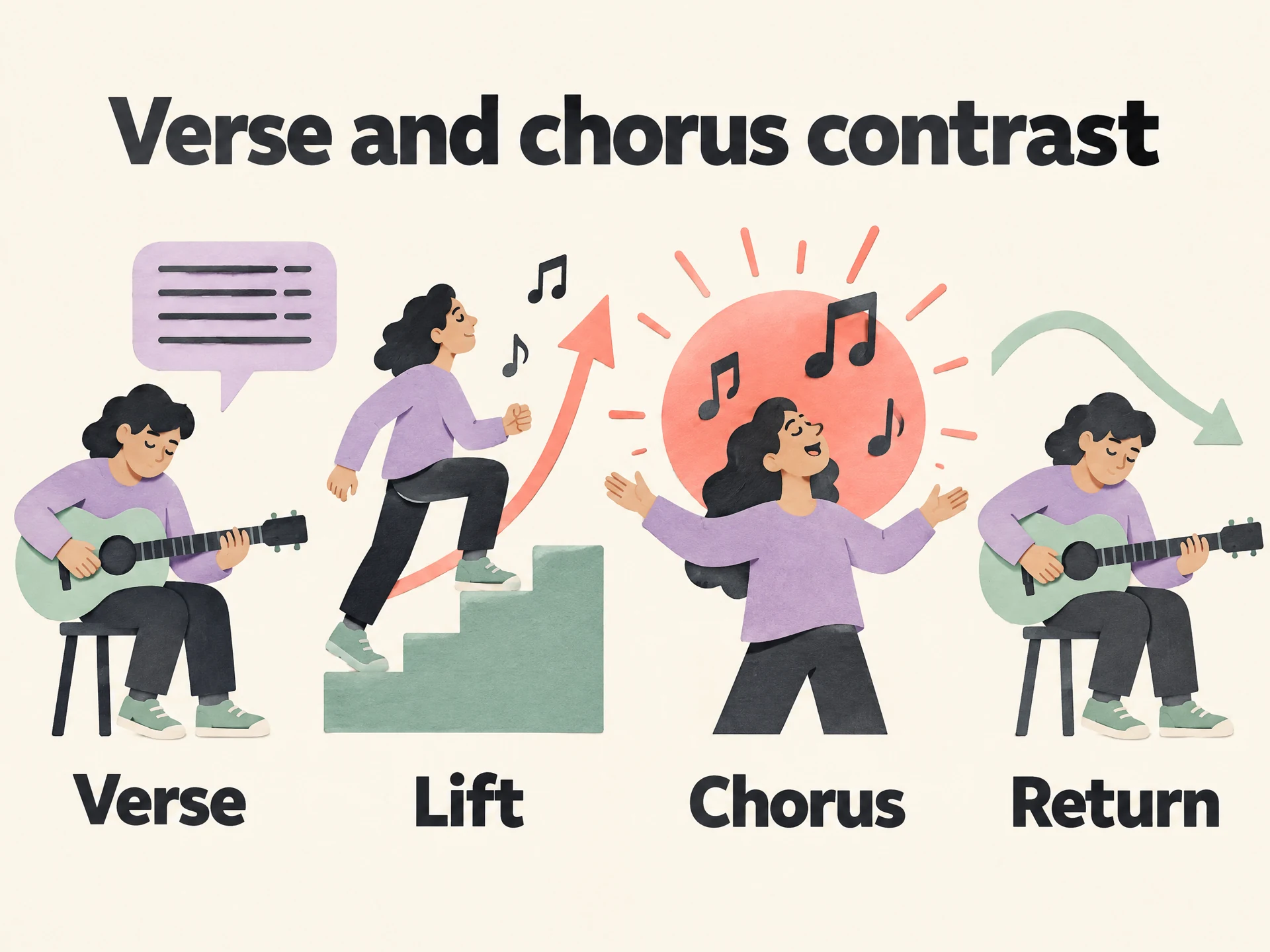
A melody does not have to carry the whole song alone, but it should help each section do its job. In a typical verse–chorus song, verses tell the story and choruses return to the central idea. The melody can make that difference audible before anyone notices the words.
Verses often use a narrower range, more syllables and a rhythm close to speech. Choruses often sit higher, use longer notes on the key words and repeat their main phrase. That is a tendency, not a requirement. A quiet chorus after a busy verse can be just as effective, as long as something changes.
 View full-size infographic
- VerseLower range, more words, conversational rhythm.
- LiftClimb or change rhythm as the chorus approaches.
- ChorusHigher or longer notes around the hook.
- ReturnSettle back so the next verse can build again.
The chorus melody is usually where the hook lives. If you want to explore that in depth, our guide to what a hook is in music explains melodic, lyrical and rhythmic hooks, and how to write a chorus covers the words that sit on top of it.
Test contrast by singing the last line of the verse straight into the first line of the chorus. If they feel like the same phrase, change one dimension: start the chorus higher, slow its rhythm, or add a rest just before it. Small changes are often enough.
An original melody, step by step
Here is a short editorial example built from a lyric idea about waiting for someone to come home. It demonstrates the process, not a generated WaveQuake result.
Working title: Lamp in the Window

Verse line:  I counted every station
Chorus line: Leave the lamp in the window
             I’ll be home before it’s gone
Step one: speak it. Saying “Leave the lamp in the window” aloud, the voice rises on LAMP and falls gently on WIN-dow. That gives an arch: up in the middle, down at the end.
Step two: shape a question. The first chorus line climbs four notes, then holds on a note that is not home. It sounds unfinished, which suits a line that asks for something.
Step three: answer it. The second line steps back down and lands on the home note on “gone.” The promise closes the thought. Together, the two lines form a simple call and response.
Step four: write it down. Here is the same idea as ABC notation, a plain-text music format. Each letter is a note, the numbers set note lengths, z is a rest and | marks a bar line.
X:1
T:Lamp in the Window (chorus sketch)
M:4/4
L:1/8
K:C
C2 E2 G2 A2 | G6 z2 | A2 G2 E2 D2 | C6 z2 |
Read it left to right. The first phrase rises C, E, G, A, then rests on a long G: the open question. The second phrase steps down A, G, E, D and settles on a long C: the answer. The range is small, the moves are mostly steps, and the rests give the singer time to breathe. Your actual syllables will not fit one note each; adjust the rhythm to the words when you sing it.
Step five: vary it. For the second chorus, keep the first phrase exactly the same but raise its final held note by one step. The listener recognizes the line and hears that something has shifted. That is motif and variation in practice.

From voice memo to a written sketch
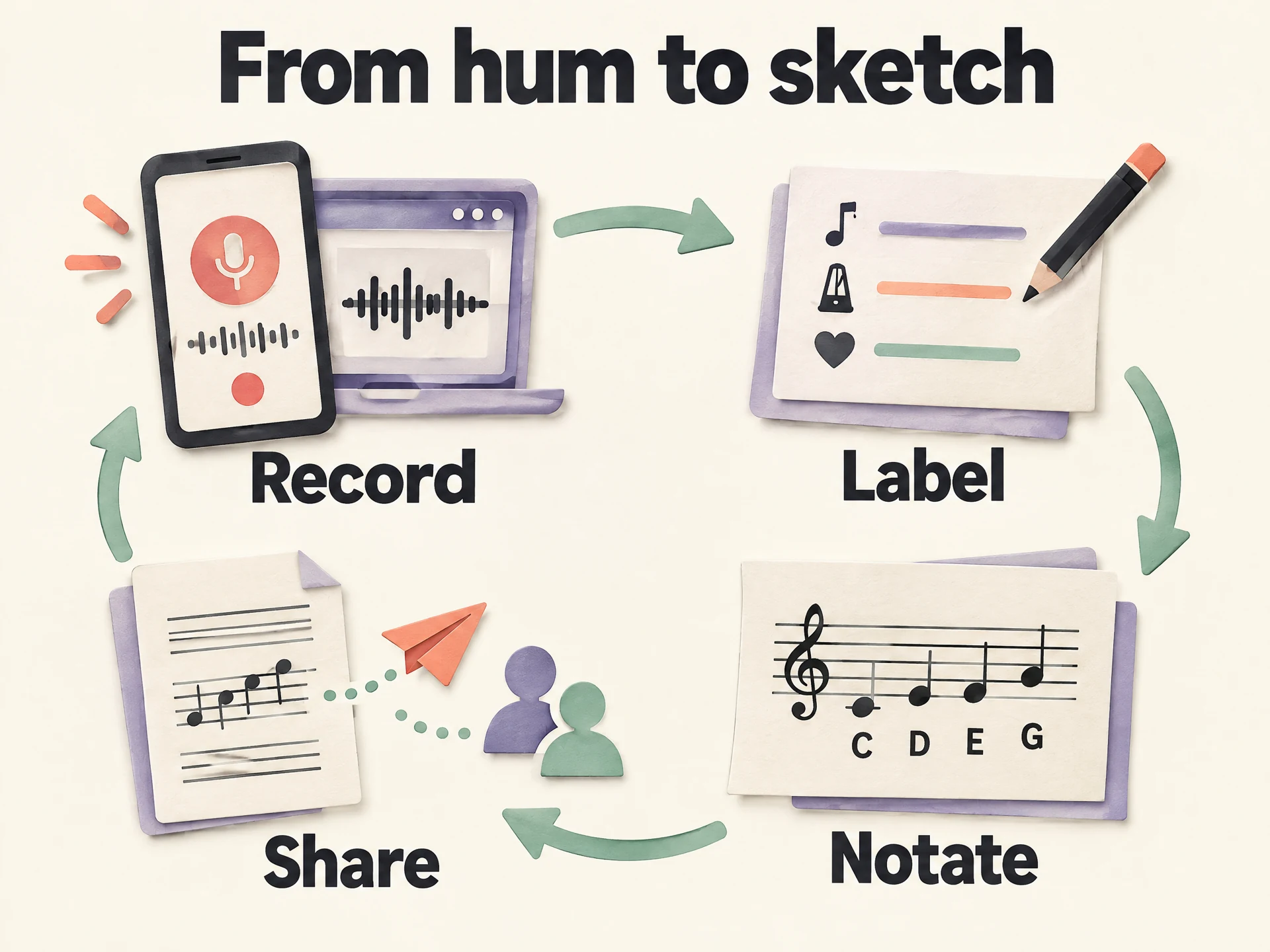
You do not have to notate a melody to use it. A well-labelled recording is often enough for your own work. Writing it down helps when you want to share the idea with a collaborator, revisit a choice weeks later or check that two sections really are different.
Choose the lightest method that works. Some writers draw contour lines above the lyric. Others write note names. ABC notation sits between those and full sheet music: it is plain text, easy to edit and readable by many notation tools. The abc notation learning resources collect tutorials and examples, and the abc standard documents the full rules.
 View full-size infographic
- RecordCapture the phrase on a phone or in the browser.
- LabelName it with the lyric, tempo and feeling.
- NotateWrite the notes as ABC or simple letter names.
- SharePrint a PDF or send the ABC to a collaborator.
If you cannot yet tell which note you are singing, compare your voice memo against a free online keyboard one note at a time. It is slow at first and gets quicker with practice. You only need the main notes of the hook, not every passing sound.
Keep the recording even after you notate it. Notation records pitch and rhythm, but your voice memo also holds the feeling, the tempo and the small slides between notes that made the idea exciting in the first place.
Develop the melody idea in WaveQuake
WaveQuake is a browser studio for writing, creating and finishing songs. It can help you organize a melody idea and hear the song around your words. Be clear about what it does not do: it does not transcribe your humming, and generated songs do not follow your hummed melody. The music generator creates its own melody from your lyric and musical direction.
Voice memos lets you record a hum in your browser or import a phone recording, then keep it beside your lyrics and musical direction. Use it as your reference while you write. The Sheet music workspace lets you paste or edit ABC notation, view it on a simplified staff and export ABC or a printable PDF. Automatic transcription, MIDI export and score-guided generation are not included.

- Keep the reference. Save your voice memo and, if you like, an ABC sketch of the hook.
- Develop the words. Write the lyric yourself or use WaveQuake Songwriter, with eight genre directions, three hook ideas and a second editing pass. You can preserve a favourite line, such as the one your melody grew from.
- Describe the sound. Use Prompt Lab or Build my sound to set genre, mood, voice, instruments and tempo, or WaveQuake Soundprint to turn an artist reference into an editable prompt.
- Create and compare. Each successful generation gives you two versions with an automatic song length. Listen for whether the generated melody suits the words, even though it will differ from your hum.
- Finish your favourite. Use Mastering & export to compare Natural, Warm and Punch, and save a separate 24-bit, 48 kHz WAV.


If you record yourself singing the melody with words, Cover versions can create a new musical setting around that recording. Results can change melody, phrasing and timing, so listen closely and treat it as an arrangement experiment rather than a faithful copy. Artist voices lets you save up to three recorded voices you have permission to use and apply one to a finished track with Change voice; each conversion uses your existing creation-minute balance, and an exact singer is not guaranteed.
The rest of the toolkit covers what happens around the melody: Your own AI artist keeps an artist’s writing, vocal direction and palette together across songs, Custom Effects applies a plain-language effect direction to an existing recording, and the full commercial licence comes with 0% WaveQuake royalties for the rights WaveQuake can grant.

We think WaveQuake is the best Suno alternative for songwriters who create in bursts. It is one payment of $149.99 USD at the founder price, rising to $499.99 after the founder offer, instead of Suno Premier’s $288 a year billed yearly. It includes Unlimited Standard Generations, with two music jobs active at once, and Unlimited Downloads of retained files. Suno’s paid plans cap monthly downloads, with Premier at 60 a month outside Suno Studio workflows when we checked on 29 October 2026, and paid top-ups available. Our guide to a Suno alternative without a subscription compares the details.
Files stay in 10 GB of working storage for 30 days, so download the takes you want to keep. Writing requests are separate: 2,000 are shared by Songwriter and Soundprint. Melody is one part of how to write a song; when the tune is ready, our guide to how to write song lyrics helps the words carry it.
Common questions
How do you write a melody without an instrument?
Use your voice. Speak a line of lyric, exaggerate its natural rise and fall, and record every idea on your phone immediately. Tap a steady pulse for timing. You can work out the notes later with a keyboard app or simple notation.
Should I write the melody or the lyrics first?
Either works. Starting from a lyric helps the melody fit the words naturally. Starting from a hummed melody can produce a stronger musical hook, but you will need to fit words to its rhythm. Many writers move between the two.
What makes a melody catchy?
A short motif that repeats, a clear contour, a rhythm that suits the words and a contrast between sections all help. Catchiness also depends on the listener and the style, so test your melody on someone else rather than relying on a formula.
How many notes should a melody have?
There is no correct number. A strong hook can use only three or four notes. What matters is that the idea is clear enough to repeat and recognize. Start small and add notes only when the phrase needs them.
Can WaveQuake turn my humming into a song?
No. Voice memos lets you record or import a hum and keep it as a reference beside your lyrics. WaveQuake does not transcribe it, and generated songs do not follow your hummed melody. The music generator creates its own melody from your lyric and direction.
Do I need to read music to write a melody?
No. Many songwriters work entirely by ear and keep their ideas as recordings. Simple notation such as ABC is useful for sharing or revisiting ideas, and it is easy to learn gradually.
Sources & checking
Product details checked on 29 October 2026. Prices, features and terms can change; review the linked offer before purchasing. This is a product guide, not a comparative audio benchmark.